Interview: How ISMAEL LOUTFI: HEAVENLY BABA is 'A Show About Authenticity at the End of the Day'
"I hope people are walking out questioning how firmly they hold on to their beliefs and what they actually stand for."
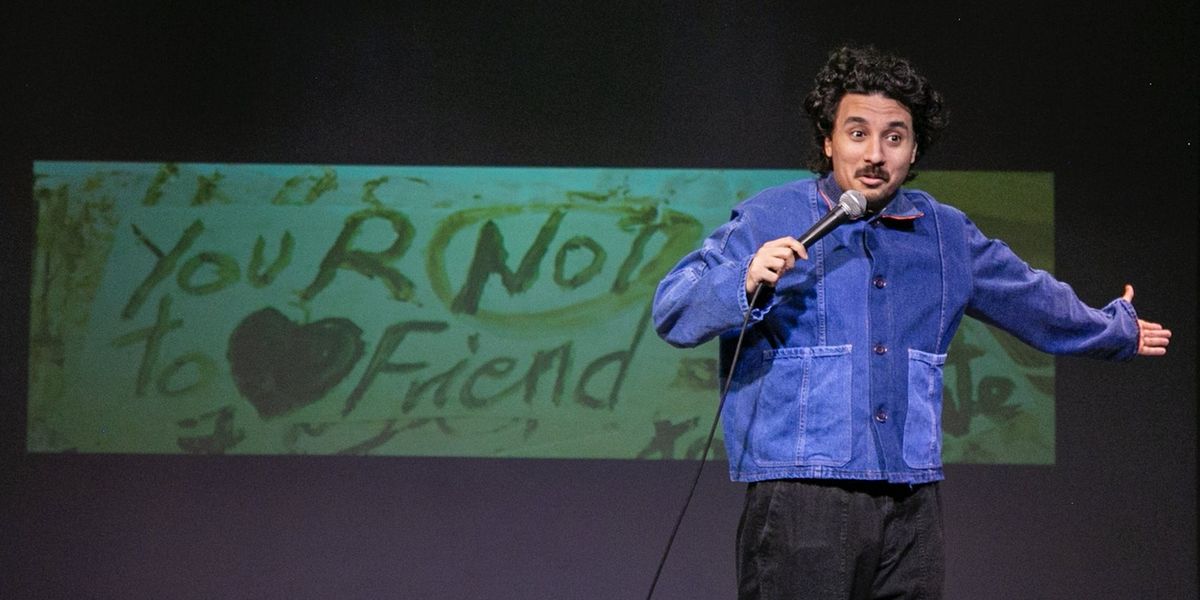
"Every parent traumatizes their kid one way or another," says Ismael Loutfi, the stand-up comic currently making his Off-Broadway debut with his one-man show Ismael Loutfi: Heavenly Baba at SoHo Playhouse. This is Loutfi's first foray into the long-form stage show, and in it he's putting his relationship with his dad front and center. In Heavenly Baba, Loutfi, with heart and humor in equal measure, examines his late father, or "Baba," an eccentric man who, while Loutfi was was growing up, drove around with Islamic slogans painted on his car in an attempt to convert the state of Florida to Islam.
In BroadwayWorld's interview with Ismael Loutfi, Loutfi reflects on the funny, honest, loving portrait of his dad that audiences connect to every night, what he's learned about himself in the process, and how "It’s a show about authenticity at the end of the day."
What was the moment when you decided to write a full Off-Broadway show discussing your father, your relationship with him, and the comedy within that relationship?
So, it was initially going to be a show more about me, and it was going to be called Kufihead, because I wore this kufi on my head for 10 years, from seven to 17, I wore it every day, the same one, and I was going to wrap in the story of my dad’s car. That was in 2020 that was first thinking about it. Then my father passed away, and it became more like, ‘Okay, I think there’s a lot more to him that I should be talking about.’ And that’s when I started thinking about writing it. I didn’t actually start writing it until 2023, but that year was when I was really thinking about doing something other than stand-up. I’ve been a stand-up for ever.
So, this is your first time creating a show that is a full narrative production, that is not just stand-up?
Oh, yes, this is absolutely my first time doing that!
Tell me about the writing process! How did you go about it, what did it look like?
Well, when you do stand-up for 15 years, it really breaks your brain in a way. So, starting this process, the first, maybe, five times I did the show—and I was lucky that there were some comedy clubs in Bushwick that were willing to let me just try something really weird—but the first five times I did the show it was majority stand-up, with pictures of my father’s car kind of thrown into the show. And as I found audiences interested in the car, I went, ‘Okay, I could take away some stand-up and add more story,’ until, fast-forward three years, and now there’s no stand-up in it. There’s two jokes from my stand-up act in the show now. But it’s like, 70 minutes of story.
It's a process of learning to trust and respect another kind of art form. It’s not stand-up— it’s related, they’re half-brothers, the one-man show and standup comedy, but it’s not the same thing, and you just have to learn to respect those differences.

The car is the central piece of the show. For audiences who might not know what to expect with this show, or what it’s about, give me your pitch! What can they expect to see?
It’s a comedy one-man show, and it’s about my father, Yasser, Loutfi, and his attempt to try to convert Florida to Islam. This took place from around 2004 to around 2018, where he was painting things all over his car. He had this old Pontiac Grand Prix, one of these old classic muscle cars, that he painted all over. He painted, ‘Jesus never said worship me or my blood,’ he painted, ‘Worship the creator, not lies,’ ‘Stop deceiving your children,’ and ‘Evolution is a big lie,’ he painted all sorts of crazy, erratic messages on the car, in an attempt to seemingly convert people.
And the show is an exploration of what made him into that kind of guy. I think a lot of Americans have seen people like that, or are related to people kind of like that, and the show is from the son of a person like that, who is explaining what made him that way, and what I learned about him in the process of making this show.
In the beginning it was really like, “I have this really interesting story that I’d like to tell, and here is the car.” And people would laugh. And I would make fun of the things he wrote on the car, because a lot of them are very funny. But then, as I worked on it, over the course of three years now, I learned so much more about him and what made him, that it’s a very full experience when people come. They come, and they laugh at it, and then a lot of people cry, which as a comic, is crazy to say, that I’m doing a performance that makes people cry, but it’s beautiful! Because people walk out going, “Your dad was awesome, and we love the story, and we love the connection you have with this character.”
What has it been like experiencing the audiences' reactions? Either right in the moment on stage, or have you heard from people after the show, or on social media reaching out to you?
There’s two parts. In the moment, on stage, everything for me comes back to stand-up, the way I compare everything, and in the moment on stage, the big difference that I’m actually really liking—which is dangerous as a comic—but I’m really enjoying it Off-Broadway, is the audiences have been great, but the audiences react a lot more moments of silence, and pauses. In comedy, as a stand-up, you’re supposed to be attacking the whole time, because that’s what the audience expects, they want you to be going after them, and hitting them with punch lines. And this show, what I’ve found, and especially in this room at SoHo Playhouse, when I say a funny line, it’ll get a laugh. And then if I pause, it’ll get another laugh. There’s more to it.
I don’t know what it is exactly, but there’s something where they want to sit with everything a little longer, with the jokes, with the serious moments, with the pictures, everything. And I enjoy it, it’s really nice, it’s dangerous as a comic, because when I go back to the club, the danger there is that stand-up audiences are not as forgiving, they don’t want the pause, they want you to just go after them. That’s why I’m continuing to do stand-up in the midst of the one-man show, just so that I keep the muscle flexed.
So that’s the one big thing from these shows. And then, after performing, I’m meeting people after. I always go outside, and take pictures, and talk to whoever wants to talk. And the thing everyone is saying, which I didn’t expect, but everyone comes up to me and says, “That show, it really reminded me of my mom, she passed away, and she was just like your dad in this way, and that way,” and, “The show reminded me of my father,” and, “I have an uncle who is like this,” and it’s eye-opening.
My dad was very singular, very erratic, and eccentric, and unique, which if you come to the show, it’s very clear, he was a little bit off his rocker. He was a good guy, but he was kooky. So, I did not expect so many people to connect with this kind of a character. And maybe it’s a virtue of America being a crazy place full of nut-jobs, because so many people say, “My mom would do a similar thing. She wouldn’t paint on her car, but she would talk to everybody, and she was always doing these weird things.” And that’s been really beautiful, because it seems to me that there’s a whole segment of the population who have parents with personality disorders [laughs] that are not represented! People who are close to someone who’s really kooky, that never really see it on a stage explored. Because that’s what we’re doing, ultimately, its an exploration of this kind of person. And the impact it has on someone close to that person. The impact it had on me, and how it made me into a comedian.
.jpg?format=auto&width=800)
I think with art, the more personal a story tends to be, the broader appeal it has in some miraculous way. I think if you try to appeal to everyone, in a way you appeal to no one. And I think if you tell a really personal story, it actually feels more personal for other people.
Absolutely. That’s what I’ve found. It’s really cool.
It probably feels good for you too, telling a story that's so personal!
Whenever I have friends come to the show, I’ll have two or three friends that will come every night, and they always tell me, “Man, I feel like I know you so much better. I love the show, it was funny, but I feel like I know you. There’s so much I didn’t know about you.” And that’s revelatory in a way. Because I’m doing this show, and it’s very personal, obviously, but as I’m doing it, I’m not thinking, 'Oh, I’m really putting a lot out there.' But then when you have friends tell you, “I know you so much better now,” I am being very vulnerable in a way. Which, for a comic, it’s not what we’re trained to do.
This show is being produced by your friend Hasan Minhaj. How has it been working alongside him to bring this show to life? And having people in your corner that way that are like, “Yeah! This show needs to be in front of audiences!”
Hasan is one of the best people I know, he’s such a genuine, pure soul. So helpful. I worked with him on Patriot Act, so I’ve known him for close to ten years now. He was a big part of me coming up, and a big part of me getting my start, not necessarily in comedy, but in show business, because it was the first job I ever had. He’s the reason I had health insurance, he’s the reason that I’ve had every other job that I’ve gotten. So I owe a lot to him.
When I worked on Patriot Act, I wrote a bunch of episodes, but two of the episodes I wrote, one of them was about Saudi Arabia, and it got him banned from Saudi Arabia, and it got the show banned from Saudi Arabia, and it got him death threats. And it was my episode, I wrote the whole thing! And the other important episode I wrote was about private equity, and it got him sued by this guy. And it was a big lawsuit, and he talks about it in one of his specials. So, I have, in two different ways, pretty radically harmed him, financially and emotionally [laughs]. And he’s never cared! He has never brought it up to me that he resents that I did those things.
So, working with him has been a real blessing. Because I could see somebody going, “I don’t want to work with that guy, because people threaten to cut my head off because of him.” He’s been the best. He’s consulted with some of the ideas on the show, some of the direction. He’s a great guy to have in your corner. Muslim comedians, there’s not too many of us, there’s like a dozen Muslim comics that are doing it, and it’s good to have somebody with you that’s up there, and successful in that way.
You went through a process of finding this material over the last couple of years, and refining it, and now people are saying that they know you better. Now that you’re onstage with this show, has your understanding of your father changed at all?
Yes. When I went into it and started this process of working on the show, I didn’t really tell my family because I was worried about how they would feel. But I went into it knowing, ‘Whatever I make about Baba is going to be ultimately loving,’ that was my intention. ‘It’s going to be illuminating, and embarrassing, but I want it to be loving.’ And I’m validated that people walk out of the show being like, “I love this guy! This guy was eccentric and crazy, but he was a good guy at the end of the day.”
In that way it’s been really nice to have that succeed. Because there’s a version of this show that’s just mocking this character, and ragging on him, “He traumatized me!” And sure, he did, of course, every parent traumatizes their kid one way or another, certainly he traumatized me with his eccentricities and how embarrassing he was all the time, but people seeing it, and feeling a connection, and loving the character has been really beautiful for me.
And then on the learning front, I grew up with this guy who was trying to convert everybody to Islam, and that’s really all I knew him as growing up. I have four older siblings, who are much older than me, I’m the youngest of five, and their experience of my dad was very different, they had a different Baba basically. They had the Baba before the car, I had the Baba with the car. So, in doing the show, I talked to them, and I talked to my mother a lot, researching this character. And I learned a whole lot about him that really explained who he was. And it’s been so rewarding getting to share that with an audience.
I feel kind of envious of the audience, because the audience is getting this fully packaged thing, it’s a beautiful lesson on this character. It’s comedic, it’s funny, etc. but it’s a full story that gives you the beginning, middle, and end of this guy. Which, I didn’t have going into it. I had the end, and I had a bit of the middle, but then I had to work on understanding the beginning, and understanding what makes someone into this character. There’s a lot of backstory that I really enjoy talking about. because for me, it’s still fresh. For me it’s still something I learned a year and a half ago about him. About what he did, and the difficulty that this guy had in life.

What is your hope that audiences will take away, ultimately, from this show?
Well, it’s a show about authenticity at the end of the day. And about art, too, and being genuine about what you believe. And I juxtapose Baba’s car with my comedy, and with my pursuit of this thing. Comedy is inherently kind of false and illusory, it’s this fabrication, every comedian is putting on a front, we want the audience to like us, that’s the whole job! The job is 'Can you get a bunch of strangers to really like you for 15 minutes or for an hour?' And what Baba was doing was an inversion of that. He was saying, ‘I want everyone to see me, and everyone to know me, but I don’t care if they like me. I don’t care if they’re put off or weirded out by me, I just want to put out what I believe, and what I think and feel, and I’m going to put it on this car. It’s going to offend people, it’s going to confuse people, make them feel uncomfortable, but I don’t care, I just want to be honest.’
And working on the show, that was painful for me, because as a stand-up, I’m the opposite of that, and it really put me in this place of really having to examine my own intentions as a performer, and as an artist, compared to this guy, who his intentions were seemingly very pure, and very genuine. So, the take away I imagine would be something about your beliefs, I hope people are walking out questioning how firmly they hold on to their beliefs and what they actually stand for. Because most people don’t really stand for much. And most people are not willing to lose friends and to lose standing for what they actually believe.
Prefer BroadwayWorld in Google Search?
Add us as a preferred source so our stories show up more often in Top Stories and Google’s AI answers — for you.

Sign up for all the news on the Fall season, discounts & more...

|
Powered by

|
.jpg?format=auto&width=300)