


Review: THE MAGIC FLUTE at Her Majesty's Theatre, Adelaide Festival Centre
A cross cultural reimagining of an old favourite.
Reviewed by Barry Lenny, Thursday 28th August 2025.
State Opera of South Australia is presenting The Magic Flute (Die Zauberflöte, K. 620), one of Mozart’s most popular operas, conducted by Dane Lam and directed by Shuang Zou. The original German libretto was by Emanuel Schikaneder, and the premiere was at his theatre on 30th September 1791. This was Mozart’s last opera. He died two months after the premiere.
There are myriad explanations of the influence of Freemasonry on Mozart and Schikaneder, synopses of the libretto, and analyses of the music. I do not intend to delve into that here. A few seconds with your favourite search engine will tell you everything that you might want to know, and far more.
The opera was originally set in ancient Egypt, with Isis and Osiris mentioned in the libretto, giving Mozart access to incorporating Middle-Eastern mysticism. This co-production by State Opera of South Australia, Opera Hong Kong, the Beijing Music Festival, and the China National Opera House, however, is set in a station on the Hong Kong subway. The opera is in the style known as singspiel, partly sung, partly spoken. In this performance, the sung parts are in German, with the spoken parts in English, using a translation by Michael Gow for an Opera Australia production.
The high priest, Sarastro, who is a symbol of the Enlightenment, has taken Pamina captive. Her mother, the Queen of the Night, representing Catholicism, which opposed Freemasonry, persuades Prince Tamino to rescue her. All does not go to plan, however, and Tamino is swayed by the high ideals of Sarastro’s philosophy. He chooses to undergo the entry rituals to become a member of Sarastro’s community, and Pamina joins him on that journey. While they both succeed, thwarting the Queen’s plans, Papageno, the bird catcher who was accompanying Tamina, fails the trials. All is not lost for him, however, as he is given the hand of Papagena, his ideal companion. Monostatos, Sarastro’s head guard who lusts after Pamina, whom he is supposed to be guarding, is defeated, after switching allegiances to the Queen. Pamina and Tamino end up together, the Queen has lost her power, Sarastro is revealed to be Pamina’s father, estranged from the Queen, whose hand he takes as they leave, and all ends well.
Tamino was sung by Nicholas Jones, bringing a depth of understanding to the role of the romantic lead who undergoes personal changes as he completes the trials to grow and reach enlightenment. His clear, crisp tenor voice is greatly suited to the role, and he clearly shows the growth that his character gains as the opera moves forward.
A train shoots past, and Tamino faints at the sight of it seeming to become a serpent. He is rescued by The Three Ladies, three air hostesses, complete with a trolley, who materialise from a poster on the wall. Helena Dix, Catriona Barr, and Fiona McArdle are the members of this lustful trio, who work for the Queen of the Night. They bring out the comedy, as well as harmonising superbly, as each tries to get rid of the other two in order to be alone with him, before all giving up and going together to inform the Queen.
Papageno appears and falsely accepts the praise for having saved Tamino, until the Ladies return and expose and punish him. David Greco seems determined to have, and to give, as much fun as he possibly can in the role, and the audience loved him for it. His clowning skills add greatly to the performance.
Pamina was to have been sung by Sofia Troncoso, but she became unwell and, with only two days' notice, Stacey Alleaume flew in and took over the part for the opening night. Although she had sung the role before, she had only sung it in its English version, so, in a superhuman feat, she learned it in German, along with all of the movement and if it hadn’t been announced, nobody would ever have known that she hadn’t been rehearsing from the very beginning. This is consummate professionalism but, aside from all that, she gave a magnificent performance, full of intense emotion and created great rapport with Nicholas Jones. Bravo!
The Queen of the Night, portrayed by Danielle Bavli, is dressed, highlighting the anti-Masonic position of the Catholic Church, to represent a mentally unbalanced Mother Superior. Her aria in the first act, O zittre nicht, mein lieber Sohn, was wonderfully delivered, leaving everybody looking forward to her Act 2 aria, Der Hölle Rache kocht in meinem Herzen (Hell’s vengeance boils in my heart), a challenge for any coloratura soprano. Did Mozart hate sopranos? Bavli negotiates the two-octave range, the key changes, and the rapidly changing, difficult intervals at the top of the soprano range with a skill that made it seem far easier than it is.
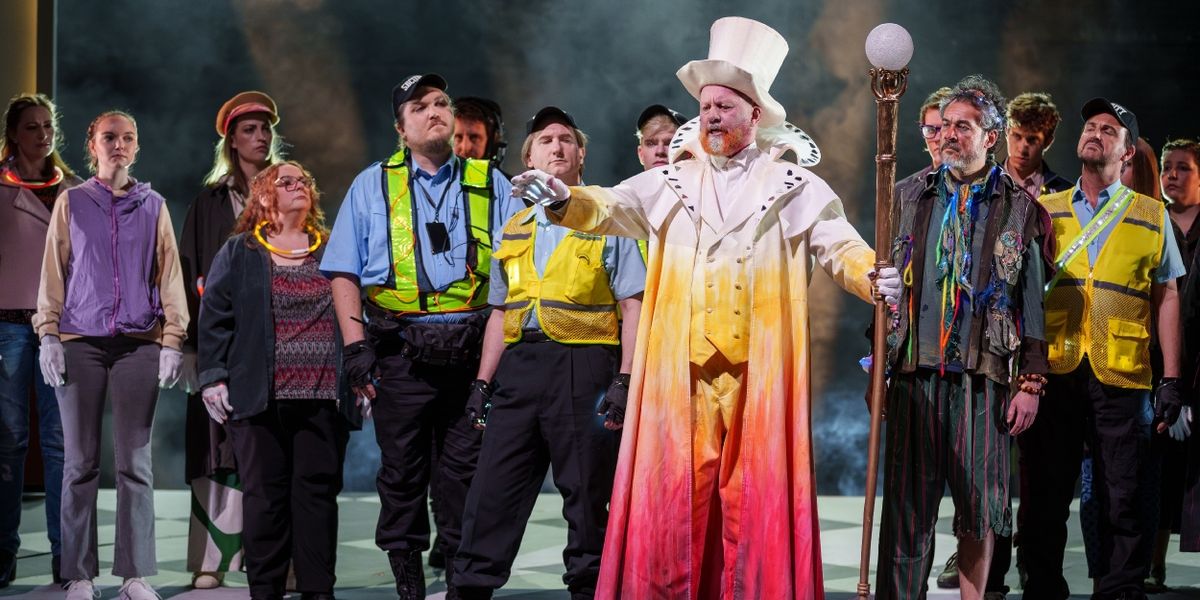
What can be said about Teddy Tahu Rhodes, who sings the role of Sarastro, that hasn’t already been said? His commanding physical presence and his rich, powerful voice couldn’t have been better suited to the role. He brought gravitas to the character commensurate with Sarastro’s exalted position in the opera.
The highly unpleasant lecher, Monostatos, is sung by the ever-popular Mark Oates, who was so convincing that there was booing amidst the applause when he took his final bows. Monostatos is Greek for stands alone, placing him as an outsider, and the original score referred to the character as a blackamoor, today seen as an inappropriate racist depiction. The character of Monostatos is, nevertheless, set apart from all of the others. Mark Oates walks that fine line with great care, leaning sensibly towards the comical side of the character
As Papagena, Jessica Dean is suitably flirtatious and energetic as she leads Papageno a merry dance, having revealed herself after pretending to be an old crone. She makes it clear that his future with her is never going to be dull. Their duet is full of charm.
As the Speaker of the temple, Pelham Andrews turns in another of those fine performances of his that demonstrates that only a few minutes can be quite long enough to create a memorable role.
The three children (Genii), played by Phillip Cheng, Ethan Zhang, and Celine Yuan, had no difficulty endearing themselves to the audience, from triplet babies in a pushchair through to little old men. Phillip Cheng, unfortunately, was also unwell so, whilst being onstage and performing all of the physical parts with the other two, Brooke Zabrowsky sang his part from the side of the stage. The show must go on, and it did.
I ran out of superlatives to heap upon the State Opera Chorus and the Adelaide Symphony Orchestra long ago. Yet again, they distinguished themselves in their performances, achieving their usual levels of excellence. Adelaide is lucky to have such wonderful groups.
Dan Potra’s design combines projected anime-inspired animations by Video Designer, Marco Devetak, with continually rearranged physical columns and beams, and a revolve on the raked stage that appeared to rise and fall as it rotated, like one of those old fairground rides. Lighting Designer, Glen D’Haenens, completed the visual feast.
With only three more performances, don’t delay in booking your tickets. The Magic Flute is popular with regular opera-goers, and Mozart’s approachable music also makes this a good introduction to newcomers to the genre.
Photography, Andrew Beveridge.

Reader Reviews
To post a comment, you must register and login.