


REVIEW: ANNIE Provides Sweet Nostalgia For Young And Old
Acclaimed Australian musical theatre icon Anthony Warlow reprises his performance of Billionaire Oliver Warbucks.
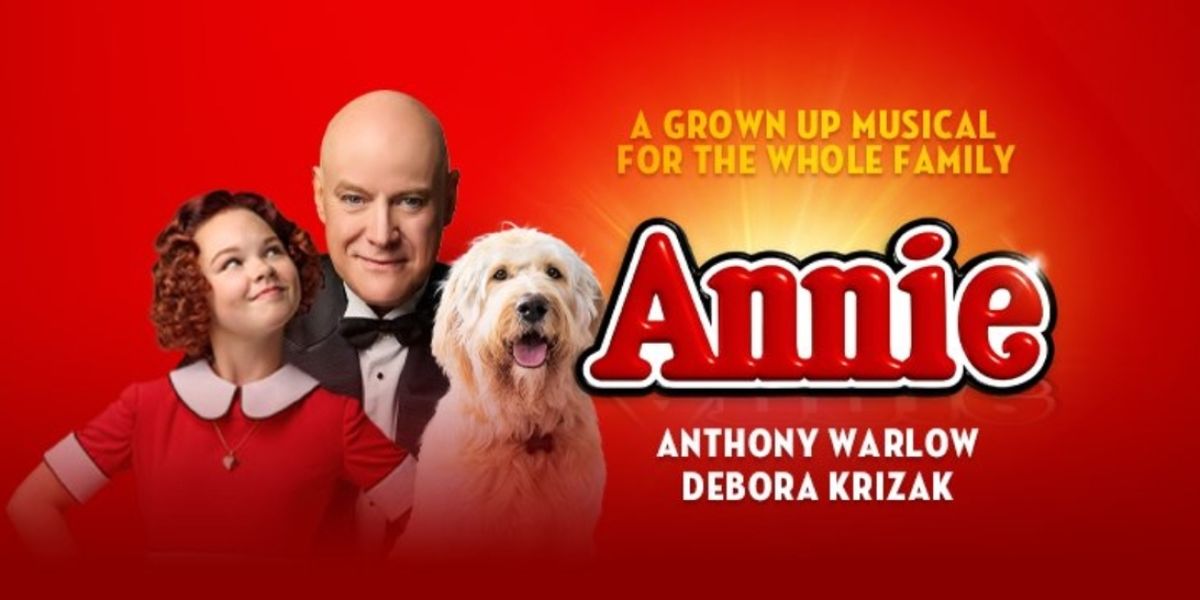
Acclaimed Australian musical theatre icon Anthony Warlow reprises his performance of Billionaire Oliver Warbucks alongside a new generation of talented young performers, and of course an adorable dog, as Annie returns to the Sydney stage. Almost half a century after Charles Strouse (Music), Martin Charnin (Lyrics) and Thomas Meehan’s (Book) musical theatre adaptation of the Harold Gray’s 1924 comic strip Little Orphan Annie premiered on Broadway in 1977 and first toured Australia in 1978, the heartwarming tale of little orphan and her dog in Depression Era New York still captivates.
%20Daniel%20Boud.jpg?format=auto&width=1400)
While many may be familiar with the Columbia Pictures 1982 movie adaptation of the musical, starring Aileen Quinn as Annie, Strause, Charnin and Meehan’s original presented on stage captures a darker side 1933 New York as America is reeling from President Hoover’s inability to pull the country out of The Great Depression which resulted in many citizens out of work and homeless, often surrendering their children to orphanages as they cannot afford to look after them. The 11 year old plucky red-headed Annie (performed by Dakota Chanel on opening night, role shared with Beatrix Alder, Matilda Casey and Stephanie McNamara) is one of those children left at an orphanage, but while others have given up hope of being reunited with their parents, Annie believes her parents will still return for her. In the lead up to Christmas, Billionaire Oliver Warbucks, as a ploy to potentially soften his image, instructs his personal secretary Grace Farrell (Amanda Lea LaVergne) to extend an invitation to an orphan child to spend a fortnight in his Fifth Avenue Mansion but the prickly businessman does not expect the child to be a girl, so detached from the realities of the poor to believe that only boys were orphans.
%20Daniel%20Boud.jpg?format=auto&width=1400)
Director Karen Johnson Mortimer ensures the production honours the original stage productions, resisting the temptation to form connections to the movie treatment while blending traditional staging styles with modern advancements in theatre staging with the use of Craig Wilkinson’s projections that add depth and context to the backdrops. Large artistic imagery of New York’s landmarks and iconic streetscapes are used to take the audience from the Municipal Orphanage’s red brick DUMBO warehouse to the streets of New York City, the Hooverville shantytown of homeless people, Warbucks’ 5th Avenue mansion and 1600 Pennsylvania Avenue Washington DC. Wilkinson’s projections also assist in indicating more surreal dreamlike sequences like N.Y.C. and Easy Street. The projections are fronted by Kenneth Foy’s set design which captures the essence of the locations with painted flats and mobile elements like the doorway to the orphanage, office set up and White House interior.
%20Daniel%20Boud.jpg?format=auto&width=1400)
Kristian Fredrickson’s costuming maintains a relatively monochrome palette for both the orphans and Warbucks’ staff and President Roosevelt’s (Greg Page) advisors. Miss Hannigan (Debora Krizak) is given a moment of colour though is generally in non-descript greys and Miss Farrell has a muted golden ‘uniform’. Whilst the greys may be referencing the Depression Era setting, the reference to the orphans damaging Miss Hannigan’s satin cushion does indicate that even the poorer have moments of finding finery so it would have been in-keeping to give the woman who is perpetually fantasising about a better life filled with a more physical relationship a few more flourishes and indulgences that shown.
%20Daniel%20Boud.jpg?format=auto&width=1400)
The children’s ensemble and the adult ensemble for this production are wonderful as they showcase Mitchell Woodcock’s choreography with a vibrant energy. This production centres on the choreography and the singing more than the dramatic moments where Johnson Mortimer generally has the performers lean into the caricature of their roles in keeping with the comic strip origins of the work. The song and dance numbers are supported by music provided by Musical Director and Conductor David Piper’s 16-piece band in the traditional orchestra pit. Of the children, 9 year old Ellie Lang was a standout as the youngest child Molly. Of the adult ensemble Nakita Clarke’s solo as the “Star to Be” in N.Y.C. is beautifully presented while Cameron Boxall’s feature as Radio Host Bert Healy captures the comedy of the moment.
%20Daniel%20Boud.jpg?format=auto&width=1400)
The standout of the show is Anthony Warlow reprising his Oliver Warbucks, a role he first performed in the 2000/01 Australian Tour and made his Broadway debut with for the 2013 35th Anniversary production. With Why Should I Change A Thing written for him for the 2000 Australian tour, he is well connected to the character and delivers it with a perfect balance of comedy and sincerity ensuring that everything is presented with an air of intuitive response in contrast to the other characters, reinforcing the idea of showing the businessman’s human side amidst an economic climate that is threatening to bring down his empire of steel factories across the country.
%20Daniel%20Boud.jpg?format=auto&width=1400)
The other showstopper is naturally Sandy, performed on opening night by a large blonde shaggy pooch, suitably named Sandy (role shared with Daisy). While the stage show gives the pup a much smaller role than the movie version, disappearing after Annie is retrieved by police from the Hooverville slums, and inexplicably appearing as a Christmas present, the brief appearances definitely drew the audience attention no matter how beautifully opening night Annie Dakota Chanel delivered Tomorrow, particularly when the chilled dog sat down for a scratch, oblivious to the events on stage or the theatre full of people.
%20Daniel%20Boud.jpg?format=auto&width=1400)
At a time when we need reminders that there may still be people that have both money and a heart, Annie is a sweet moment of hope. While the global economy may not have sunk to the post Hoover Great Depression shown on stage, the machinations of current US Leadership and global politics indicates that there could be parallels so we hope that there are similar altruistic leaders of commerce like Warbucks who are thinking, not just of their own bottom lines, but also the average citizen and the wellbeing of the nation and the global economy, for those expecting the movie plotline, approach the stage show with a fresh mind as, while it tells a similar story, its underlying themes are much more powerful and below the fun and fluff, there is a darker more imperative moral to the story.
Photo Credit: Daniel Boud
%20Daniel%20Boud.jpg?format=auto&width=1400)
|
Rigoletto Joan Sutherland Theatre, Sydney Opera House (7/21-8/21) |

|
Dixon and Daughters by Deborah Bruce Old Fitz Theatre (9/18-10/03) |
|
I Love Your Faces: The Don Lane Story Jetty Memorial Theatre (9/05-9/05) |
|
The Merry Widow Joan Sutherland Theatre, Sydney Opera House (7/08-8/18) |

|
Carousel Foundry Theatre (10/15-10/17) |
|
Beetlejuice the Musical Capitol Theatre, Sydney (11/21-1/10) |
|
Moulin Rouge! The Musical (Australia) Sydney Lyric Theatre (3/09-4/04) |
|
Weddings and Parties Over Coffee St Finbar’s Catholic Church (8/16-8/16) |

|
Captain Corelli's Mandolin Genesian Theatre (9/04-10/10) |
|
Good Company Entertainment Presents: The Big Chillout Saraton Theatre (10/11-10/11) |