


Review: THE MEMORY OF WATER at Theatre Artists Studio
The production runs through May 18th at Theatre Artists Studio in Scottsdale, AZ.
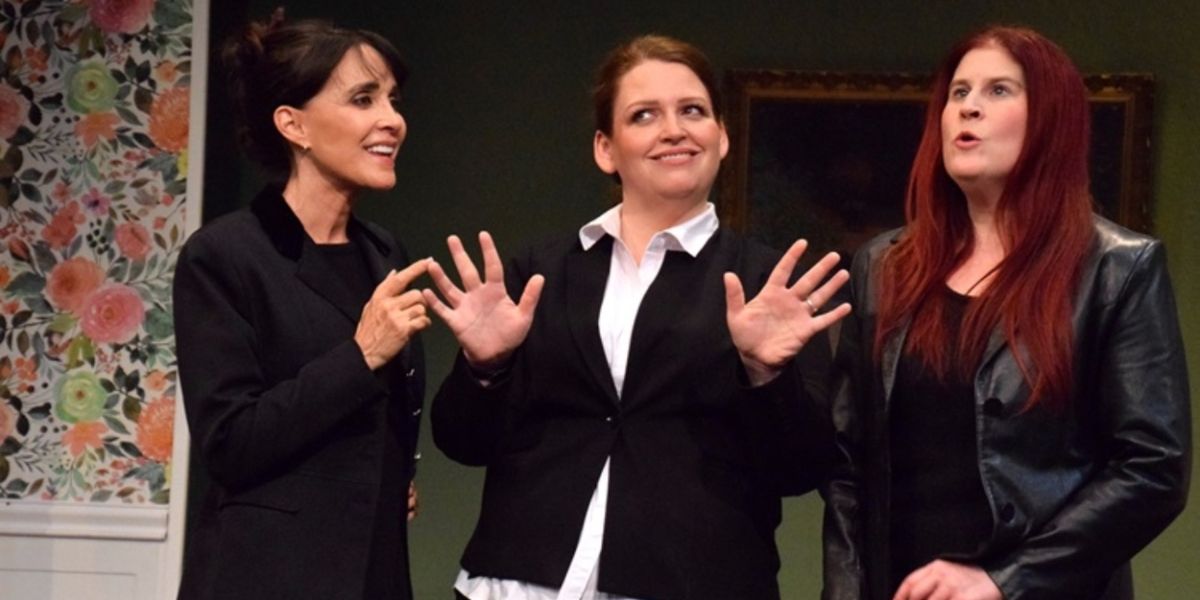
Shelagh Stephenson’s THE MEMORY OF WATER is a play of emotional complexity—a chamber piece centered on three sisters navigating the murky waters of grief, memory, and the lingering bruises of childhood. First staged in 1996, it remains resonant today—not only for its piercing exploration of familial bonds and the fragility of recollection, but for its poignant commentary on how women carry the weight of generational trauma and unspoken expectation. Its delicate architecture depends on a director’s ability to walk a tightrope between the play’s biting wit and its aching melancholy. In Theatre Artists Studio’s production, under the direction of Janis Webb, that balance was never found.
Rather than delivering the emotionally layered portrait that the script demands, this staging lurched between discordant tones. It too often veered into shrillness, farce, or sentimentality—blunting the impact of Stephenson’s rich characterizations and undermining the credibility of the relationships at the play’s core. The show felt less like an intimate unraveling of familial mythology and more like a strained attempt at manufactured drama.
The play centers on three estranged sisters—Teresa, Mary, and Catherine—reunited in their childhood home on the eve of their mother’s funeral. In the hands of a skilled ensemble and discerning director, these characters offer a kaleidoscope of grief, memory, and self-deception. Each sister carries a distinct wound, a separate version of the past. Their collisions are meant to feel both cathartic and inevitable.
Here, however, the performances never quite achieved emotional cohesion. The ensemble operated at different volumes—metaphorically and literally. Conversations that should have simmered with subtext too often devolved into shouting matches, sapping the play of its quiet tension. Moments meant to reveal the vulnerability beneath the bickering were hurried or overacted, denying the audience the chance to connect with the characters as real, bruised people.
The production is further weakened by its inability to strike a consistent emotional tone. THE MEMORY OF WATER is a dark comedy, but it is also a lamentation. Stephenson’s dialogue moves fluidly between the absurd and the profound, and in strong productions, those shifts feel natural—even poetic. Take, for instance, Catherine’s outlandish monologues about herbal remedies and disastrous boyfriends, which veer from laugh-out-loud absurdity into heartbreakingly candid expressions of rejection. Or Mary’s confrontations with her mother’s ghost—scenes marked by surreal, comically evasive exchanges that are nevertheless steeped in unresolved grief. (“You didn’t even remember my birthday,” Mary accuses. “Well, I had a lot on my plate,” Vi replies.) Here, however, the director seemed uncertain of which emotional tone to prioritize. Laughter was courted in odd moments, undercutting the gravity of scenes meant to evoke loss or trauma. Conversely, moments that called for levity were flattened by overwrought earnestness. The result was an emotional dissonance that never fully resolved.
Vi (Carol Riebe Bennett), the ghostly presence of the sisters’ recently deceased mother, is a challenging role—less a character than a haunting embodiment of the family’s unfinished emotional business. In this production, however, her presence felt more like an interruption than a revelation. Delivered with overwrought emotion and little interpretive depth, the performance leaned heavily on volume and gesture, missing the nuances that could have made her appearances truly haunting. That absence of subtlety echoed a broader issue: the emotional connections among the cast (each of whom, in their own right, are undeniably gifted artists), especially among the sisters, rarely felt lived-in or convincing.
Each of the sisters contains the seed of compelling character study. Yet in this production, these complexities were too often reduced to caricature: the cold intellectual, the shrill martyr, the manic free spirit. Without careful modulation, the pathos of each woman’s story was obscured by exaggeration.
Mary (Cindy Pruett), the emotionally reserved doctor, is haunted by both personal and professional failures. Burdened by the memory of a child she gave up and a relationship that offers more frustration than fulfillment, she deals with her memories and relationships with the analytical detachment of a physician—clinical, composed, yet masking wounds she cannot heal.
Teresa (Andrea Hough), the eldest, craves order and respect but has become brittle under the weight of her burdens. She seems exhausted from a life spent shouldering responsibility for the family and compensating for everyone else's denial. Her unraveling, especially when drinking, reveals a woman losing control and whose version of truth may be less fact than necessity.
Catherine (Rachel Weiss) is the spark plug of the play. The youngest and most erratic, she lashes out with attention-seeking antics to disguise deep-seated loneliness and rejection.
The supporting male characters—Mike (Christopher Dorto), Mary’s married lover, and Frank (Tom Koelbel), Teresa’s husband—serve as emotional foils but were played with such broad strokes that their function in the narrative became muddled. Mike, in particular, needs to exude charm tinged with selfishness; here, he felt more like a plot device than a person.
Despite the directorial misfires, Stephenson’s writing retains its integrity. Her dialogue still sparked in moments—witty, wounded, and rich with ambiguity. There were flashes when the actors connected, when a line landed with its full emotional charge, and the potential of the piece briefly shimmered through. But these moments were too isolated to lift the production out of its unevenness.
Ultimately, THE MEMORY OF WATER is about the stories families tell themselves in order to survive—the distortions, the denials, the half-remembered truths that become gospel. When done right, it leaves audiences with the uneasy realization that memory is both sanctuary and snare. But when directed without sensitivity to its fragile emotional architecture, the play loses its soul.
Despite earnest efforts and glimpses of talent, this production failed to honor the quiet depth of Stephenson’s work. What should have been a meditation on grief and memory became a confused clash of tones—as if the production itself had forgotten what it was meant to remember.
THE MEMORY OF WATER runs through May 18th at: Theatre Artists Studio ~ https://www.thestudiophx.org/ ~ 12406 N. Paradise Village Parkway E., Scottsdale, AZ ~ 602-765-0120
Photo Credit: Mark Gluckman – L to R: Cindy Pruett, Andrea Hough, Rachel Weiss


|
The Tempest Arizona Theatre Matters (10/05-12/31) |

|
Murder For Two The Phoenix Theatre Company (8/26-9/20) |

|
Geoffrey Asmus 191 Toole (9/27-9/27) |

|
Coffee Mixed with Cream Fountain Hills Theater (8/21-8/30) |

|
The Comedy of Errors By William Shakespeare Adapted by Stephen Frankenfield Live Theatre Workshop (9/18-10/11) |

|
A Tribute to Woodstock 1969: The Music of Janis Joplin, Joe Cocker, The Band, Jefferson Airplane and more Hale Centre Theatre (8/14-8/29) |

|
The Taming Beaver Street Theatre (9/17-10/04) |

|
BASKERVILLE: A Sherlock Holmes Mystery Don Bluth Front Row Theatre (7/23-8/29) PHOTOS |

|
Campbell, Rogers, and Denver: A Tribute Hale Centre Theatre (11/06-11/21) |

|
Peter Hook And The Light The Van Buren (9/15-9/15) |
Reader Reviews
To post a comment, you must register and login.