


Review: SUFFS at ASU Gammage
The production runs through October 19th at ASU Gammage in Tempe, AZ.
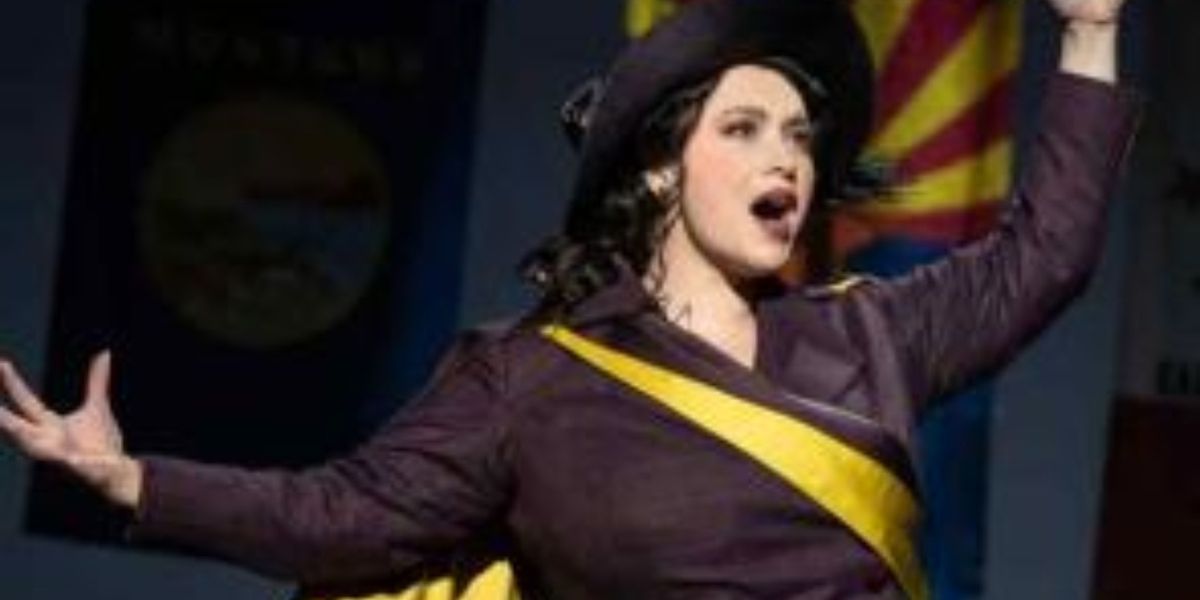
Guest contributor David Appleford gives thumbs up to the National Touring production of SUFFS at ASU Gammage.
The National Touring production of the Broadway musical SUFFS, now playing at ASU Gammage until October 19, didn’t arrive on the stage quietly. Like its subject matter, it gathered like a movement and was shaped by persistence. The show, written, composed, and, on its Broadway opening, led by Shaina Taub, is a reclamation of voices long overlooked and of equality battles still to be won.
Unlike the average musical, in the case of SUFFS, it pays to know a little of the show’s history in order to fully appreciate what this current touring production now delivers. Once the show opened on Broadway, Shaina Taub joined a rare and formidable lineage, becoming only the second woman in Broadway history to write the book, music, lyrics, and star in her own work. Originally titled Suffragist and written as a pop-opera, or sung-thru musical with dialog added later, SUFFS opened on Broadway in April 2024, earning six Tony nominations and winning for Best Book and Best Score.
As performed by an all-female cast in both male and female roles, it’s a show about women demanding to be written into the American story, and it meets them as they no doubt were: brilliant, unrelenting, but flawed.
Rather than preach, SUFFS lets its politics emerge through personality. Its cheeky, pointed opening number, Let Mother Vote, is led with sly precision by genteel suffragist Carrie Chapman Catt (Marya Grandy). And when a more youthful Alice Paul (Maya Keleher) enters as a storm in petticoats, conflict follows. It’s old-guard respectability meets next-wave radicalism, and the two immediately clash.
Keleher’s energized Alice is no anointed heroine; she’s stubborn, uncompromising, sometimes alienating, but always magnetic. The tension between her and the older, more established Carrie provides the show’s central engine. Grandy’s performance is particularly rich, finding dignity and ache in a woman watching the world change faster than she can comfortably follow. Her song This Girl, where she sings in anger “She thinks I'm obsolete. She oughta kiss my feet. I lit the way for her, but no, she thinks she knows better” is a harsh dismissal of the younger woman’s approach to achieving success when an acknowledgment of a shared purpose would have helped the movement better.
In Maya Keleher’s case, it’s interesting to note that when the Broadway version first opened, reviews were mixed, noting that the show’s original Alice Paul, its writer Shaina Taub, was sometimes viewed as giving a muted performance. Some audiences even remarked they preferred the energy of her understudy. For this tour now playing at Gammage, it’s Maya Keleher in the lead. With powerhouse vocals and a performance to match, the last thing you could ever call Keleher is muted: your attention is focused whenever she’s on stage, which, to the show’s good fortune, is the majority of the time.
Director Leigh Silverman steers the action with a propulsive rhythm that matches the material’s urgency. Over the seven-year stretch between Alice’s 1913 march and the ratification of the 19th Amendment in 1920, the production never lags. It swerves, charges, slows, and sings with a musicality that mirrors its characters’ own emotional arcs. Scenic designer Christine Peters’ white columned set provides a cold, imposing frame. They’re monuments to power, but it’s the women who animate and upend it.
The ensemble is a force unto itself. Gwynne Wood’s Lucy Burns is the perfect foil: blunt, funny, furious, while Monica Tulia Ramirez is both luminous and tragic as Inez Milholland, the suffragist as warrior astride a white horse.
Danyel Fulton delivers a scorching performance as Ida B. Wells, reminding everyone, onstage and off, that racial injustice was not just a side issue to be temporarily ignored until the time was right, but a gaping wound within the movement. Her song Wait My Turn with its lyrical depth and Fulton’s moving, emotion filled delivery, is both an indictment and a lament as she declares “No matter what you tell me, I will NOT wait one more minute for my turn!”
The score itself is tuneful and often witty, and there are moments when melody and meaning dovetail beautifully. The Tony-award winning score works hard to carry the sheer volume of history packed into the book’s narrative. Staging too often mirrors this earnestness. The production is sleek, polished, and sometimes almost antiseptic, as though every gesture was rehearsed with precision within an inch of spontaneity.
To the show’s credit, like Maya Keleher’s central performance, its energy is undeniable, and its desire to place women’s voices, long ignored in historical pageants, at the center of a Broadway show is itself thrilling. When the songs soar, they soar high, and when the ensemble rises in harmony, the sheer sound can lift an audience out of their seats. Great American Bitch is a comic showstopper of reclamation and glee; Finish the Fight brims with urgency; and Ladies, performed by Jenny Ashman as President Woodrow Wilson, is a vaudevillian act of condescension.
There are no cartoon villains. Even President Wilson is less a mustache-twirling tyrant when he could so easily have been portrayed as such. And yet, there’s a sly poignancy in the show’s inclusion of Dudley Malone (Brandi Porter), the president’s political aide-turned-ally to the movement, who gets a tender, almost wistful love duet with the movement’s note-taker Doris Stevens (Livvy Marcus), a woman who would go on to be the author of the book Jailed For Freedom, a blistering account of imprisonment and protest that eventually inspired the writing of the musical.
The show reminds us that history is made by the narrowest margins: a mother’s letter, an imprisoned protester’s hunger, a woman who refused to wait her turn.
In the end, what the show leaves you with is admiration. This outstanding new musical to the valley reminds us that progress is not the work of a moment or a monologue, but of sustained, often maddening, collective will. And when the final line of the show rings out, “Keep marching,” not only will the rousing chorus resonate like an earworm as you leave the theater, the words indicate that the struggle for genuine equality still continues: it’s a passing of the baton.
ASU Gammage -- https://www.asugammage.com/ -- 1200 S. Forest Avenue, Tempe, AZ -- 480-965-3434
Image courtesy of ASU Gammage


|
The Seagull Flagstaff Shakespeare Festival (8/14-8/15) |

|
It's A Wonderful Life Don Bluth Front Row Theatre (11/19-12/23) |

|
The Velocity of Autumn by Eric Coble Live Theatre Workshop (8/07-8/30) |

|
A Tribute to Woodstock 1969: The Music of Janis Joplin, Joe Cocker, The Band, Jefferson Airplane and more Hale Centre Theatre (8/14-8/29) |

|
Geoffrey Asmus 191 Toole (9/27-9/27) |

|
SHE LOVES ME Don Bluth Front Row Theatre (9/17-10/31) |

|
Campbell, Rogers, and Denver: A Tribute Hale Centre Theatre (11/06-11/21) |
|
BASKERVILLE: A Sherlock Holmes Mystery Don Bluth Front Row Theatre (7/23-8/29) PHOTOS |
|
I'm Gonna Marry You Tobey Maguire The Scoundrel and Scamp Theatre (9/24-10/11) |

|
The Tempest Arizona Theatre Matters (10/05-12/31) |
Reader Reviews
To post a comment, you must register and login.