


Review: The SHARK is BROKEN at Revolution Stage
The production runs through April 19 at Revolution Stage in Palm Springs
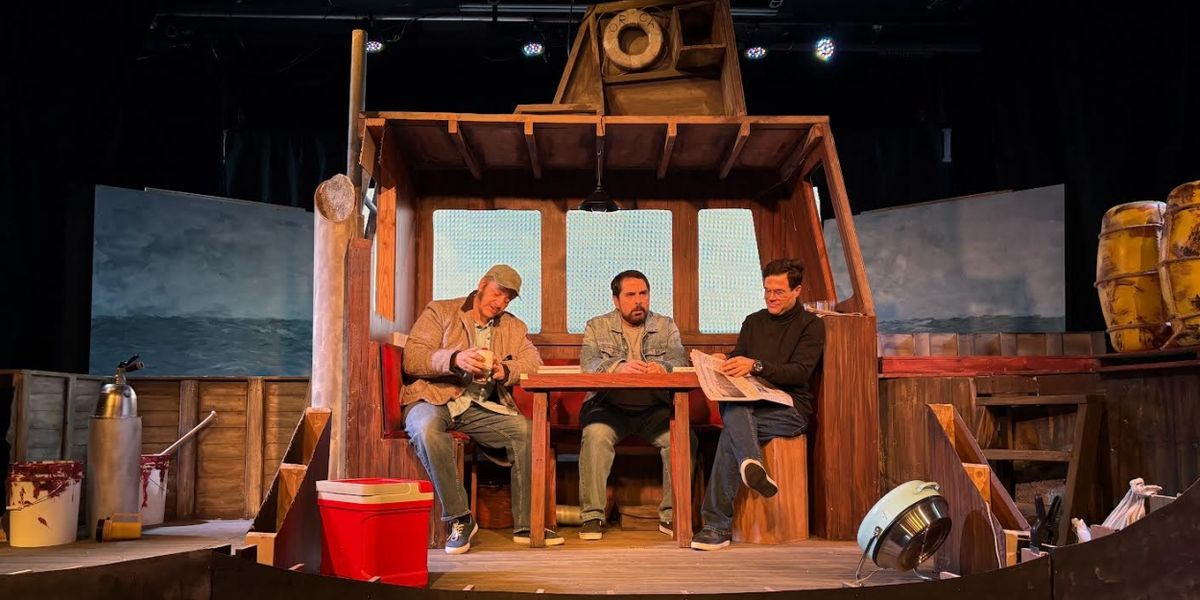
The Shark is Broken, a three-man, two-hour play inspired by the technical problems that delayed the filming of Jaws, is now amusing audiences at Revolution Stage Company in Palm Springs through April 19. Directed by Roger Welch, the script by Ian Shaw and Joseph Nixon dramatizes the frustrations of actors Roy Scheider, Richard Dreyfuss, and Robert Shaw who were forced to wait aimlessly between takes in the cramped galley of a boat. Revolution Stage is presenting the production in celebration of the 50th anniversary of Jaws.
For those unfamiliar with the problems the film production experienced, let’s walk down memory lane. Before production began in May 1974, Jaws had an estimated budget of under $4 million, with a shooting schedule of 55 days. Steven Spielberg, the emerging wunderkind in Hollywood, was determined to shoot the film in the ocean rather than in a pool in the studio’s back lot. Once the studio approved the location, no one considered the possibility that a prop-department shark might not work in the rough seas and unpredictable weather off Martha’s Vineyard. When the film wrapped in June 1975, the malfunctioning of three mechanical sharks--collectively named Bruce--multiple re-writes, and the destruction of cameras and other equipment drove the budget to $9 million and actual filming to 159 days.
Here’s more back story. Nothing was planned to occupy the three principals during the unanticipated delays. As a result the actors became increasingly frustrated. Robert Shaw had agreed to do the film only because he owed money to the IRS. In Shark Broken, as portrayed by Jason Mannino, Shaw becomes a nonstop-guzzling alcoholic, which is close to the truth. I’ll say this about Mannino: he gets the nonstop-guzzling down pat. I’m familiar with Jason’s fine work. He has many funny lines in this show. Unfortunately, much of his dialogue is garbled in an artificial British accent.
Once again I am harping on the challenge of using accents. When a role calls for an accent or dialect that is not native to the actor, the director must ensure that the actor’s enunciation, articulation, and projection are flawless. Yes, the buck stops there. If an actor is unable to demonstrate an authentic accent during the audition and is cast anyway--unless the producer hires a dialect coach—the coaching job falls into the hands of director or assistant director—for the sake of the audience.
Ronald Douglass portrays Roy Scheider. In the film, Scheider is the town sheriff who manages the horrific emergency of keeping beachgoers from being severely injured or killed by a very big fish. Roy becomes part of the team that goes out in Shaw’s boat to catch the fish/aka Shark. Ronald masters the characterization, but I couldn’t understand parts of his lines, particularly in the opening scene, because of his rapid delivery. Maybe it was due to opening night nerves. But there should be someone who keeps reminding the cast, even experienced actors, that the audience is hearing their dialogue for the first time. Sitting in the first row, I could hear most of Ronald’s speeches, but I missed the point of some.
I had no trouble understanding Marcello Tulipano as Richard Dreyfuss. He is “out there.” He is funny. He clearly expresses Dreyfuss’s angst and striving to become a more important star with each role he plays. Since the dialogue refers to Dreyfuss’s early film roles—both pre-Hollywood and in Spielberg films—I wonder whether anyone under, say 70, would know what he was talking about. But that is a question for the author, not the actor or director.
The play is not only about filming delays. It deals equally with the emotions of the actors during the delays. Since so much of the story concerns them, It might be interesting to hear more about their characters’ respective backgrounds as they talk about themselves.
I tip my hat to Joy Anne Tracy and Corin Frost for the set that replicated the galley, Mariah Pryor and Nick Forde or the sound design, and Mariah Pryor for Lights and Video. Welch’s blocking worked well in that space and in the tight performing area downstage. I admire the actors for avoiding collisions with set pieces.
The running time was almost two hours without an intermission. A heads-up would be helpful. There are several places in the script that justify an intermission.
Thanks to the bold choices of Gary Powers and James Owens, Palm Springs has access to an expanded variety of year-round entertainment.
For more information, revolutionstage.com.
THE SHARK IS BROKEN: BACK INTO THE BELLY OF THE BEAST
By June August
Shark Broken, a three-man, two-hour play inspired by the technical problems that delayed the filming of Jaws, is now amusing audiences at Revolution Stage Company in Palm Springs through April 19. Directed by Roger Welch, the script by Ian Frost and Joseph Nixon dramatizes the frustrations of actors Roy Scheider, Richard Dreyfuss, and Robert Shaw who were forced to wait aimlessly between takes in the cramped galley of a boat. Revolution Stage is presenting the production in celebration of the 50th anniversary of Jaws.
For those unfamiliar with the problems the film production experienced, let’s walk down memory lane. Before production began in May 1974, Jaws had an estimated budget of under $4 million, with a shooting schedule of 55 days. Steven Spielberg, the emerging wunderkind in Hollywood, was determined to shoot the film in the ocean rather than in a pool in the studio’s back lot. Once the studio approved the location, no one considered the possibility that a prop-department shark might not work in the rough seas and unpredictable weather off Martha’s Vineyard. When the film wrapped in June 1975, the malfunctioning of three mechanical sharks--collectively named Bruce--multiple re-writes, and the destruction of cameras and other equipment drove the budget to $9 million and actual filming to 159 days.
Here’s more back story. Nothing was planned to occupy the three principals during the unanticipated delays. As a result the actors became increasingly frustrated. Robert Shaw had agreed to do the film only because he owed money to the IRS. In Shark Broken, as portrayed by Jason Mannino, Shaw becomes a nonstop-guzzling alcoholic, which is close to the truth. I’ll say this about Mannino: he gets the nonstop-guzzling down pat. I’m familiar with Jason’s fine work. He has many funny lines in this show. Unfortunately, much of his dialogue is garbled in an artificial British accent.
Once again I am harping on the challenge of using accents. When a role calls for an accent or dialect that is not native to the actor, the director must ensure that the actor’s enunciation, articulation, and projection are flawless. Yes, the buck stops there. If an actor is unable to demonstrate an authentic accent during the audition and is cast anyway--unless the producer hires a dialect coach—the coaching job falls into the hands of director or assistant director—for the sake of the audience.
Ronald Douglass portrays Roy Scheider. In the film, Scheider is the town sheriff who manages the horrific emergency of keeping beachgoers from being severely injured or killed by a very big fish. Roy becomes part of the team that goes out in Shaw’s boat to catch the fish/aka Shark. Ronald masters the characterization, but I couldn’t understand parts of his lines, particularly in the opening scene, because of his rapid delivery. Maybe it was due to opening night nerves. But there should be someone who keeps reminding the cast, even experienced actors, that the audience is hearing their dialogue for the first time. Sitting in the first row, I could hear most of Ronald’s speeches, but I missed the point of some.
I had no trouble understanding Marcello Tulipano as Richard Dreyfuss. He is “out there.” He is funny. He clearly expresses Dreyfuss’s angst and striving to become a more important star with each role he plays. Since the dialogue refers to Dreyfuss’s early film roles—both pre-Hollywood and in Spielberg films—I wonder whether anyone under, say 70, would know what he was talking about. But that is a question for the author, not the actor or director.
The play is not only about filming delays. It deals equally with the emotions of the actors during the delays. Since so much of the story concerns them, It might be interesting to hear more about their characters’ respective backgrounds as they talk about themselves.
I tip my hat to Joy Anne Tracy for the set design and Corin Frost for the set construction that replicated the galley, Mariah Pryor and Nick Forde or the sound design, and Mariah Pryor for Lights and Video. Welch’s blocking worked well in that space and in the tight performing area downstage. I admire the actors for avoiding collisions with set pieces.
The running time was almost two hours without an intermission. A heads-up would be helpful. There are several places in the script that justify an intermission.
Thanks to the bold choices of Gary Powers and James Owens, Palm Springs has access to an expanded variety of year-round entertainment.
|
Mama''s Boy Starring Gregg Glaviano Plaza Theatre (9/26-9/26) |

|
Gunhild Carling at Oscar's Palm Springs Oscar's Palm Springs (9/03-9/03) |
|
Jonathan Van Ness: Hot & Healed Comedy Tour 2026 Grove of Anaheim (10/09-10/09) |

|
The Rocky Horror Picture Show Spooktacular Tour with Nell Campbell Fox Theatre (10/09-10/09) |

|
Little Shop of Horrors 40th Anniversary Tour with Ellen Greene (the Original Audrey) Fox Performing Arts Center (8/14-8/14) |

|
Little Shop of Horrors 40th Anniversary Tour with Ellen Greene (the Original Audrey) The Plaza Theatre (1/27-1/27) |

|
John Cameron Mitchell: Hedwig 25th Anniversary Movie Tour Palm Springs Cultural Center (11/07-11/07) |

|
Mourning Sunset Irvine United Congregational Church (8/06-8/15) VIDEOS |
|
Fool For Love The Palms Restaurant (8/08-8/16) PHOTOS |

|
The Rocky Horror Picture Show Spooktacular Tour with Nell Campbell The Plaza Theatre (10/11-10/11) |
Reader Reviews
To post a comment, you must register and login.