


Review: DISPERSION OF LIGHT at Desert Ensemble Theatre
This excellent production is playing at DET for one more weekend.
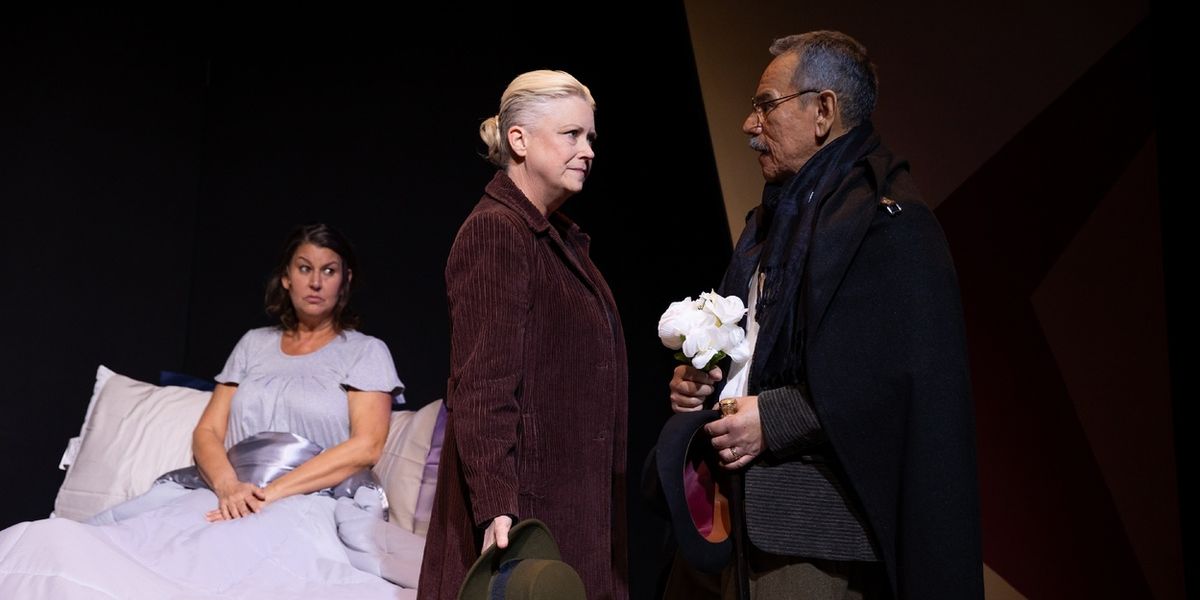
Desert Ensemble Theatre’s (DET’s) world premiere production of DISPERSION OF LIGHT, a historical drama by Richard Rubin, is, as usual, brilliantly directed and acted and technically superb. Mr. Rubin, who also wrote DET’s acclaimed KAFKA’s JOKE, has, this time, written a darker psychological study that requires a great deal of thought on the audience’s part. The production is a must-see.
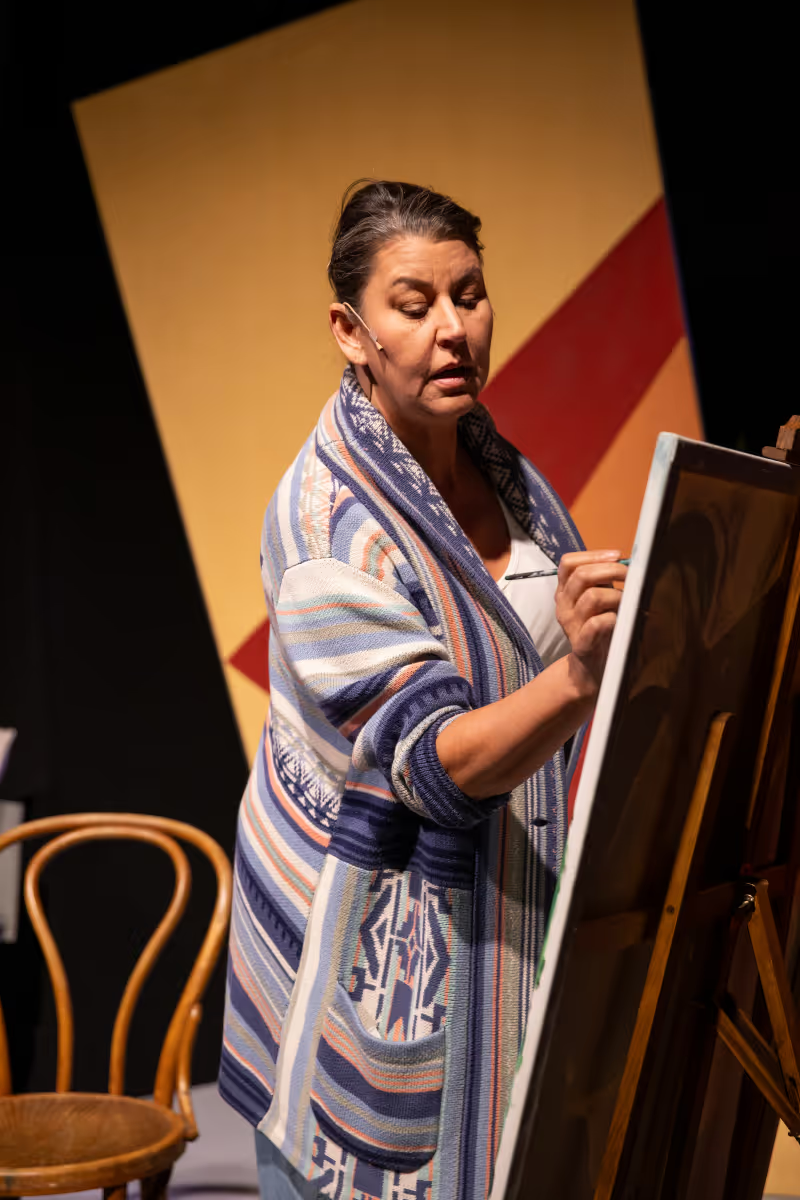
The word “light” in the title undoubtedly refers to Stieglitz’s and O’Keeffe’s efforts to capture the correct angles and color of the light that illuminates their subjects. But what about the “dispersion?” Is it only the light that is dispersed, or is it the relationships? Are Stieglitz and O’Keeffe each each other’s “light” and their physical separation and his affairs scatter it? Does the title refer instead to spreading the light? I have not figured it out.
I am also still trying to figure out how I feel about the script for DISPERSION OF LIGHT. In my opinion, it is too long and talky, and the play should, instead, be only one act. Conversely, the ending was so sudden and the last scene so short that the play was over before I could fully absorb what had happened in the last few minutes. Nevertheless, the play about the dysfunctional marriage of real-life artist Georgia O’Keeffe (1887-1896) and her husband, Alfred Stieglitz (1864-1946), is richly layered.
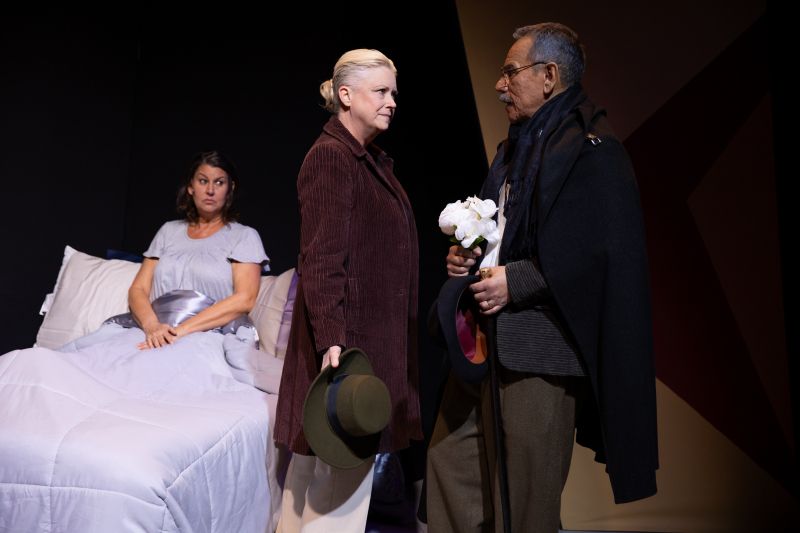
and her husband, photographer Alfred Stieglitz (Charles Herrera).
The events portrayed in the play take place in 1932. The story itself is really not that important, except as it sets up the interactions between the characters and invites them to explore their relationships. O’Keeffe became a model for Stieglitz, entered into an affair with him, and ultimately married him. He was an impresario as well as a photographic artist himself; her career took off when she placed him in charge of the business aspects of her work. Their marriage was unconventional in that she spent much of the year in Taos painting the mountains while he remained in New York, where he entered into an affair with a woman forty years his junior. When O’Keeffe discovered them in bed, she had a nervous breakdown.
This production shows the imperative of a top-notch director (in this case, DET’s artistic director, Jerome Elliott Moskowitz) and top-notch actors willing to spend a great deal of time and effort researching their real-life subjects. If I recall correctly, this is the first Coachella Valley production I’ve seen where the program credits a dramaturg (stage manager Sierra Barrick), and this play needs one.
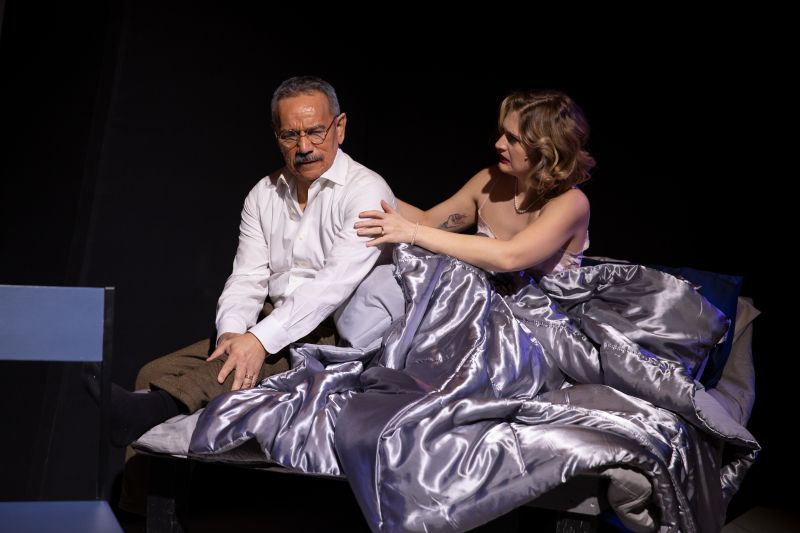
Dorothy Norman (Sarah Elizabeth Woolsey).
Scenic designer Thomas L. Valach, whose work I’ve very much enjoyed since I arrived in the Coachella Valley in 2014, has incorporated what the program calls a “facsimile work-in-progress” by Cathedral City High School student Kathryn Clayton. In addition, there is a painting through which a dream-like monochromatic video of a man and woman having sex is projected. The painting may be a flower but it may be a female sex organ — theatregoers are free to decide.
As I have indicated above, the acting and directing are extraordinary. I have seen both leads (Melanie Blue as O’Keeffe and Charles Herrera as Stieglitz) in several plays, in each of which their performances were completely different from in the others. As O’Keeffe, Ms. Blue speaks with a flat midwestern accent, which she does not lose once. In one scene, after O’Keeffe suffers a nervous breakdown, Ms. Blue affects a weak, defeated demeanor, completely different from O’Keeffe’s usual, strong demeanor.
I do not know how accurately Mr. Rubin’s script portrays the events in the characters’ lives, but whether or not it is historically correct makes no real difference. Thanks to the extensive research, the description of the characters and biographical data in the program, as well as the photos, helps the audience determine whether the individuals in O’Keeffe’s and Stieglitz’s orbits are as the characters see the others or whether O’Keeffe and Stieglitz have blind spots about those with whom they interact, including each other.
Key questions revolve around the relationship between O’Keeffe and her Best Friend, Rebecca Strand (Lisa Hammert). “Beck,” who also previously modeled for Stieglitz, denies to O’Keeffe having an affair with Stieglitz, but freely admits an affair with someone else. However, she seems less interested in sleeping around than in serving as a bulwark for O’Keeffe against life’s vicissitudes. For example, when O’Keeffe has her nervous breakdown, Beck gets right on a train to travel from Taos to New York to be there for her friend.
Anyone would be lucky to have a friend such as Beck, but I got the feeling that she and O’Keeffe were more than friends. My suspicion that the friends might also have been lovers stems from a clue dropped by the director and the Costume Designer (Denée Dentice). They apparently took a great deal of care to ensure that the costumes are appropriate for the period — especially Stieglitz’s suit and Dorothy Norman’s outfit, complete with curls and a cloche hat. (O’Keeffe wears period non-specific dresses and artist’s smocks; the fifth character, Donald Deskey, played by Ray Kelly, dresses in a nondescript suit). Beck, however, wears pants. Women in the early 1930’s did indeed wear pants, but to ride bikes or horses, to lounge on the beach or to paint the house. “Ladies” wore skirts and dresses in public. When Beck visited the New York City hospital room, she probably would have heard nasty comments had she worn the pants that even a decade later would have been accepted in New York.
Where does this analysis of Beck’s dressing preferences lead? It’s clear that, between her affairs and her pants, she is willing to ignore norms. Could she also have ignored norms by entering into an affair with O’Keeffe? Is the designer dropping a bread crumb based on the preference of some lesbians to wear pants instead of dresses? All of this is speculation, but that is the nature of this play.
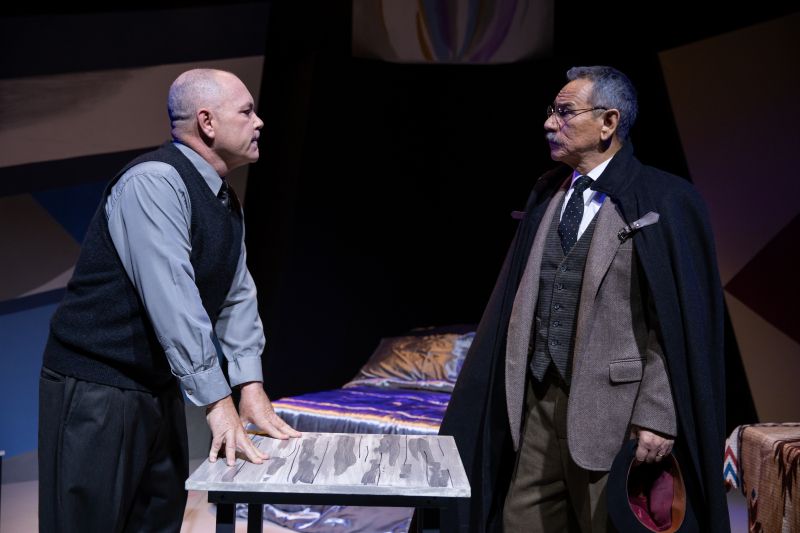
All five actors in this play do a fabulous job in their roles. An example is when Stieglitz and his young lover, Dorothy Norman (Sarah Elizabeth Woolsey), converse from opposite sides of a table; Dorothy stares adoringly at Stieglitz while he all but ignores her, an impressive demonstration of Stieglitz’s self-centered nature that only top-notch actors can pull off. The fifth actor, Ray Kelly, also shines in his small role as Donald Deskey. I really enjoyed watching the testosterone flow when Deskey and Stieglitz got into a rip-roaring argument.
DISPERSION OF LIGHT will play for one more weekend, through Sunday, February 1st, on Friday and Saturday evenings at 7:30 and on Saturday and Sunday afternoons at 2:00 p.m., with tickets priced at $44.20 including fees. All performances take place at the Palm Springs Cultural Center, located at 2300 East Baristo Road, Palm Springs CA 92262, in the old Camelot Theater. Tickets are available at holdmyticket.com/event/449338. For more information, check the Web site at www.desertensembletheatre.org/, call (760) 565-2476, or email DETCTheatre@gmail.com. The Postal Service mailing address is P.O.Box 2885, Palm Springs, CA. 92262.
The remaining two productions of this season, DETC’s last, are METEOR SHOWER, by Steve Martin — yes, THAT Steve Martin — March 6-15, 2026; and KNIFE TO THE HEART, April 10-19, 2026.
PHOTO CREDIT: Tara Howard
Sign up for all the news on the Summer season, discounts & more...

|
Mizell Center Presents - Stephanie J Block Live In Concert Palm Springs Cultural Center (11/12-11/12) |

|
John Cameron Mitchell: Hedwig 25th Anniversary Movie Tour Palm Springs Cultural Center (11/07-11/07) |

|
The Rocky Horror Picture Show Spooktacular Tour with Nell Campbell The Plaza Theatre (10/11-10/11) |

|
FRIDAY NIGHT LIVE! FNL Improv with PRNIT! PseudoRandomNoise Improv Theater (7/10-6/11) |
|
Jonathan Van Ness: Hot & Healed Comedy Tour 2026 Grove of Anaheim (10/09-10/09) |

|
The Rocky Horror Picture Show Spooktacular Tour with Nell Campbell Fox Theatre (10/09-10/09) |
|
Mama''s Boy Starring Gregg Glaviano Plaza Theatre (9/26-9/26) |

|
The Shawshank Redemption Desert Theatreworks (9/25-10/04) |

|
Little Shop of Horrors 40th Anniversary Tour with Ellen Greene (the Original Audrey) The Plaza Theatre (1/27-1/27) |
|
Fool For Love The Palms Restaurant (8/08-9/27) PHOTOS |

Reader Reviews
To post a comment, you must register and login.