


Review: THE RIPPLE, THE WAVE THAT CARRIED ME HOME at Stages Houston
This recent work is making a splash at Stages.
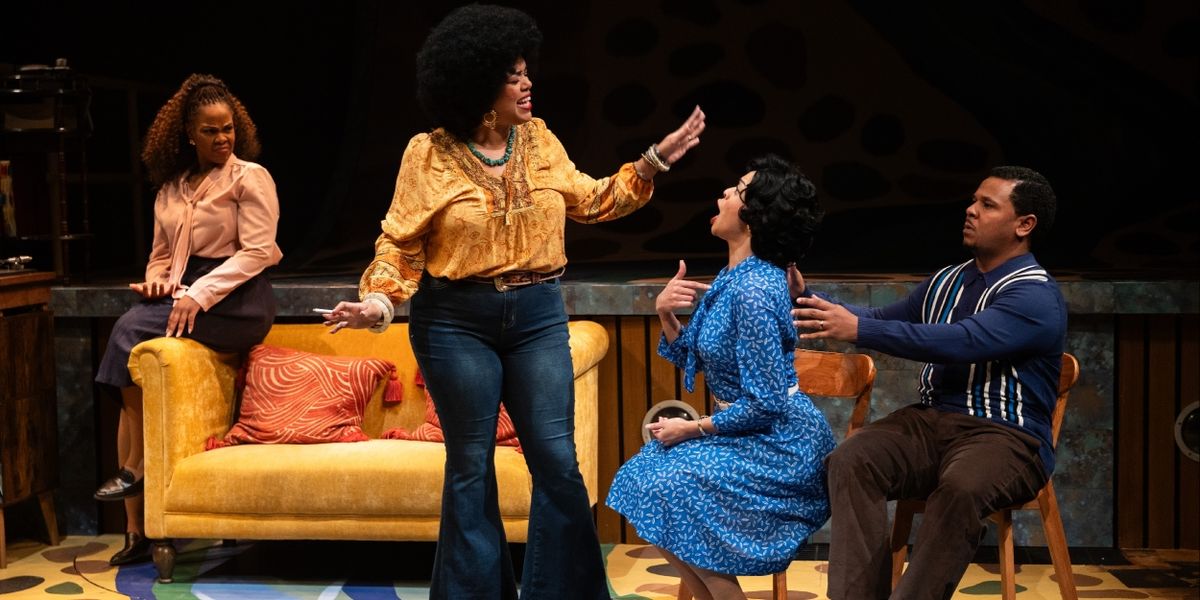
Written by Tony-nominated playwright Christina Anderson and directed by Eboni Bell Darcy, this deeply moving story follows one person’s emotional journey to rediscover their roots, heal old wounds, and find their way back home. With striking performances and a captivating narrative, the production explores the power of family, love, and self-discovery.
At its core, this is a story about a woman searching for her own identity outside of her parents’ activist cause—and the quiet distance that grows between them over time. However, two historical events (one real, one fictional) create an undercurrent that runs through this multi-generational tale. In 1960s Beacon, Kansas, Helen and Edwin, a Black couple, are fighting for a simple yet deeply significant cause: a public swimming pool for their community. The town’s three local pools (two White, one Black) were shut down after a tragic incident—the drowning of the Beacon Three, a group of eight-year-old boys (two Black, one White) who lost their lives in a local lake after the pool closures.

Janice, their daughter, grows up immersed in her parents’ cause. Taught to swim by her mother, she is encouraged to speak at one of the movement’s rallies as a child. But as she matures, her interests shift, and a traumatic run-in with a police officer—one that she and Helen experience together—pushes her away from both the cause and swimming altogether. As the rift between them deepens, Janice flees further inland to her Aunt Gayle’s farm, where she “falls in love with the land.” Years later, now an adult with a family of her own in Ohio, Janice is invited to return to Beacon to speak at the dedication of a new public pool, named in her father’s honor. When she arrives, the nation is reeling from the acquittal of the police officers who beat Rodney King.
Yes, these weighty historical events serve as the backdrop, but the production is also full of sheer moments of joy and laughter. Lakeisha Rochelle Randle delivers a grounded and deeply engaging performance as Janice, impressively commanding the stage for nearly the entire show. As the story’s narrator, she seamlessly shifts between past and present, embodying younger versions of herself with shifts in voice and physicality. Her nostalgia is palpable, and we feel the full weight of her inner conflict—torn between land and water.
Sarah Sachi and Joseph Palmore bring incredible chemistry to the roles of Helen and Edwin. Whether dancing or arguing, they do it with their whole hearts, pulling us into their dynamic with Sachi’s rich, resonant voice and Palmore’s expressive, comedic physicality. Through beautifully delivered monologues, we learn about their individual connections to water and why they are so deeply committed to their cause.

Last, but certainly not least, is Deshae Lashawn, who pulls double duty as Aunt Gayle and Young Chipper Ambitious Black Woman (a character name I will love for a long time to come). Lashawn steals the show with two distinct and equally compelling performances, effortlessly shifting between them.
Overall, the production is unique, heartfelt, and an intricately woven tapestry of emotions and events. This is all heightened by an impressively painted, versatile set (designed by Torsten Louis) and a lighting design (by Bryan Ealey) that skillfully guides us through time and place as the story moves across generations.
THE RIPPLE, THE WAVE THAT CARRIED ME HOME runs until March 23 at Stages on the Sterling Stage. Performances are Wednesday through Saturday evenings, with matinees on Saturdays and Sundays. The show is approximately 1 hour and 50 minutes with no intermission and is recommended for ages 12 and older. More information about the theater and the production can be found here.

|
Jesus Christ Superstar Deluxe Theatre (8/14-8/17) |

|
The Tavern by George M. Cohan Theatre Suburbia (7/24-8/22) |
|
Disney's The Little Mermaid Theatre Under The Stars (12/08-12/24) |
|
Ride the Cyclone HITS Theatre (8/14-8/14) |
|
Ride the Cyclone HITS Theatre (8/16-8/16) |
|
Oh, Mary! Theatre Under The Stars (4/27-5/09) |
|
Sweat Theatre Southwest (2/19-3/13) |
|
To The Bone Theatre Southwest (5/28-6/19) |

|
Mrs. Doubtfire The Musical Theatre Under The Stars (10/13-10/25) |

|
PROOF 4th Wall Theatre Company (9/11-10/03) |
Reader Reviews
To post a comment, you must register and login.