
Review: GREASE at The Carnegie
The Carnegie closes its summer season with another hit!
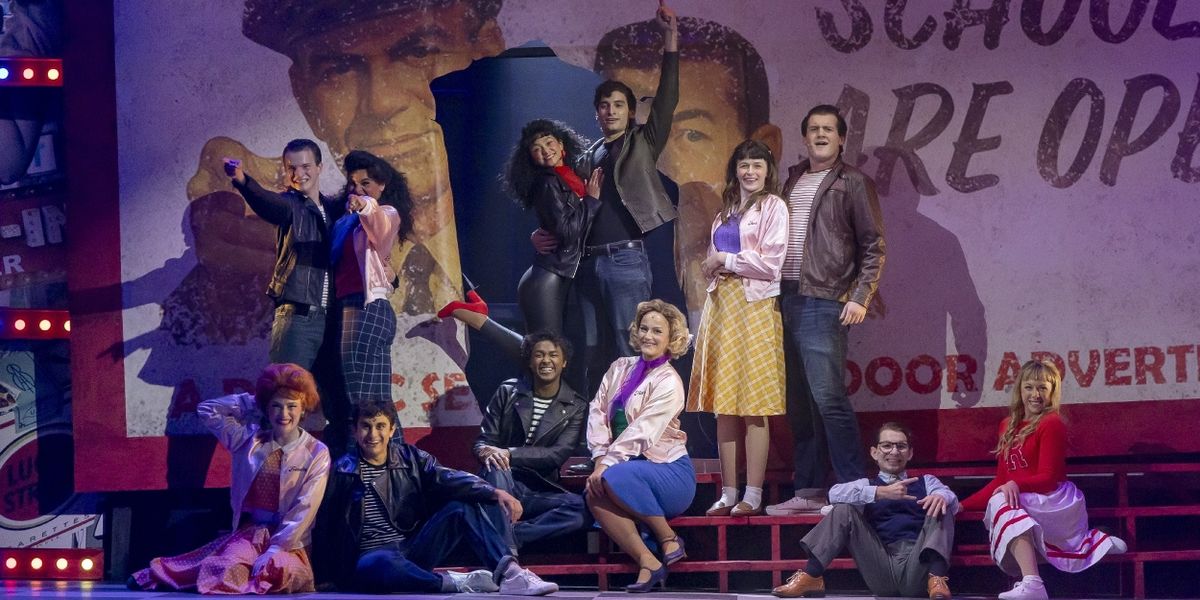
The Carnegie honored the end of the summer season with some of its own “summer lovin’” with their latest production of Grease, which ran from August 15-24th, 2025 in Covington, Kentucky. This classic musical, as well as the wildly popular movie that followed it, tells the story of a group of high school kids in the late 1950s as they explore relationships, friendship dynamics, and their core values as they head towards adulthood. The catchy doo-wop and early rock n’ roll style of music alongside the fashion and other paraphernalia of the setting give a nostalgic feeling, but the topics of rebellion and scandal provide a unique contrast to the squeaky-clean reputation many may associate the era with. With direction and choreography by Eric Byrd, this production of Grease doesn’t shy away from its adult content, giving a necessary edge to make this show successful.
In connection with the rebellious themes in the show, it’s important to begin by recognizing the context around the making of the show. Written by Jim Jacobs and Warren Casey, the original production of Grease premiered in Chicago in 1971 with the Broadway production following it in 1972. By the time the show made it to New York, the original vulgar, gritty content was toned down quite a bit to make it more family-friendly and appeal to a wider audience. It clearly worked, and it eventually went on to become the longest-running Broadway show in history in its time, lasting for over well over 3,000 performances. Later on, further adaptations were created to conform to school and other community standards, making the G-rated version a popular choice for local theatres to produce; however it’s the raunchier and uncensored content that allows the show to work closer to the way it’s intended.
It should be noted that this next part is strictly a theory that came to mind while viewing this production of Grease: It is known that the central relationship between Danny Zuko and Sandy Dumbrowski is a subversion of the traditional 1950s film trope in which the good girl tames the bad boy, and instead here the boy unleashes the wild side of the girl. However, it could be questioned if this social commentary could have expanded even further. Between 1934 and 1968, The Hays Code, a strict set of standards to limit different sorts of controversial material, was applied across Hollywood motion pictures. Due to these restrictions, films created during this time simply weren’t allowed to be as bold and brash as they may have wanted to be, and stories like Grease wouldn’t have been able to be made, even in its current form. So in addition to the idea of the revisionist take on the teen romance genre that shifts traditional expectations, was Grease also designed to be a social commentary on censorship during this era? And was this one of the first period pieces of this setting to break into the mainstream and let people see a fresh representation of a group of working-class high schoolers in the 1950s? And is that a significant factor that contributed to its popularity? These questions stay unanswered for the time being, but the approach The Carnegie took with their production allowed for these ideas to come to mind.
The current (full adult) iteration of Grease finds a balance to explore the risqué matters and the lightness, and The Carnegie does an excellent job of executing this work within the confines of the text. The students of Rydell High felt incredibly well-developed, and each actor had outstanding talent to make them stand out in their own way. Even during the opening ensemble performance of the titular song “Grease”, it was very clear to decipher Indya Lincicome as Betty Rizzo strictly from her suave, strong movements and an attitude that stood out. Her rendition of “There Are Worse Things I Could Do” was bitter and heartbreaking in all the best ways.
Monique Churchill was another big highlight as Sandy, as she was able to balance both the innocent and headstrong aspects of her character. She can seem inexperienced and vulnerable in some parts, but she wasn’t afraid to turn Danny (Nick Abouzeid) down when he wasn’t behaving to her standards, nor did she hesitate in physically attacking Rizzo during a fit of rage. Her voice was a joy to listen to, and every note was breathtaking during the act one finale of “Hopelessly Devoted to You” (which was not featured in the original production of Grease, but was added onto revivals after the success it had when it premiered in the film adaptation.)
The transformation Sandy undertakes at the end of Grease can be a controversial topic as people worry it sends a bad message or undermines her character, especially when people are viewing it from a modern lens and their own personal biases. But in seeing a more assertive side of her throughout the show, it makes the shift less shocking. Plus considering the context of the show and its creation, Sandy’s change doesn’t have to be either positive or negative, but just an exploration of the effects of high school peer pressure and the experimentation of self expression during that age. The Carnegie framed the scene earnestly, as Sandy giggles with the rest of the Pink Ladies as she tries out her makeover on the T-Birds. This ending is not about the characters making perfect decisions and being a good example for those seeing the show; it’s about this group of people going through adolescent events and seeing these specific moments as they themselves experienced them. And considering how invested and engaged the audience was throughout the show, The Carnegie certainly succeeded in forming an outstanding production of Grease.
As always, The Carnegie has a fantastic team behind every show. The scenic design by Tyler Gabbard features a back-to-school billboard ripped through to make a door space (perhaps a way to show how the kids ignore and fight societal wishes) with 1950s iconography bordering the stage. Costume Designer Cat Schmeal-Swope provided each character a fun look to go with each of their strong personalities, even while sharing matching jackets. The detail of making Rizzo the only girl to wear pants was an excellent touch too. Lighting designer Julie Cowger also did amazing work on this show, particularly during the sock hop scene where the disco ball shined throughout the theatre. And to add a special layer to the performance side, Broadway alum and Trading Spaces host Paige Davis was invited to join the cast as Miss Lynch, a stern teacher at Rydell High. Her presence was profound every time she appeared on stage, but she never overshadowed the rest of her costars.
Grease concluded its run at The Carnegie on Sunday, August 24th, 2025. To learn about more of their upcoming events, including their remounted production of The Rocky Horror Show that they produced last summer, visit thecarnegie.com or click on the link below.
Photo Credit: Mikki Schaffner
Weekly top stories - unsubscribe anytime.
|
DR. SEUSS’S HOW THE GRINCH STOLE CHRISTMAS! THE MUSICAL The Emery Theater (12/04-12/20) |
|
Mrs. Mannerly Ensemble Theatre Cincinnati (10/13-11/01) |

|
Bad Dates: End Game Ensemble Theatre Cincinnati (5/08-5/30) |
|
Cabaret Patricia Corbett Theater, CCM Village, University of Cincinnati (3/04-3/06) |
|
Musical Theatre Senior Showcase Patricia Corbett Theater, CCM Village, University of Cincinnati (3/12-3/13) |
|
Holidays Around the World! Corbett Auditorium, CCM Village, University of Cincinnati (12/12-12/12) |
|
Of Land and Sea Corbett Auditorium, CCM Village, University of Cincinnati (3/05-3/05) |

|
Grangeville by Samuel D. Hunter Know Theatre of Cincinnati (2/11-2/27) |
|
Duke Ellington's Nutcracker Suite Corbett Auditorium, CCM Village, University of Cincinnati (11/22-11/22) |
|
Much Ado About Nothing Patricia Corbett Theater, CCM Village, University of Cincinnati (2/11-2/13) |
Reader Reviews
To post a comment, you must register and login.