


Review: Lincoln Center’s Festival Orchestra Concert Covered the Globe, from Paris to Patagonia
Under Karen Kamensek, Soprano Gabriella Reyes Glows in Osvaldo Golijov Songs
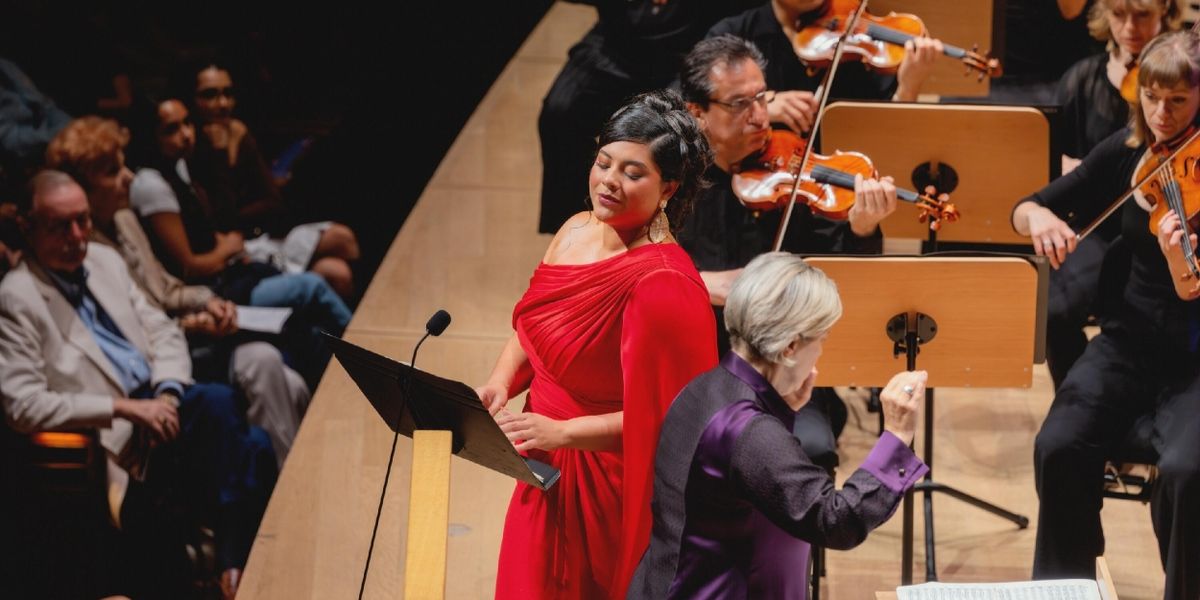
Maestro Karen Kamensek opened the Lincoln Center Festival Orchestra’s concert at Geffen Hall—“Paris to Patagonia”—with some interesting introductory remarks that almost sounded like an audition for the Philharmonic’s storied Young People’s Concerts. While fascinating in their own way, they didn’t quite prepare us for what the program really had in store for us.
The evening consisted of four works and while the title of the concert led us to expect a variety of national styles, that wasn’t quite what we received. Slow songs and quick orchestral pieces are about all that the pieces of the orchestra’s program seemed to have in common.
This included a student work of George Bizet, French-inspired songs by Benjamin Britten, a jerry-built song cycle by Argentinian Osvaldo Golijov (actually three songs written at different times) and Parisian inflected, Gershwin-esque piece by Jacques Ibert.
Under the baton of Maestro Kamensek, the various configurations of the orchestra—changed according to the demands of each particular piece--were quick to adapt to each style called for, whether the often-cacophonous Ibert or the bat-out-of-hell speed of the Bizet.
For me--though I am partial to Bizet’s Symphony in C, from the wonderful choreography George Ballanchine devised for his ballet of the same name--I was at the concert first and foremost for the vocal pieces and powerful soprano of Gabriella Reyes.
Reyes has done some fine work across the plaza at the Met, particularly as Rosalba in Catan’s FLORENCIA EN EL AMAZONAS. That piece showed off some of her voice’s dramatic glamour in its Puccini-esque score, but I was most curious about what she would do with “Les Illuminations” by Britten, a much-admired work done to the poetry of the Frenchman Arthur Rimbaud, that has been taken up by both sopranos and tenors, though it was written for the former. It was the first of Britten's song cycles to find widespread popularity.
For me, however, the performance was something of a disappointment, perhaps too low key for a singer I knew had much more to offer. I was blown away, however, by Golijov’s “Three Songs for Soprano and Orchestra,” which she seemed to connect to in its eclectic style.
The composer grew up in a family where she was exposed to traditional chamber music, Jewish liturgical music and klezmer, with the local influences of Piazzolla thrown in for good measure—and he absorbed all these different styles of music. (In AINADAMAR at the Met, his love of flamenco also came to the fore.)
Even though the songs were written separately and not as a cycle, they fit together like the pieces of a puzzle (with a little cutting and pasting by Golijov) and we don’t question for a moment the composer’s decision to join them into a single piece.
The first, to a text by Sally Potter, was the gorgeously plaintiff “Night of the Flying Horses,” which starts with an a cappella lullaby followed in its second half by an urgent orchestral solo. It was originally used in Potter’s film “The Man Who Cried,” about the love between a Jewish woman and a gypsy man, and had a variety of inspirations: a Yiddish lullaby, a sad Romanian song and a Roma theme borrowed by Golijov.
The second song, “Lua Descolorida,” to a text by Rosalia de Castro written in Gallego, from the region of Galicia in Spain. “Lua” was written for the great soprano Dawn Upshaw, with her multi-colored sound that was a muse for Golijov. Besides having its place in this trio of songs, Golijov also incorporated it into the composer’s “Passion according to Saint Mark.” Reyes found this salubrious for her own voice as well.
The cycle ends with a song set to a text by the poet Emily Dickinson, “How Slow the Wind.” The composer wrote this in response to the death of a friend: “one of those seconds in life that is frozen in the memory…” The aria is rapturously beautiful: “How slow the wind, how slow the sea…” It’s a that every soprano (or tenor) should incorporate into any lieder concert—just gorgeous. And Reyes gives it her considerable all.
Caption: Gabriella Reyes (in red) and Maestro Karen Kamensek
Photo credit: Lawrence Sumulong
Sign up for all the news on the Summer season, discounts & more...

Reader Reviews
To post a comment, you must register and login.