How Wahid Bayar Turns Hip-Hop and Afghan Rhythms Into Award-Winning Theatre and a Platform for Youth
A look at how fresh ideas keep the stage surprising, from bold choreography to wordless storytelling.
Written by Molly Peck
Theatre has a way of getting under your skin. It’s in those unexpected moments—a scene that makes you laugh harder than you expected, a sudden shift in lighting, or a rhythm you’ve never heard before—that the stage truly comes alive. Audiences return for that jolt of the unexpected, for the sense that, just for an evening, they’re seeing the world in a way they never have before. It’s in this space, between what's familiar and what's never been tried, that theatre reinvents itself, blending traditions and ideas until something entirely new emerges.
And audiences are ready for it. A recent JCA Arts Marketing report shows that over 40% of people attended a performance last year in a genre that was completely new or unexpected to them. This hunger for surprise is pushing directors and artists to experiment with forms, and the dancer and performer Wahid Bayar has successfully found the optimal blend of novelty and tradition, combining hip-hop, Afghan rhythms, and theatrical storytelling to create work that challenges expectations and expands what theatre can be.
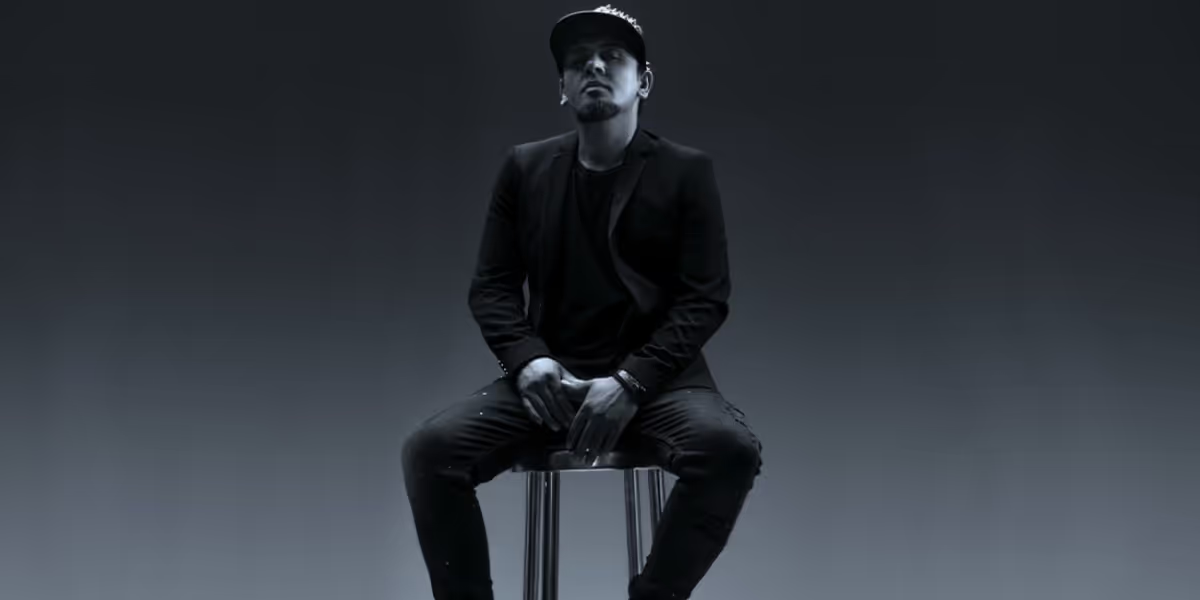
From the roar of hip-hop battles to the hush of a darkened theatre, Bayar has spent a 25-year career blurring the lines between urban movement and theatrical storytelling. He has performed in more than 1,500 shows across five continents, toured internationally with the award-winning ISH Dance Collective, and co-directed productions that showcase his unique artistry. Wahid Bayar is the founder and artistic director of ME DANCE STUDIO, officially recognized by the Dutch government as an educational institute. Wahid is a member of UNESCO’s International Dance Council, has been awarded the civic title “Amsterdamse Held” for his contributions to youth and community initiatives. In addition to his work as a performer and director, Bayar continues to be celebrated for his music. In 2025, he won gold in the Best Composition category at the Global International Music Competition, earning over 94 points out of 100 — another example of how his creativity resonates beyond the theatre.
To explore how his cross-cultural style is challenging and expanding what theatre can be, we spoke with Bayar about the influences and choices behind his work.
Wahid, your work blends hip-hop, Afghan rhythms, and theatrical storytelling — a combination not often seen on stage. What first inspired you to bring these elements together, and how did audiences react when you debuted this style?
I grew up between two worlds — Kabul, where music and dance were often restricted, and the Netherlands, where artistic expression was encouraged. Hip-hop gave me the energy and freedom to move, while Afghan rhythms carried the memories and emotions of home. I didn’t want to choose between them, so I started experimenting with ways to let both speak on stage.
Many of your works are performed without spoken dialogue. How do you ensure the audience still feels the arc of a story when words aren’t part of the equation?
Music is my first language, movement is my second. Through these two strong elements, I convey the feeling and emotion of the piece and translate them into a story. I often use leitmotif choreography, a kind of repeated movements tied to a character or feeling, creating a clear red thread throughout the performance. This helps the audience easily follow the story, even without words.
Additionally, I follow the principles of selective visibility. Simply put, I use lighting to guide the audience’s focus by shifting brightness, color, and angles to replace spoken cues. I also play with the distance between performers to express connection or tension. Together, these choices make the story just as clear as if it were told in words.
In 2007, you released Chera (Why) — widely recognized as the first Afghan track to blend Dari lyrics with hip-hop, breakdance, and urban theatre. It even climbed to #1 on Afghan TV and radio, paving the way for new voices. What did that moment mean for you personally?
For me, Chera was about connecting two worlds I belong to. The word itself means Why in Dari, and that question — why can’t Afghan sounds live alongside hip-hop, why can’t traditions and modernity meet — became the spirit of the piece. On stage, it grew into more than a song; it turned into a performance that merged movement, light, and sound. That moment showed me that art could challenge limits and still bring people together.
During your six years with ISH Dance Collective, you performed in acclaimed productions such as FreestyleISH and W-ISH, and you even co-directed StyliSH, shaping both choreography and staging. How did these experiences influence your artistic journey?
Each project taught me something different. FreestyleISH and W-ISH showed how street dance could be transformed into theatrical storytelling, while StyliSH gave me the chance to step into a co-director’s role, shaping pacing, visuals, and music. Together, they taught me that theatre can be both high-energy and deeply human.
You’ve taken part in more than 1,500 performances across five continents with ISH Dance Collective — work that earned you recognition as an international expert in fusing hip-hop with theatre. Did audiences everywhere respond to your performances in the same way?
Touring taught me that every audience has its own “heartbeat.” In New Delhi, during a theatre show with ISH, 1,200 grown-ups and 5000 kids just stood up mid-show and started clapping and dancing along with the choreography and rhythm. In Antwerp, Belgium, the same piece played to a silent, focused crowd, where pauses felt like dialogue. Those contrasts taught me to read a room within minutes and adjust — sometimes amplifying the energy, sometimes letting stillness carry the weight.
That blend of physical storytelling often includes Afghan rhythms alongside Western theatre styles. Was there ever a performance where this fusion created an unexpected reaction?
Yes — in 2006 at the local music and dance festival in Addis Ababa, Ethiopia. I performed Afghan melodies over street dance. After the show, several people in the 500-plus audience told me the rhythm reminded them of their own folk music. That shared recognition was a powerful reminder of how connected our cultures can be.
Your projects often carry social themes, from resilience to identity. How do you weave those messages into your work without losing the entertainment factor?
The message has to live in the emotion, not just in the words or images. If the audience feels joy, grief, or hope alongside the performers, the message is already there. I believe in making a show you want to watch first, then letting the truth surface naturally through the art.
Imagine you were given a Broadway stage tomorrow with complete creative freedom. What would that production look and feel like?
It would be a cross-cultural journey told through movement, music, and visual design—no spoken dialogue, just an emotional language everyone understands. Afghan rhythms would meet urban beats, classical staging would merge with street choreography, and the audience would be part of the journey, not just observers. I’d want people to leave feeling like they’d travelled the world without leaving their seat.

Beyond the stage, you’ve built platforms like ME DANCE STUDIO, Dance Camp Nederland, and Talent College — initiatives that have given over 2,000 children from low-income families access to structured creativity and helped dozens of young people launch careers as artists, teachers, and mentors. Why is building these social platforms as important to you as performing?
Theatre and dance can transform a young person’s sense of self. They build confidence, discipline, and communication skills that last long after the curtain falls. That’s why I founded Dance Camp Nederland in 2010, giving thousands of children from low-income families a week of creative activities each summer. With ME DANCE STUDIO, I created a daily hub where hundreds of students train with professional instructors, and Talent College goes a step further by combining artistic skills with business knowledge. Together, these platforms show that art can open doors and create real opportunities for the next generation.
Talent College in particular stands out for its integrated approach, combining training in music, choreography, and video with business knowledge like licensing, publishing, and bookings. How do you see its impact on the next generation?
It bridges the gap between talent and opportunity. Students learn creative skills like music production, choreography, and video editing, but also the business side — licensing, publishing, bookings — all through project-based work guided by professionals. They finish with tangible portfolios they can use in the industry.
Many students have become artists, teachers, producers, or youth mentors, and some have staged performances or released music of their own. The model has even been adopted by organisations such as Upcycle Connection and BBG, including in healthcare. That reach shows me the program equips young people with tools that last well beyond the classroom.
Finally, for young performers who refuse to be defined by one tradition or style, what’s the one piece of advice you’d pass on?
Be a student of everything and a prisoner of nothing. Learn every style you can, but don’t let any of them box you in. Your uniqueness comes from the combinations only you can make. That’s how you keep the stage — and yourself — alive.
Photo Credit: Wahid Bayar