


Review: IHSANE at National Arts Centre
At times heavy, Ihsane encourages the audience to embrace their roots, reflect on their heritage, and strive to achieve their own version of perfection.
NAC Dance’s new 2025-2026 season is now in full swing, presenting events showcasing artists from across the globe. Ihsane, a co-production between the Ballet du Grand Théâtre de Genève and Eastman, is an utterly captivating show. Choreographed by Sidi Larbi Cherkoui, Ihsane combines dance, live music, intricate set pieces, and theatrical elements that work together to create an unforgettable experience. The word “ihsane” in Arabic has no direct translation into English or French. It denotes benevolence or kindness and represents the perfection that all humanity should strive to achieve. It was also the given name of a young man, Ihsane Jarfi, who like Cherkaoui, was of Moroccan Belgian heritage. In 2012, Jarfi was brutally murdered in what was to become the first officially recognized homophobic murder in Belgium. The tragedy struck Cherkaoui because of their shared traits; Cherkaoui noted that it was especially horrific that someone whose name meant perfection should have their light so inhumanely extinguished.
Ihsane’s setting begins in Morocco, honouring Sidi Larbi Cherkaoui’s paternal heritage. Cherkaoui had a fraught relationship with his father, who passed away when he was 19 years old. Cherkaoui did not attend the funeral, something he has always regretted. As he grows older, Cherkaoui has a renewed appreciation for his heritage and is using this opportunity to rediscover it, with the recognition that he carries his father inside of him, as do we all when we lose the people we love.
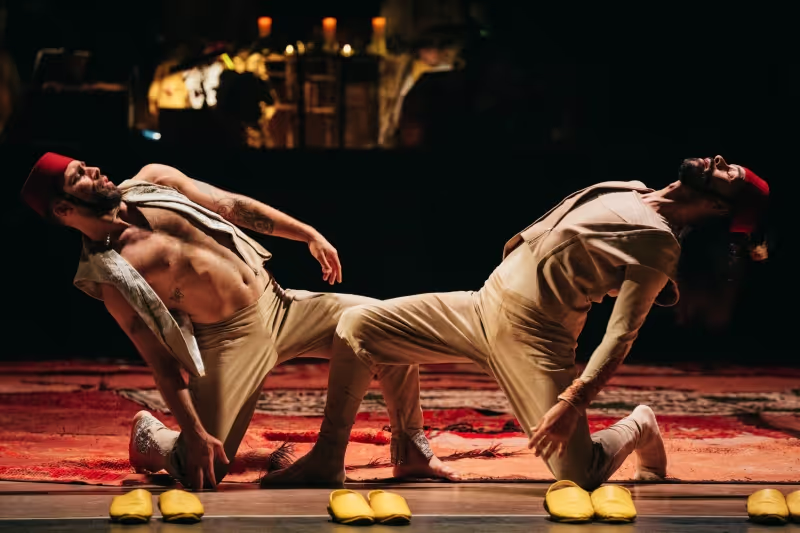
Photo by Filip Van Roe.
In the opening scene, the dancers are students in a classroom are learning Arabic through repetition, some with greater success than others, to the consternation of their professor, who is equally frustrated by the audience’s attempts to parrot the words. Although the students may not yet fully understand what they are learning, they are still able to capture its essence, laying down a foundation for the future.
Ihsane is also dotted with depictions of violence. Jarfi’s murder is recreated with a series of graceful dance movements, simultaneously beautiful and haunting to watch. Later in the performance, when a dancer representing a sheep is slaughtered; video screens show a hand dripping with its blood. This vision transforms into the Palestinian flag, its red triangle slowly filling with the blood of the victims of the conflict, one of the most powerful images I have ever seen on stage. Subsequent screens show the horrors of war and its innocent victims, while the dancers gather Berber rugs in their arms as if they are corpses and drop them into the pit before collapsing upon them in agonized grief.
In one of the final scenes, a pile of sand is being gathered by a man who then allows it to fall back down. Two dancers outstretch their arms to capture the falling sand. As they gather what they can onto their own plates, they turn to allow some of the sand they have gathered to fall into another pair of waiting hands. When the source of the original sand - the patriarch - dies, there is enough remaining sand on the plates to continue sharing it. As the patriarch's body ascends to the sky, first the sand falls back to the earth, followed by the rain of a thousand tears. It is a touching allegory for the transfer of knowledge and values from one generation to another, and it is visually spellbinding.
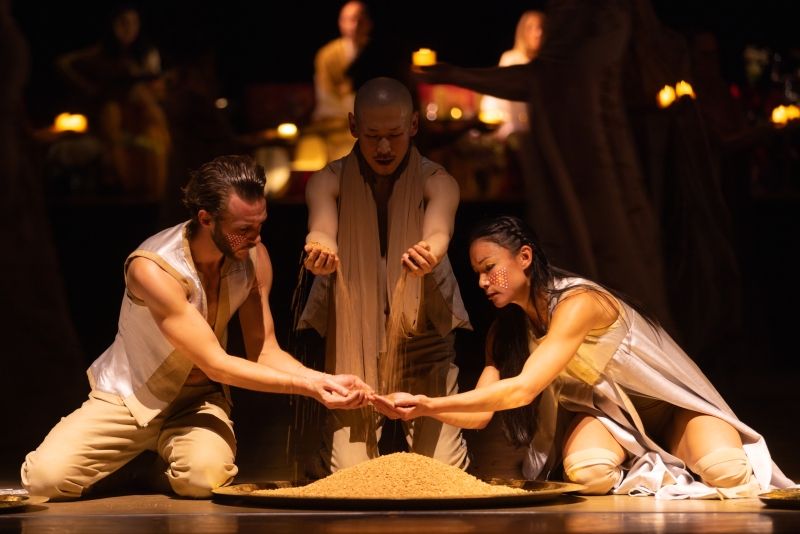
Photo by Gregory-Batardon.
The live music and accompanying vocals by Mohammed El Arabi-Serghini and Fadia Tomb El-Hage allow one scene to flow into another seemlessly. The grief and sorrow embedded into the soul of the show is palpable, but with it also comes the realization that, despite the destruction and violence in the world, it is important to find your own inner peace. Even though Ihsane is, at times, heavy and even disturbing, it encourages the audience to embrace their roots, reflect on their heritage, and strive to achieve their own version of ihsane.
Ihsane was on stage at the National Arts Centre’s Southam Hall on October 9, and 10, 2025. Click here to discover the National Arts Centre Dance’s programming for the 2025-2026 season.
Reader Reviews
To post a comment, you must register and login.