Interview: Andrea Miller & GALLIM Return to the Joyce with MOTHER
MOTHER will be taking the stage at the Joyce from November 5–9, 2025.
Andrea Miller is coming home.
After years spent creating work for other companies, including Martha Graham Dance Company and New York City Ballet, Miller is returning to the Joyce theater with GALLIM, where she serves as Artistic Director and Choreographer, with her first full-length world premiere since 2018. Inspired by her own journey of motherhood and the ancestral vines that connect us all, MOTHER seeks to uncover the origins, mechanisms, and community of a universe coming into being.
I recently sat down with Miller to discuss her artistic vision, and what feels most exciting about this time in her life.
Q: It's your first full-length world premiere with GALLIM since 2018 and the world looks very different than it did then. I know you've been creating works with other companies, but how does it feel to be back with GALLIM at the Joyce ?
AM: It means a lot to me. When [we] have things that are as destabilizing as the pandemic... I felt the scale and size of absence in that time. And so, I don't even know how to describe the gratitude and how much I value the time I have to be able to create and work. I feel like [dancers] are architects of hope, because we are just always building something where there's nothing, and with a lot of nothing in terms of resources. And often, the purpose is to create some meaning, or understanding, or connecting. And it's beautiful work. When the world is as uncertain or volatile, it makes...how much I value this work high.
Q: I love that, "architects of hope". It gave me goosebumps when you said that, and it's true because so often, when we're at this kind of critical juncture of social, political, and artistic unrest in the world, you need that light of hope. I would love to hear about the early threads of inspiration for MOTHER. What were the feelings or motivations that led you down this direction? And how did you start to shape it into existence?
AM: All the time, I want to push myself into some space that is maybe scary. I think that the things I find scary are things that I'm avoiding artistically...I don't like making work about specific experiences of mine or my life—I really am much more pulled to things that feel like...a fantasy, and I like exploring that scale of human experience. And so, my story never really shows up, [but] this time I said, "I really need to stop doing that." And I think a subject that can really keep me to my goal is this very profound experience of becoming a mother. And for a lot of the process, I was like, "Oh, I'm just making this more anthropological study of creation. You know, over thousands of years—humans, mothers—have been doing this forever." And then slowly, I started seeing myself inside of it. And it's been very interesting and exciting to do that.
Q: That's so interesting, the tension between something that you had been avoiding and then through it, you found yourself in it. It's exciting to hear that you had a different relationship to it by including pieces of yourself.
AM: Yeah, yeah. And something different happens when you put yourself in that position where you don't necessarily feel 100% safe or sure of what you're doing. And I really love what I learned in that situation. I feel like audiences are kind of in the same boat; they're in this completely new world that you're kind of exposing to them and if I'm in a similar place, we can go through that together.
Q: I'd love to hear about the movement quality of this piece. How do the dancers that you're working with inform the work?
AM: In a previous commission, I said, "I'm sick of every time I start a piece, I feel like I'm scratching a wound." Not necessarily my wound, but it's social, political things, or climate. [This time] I wanted to try making a piece where I start with what I imagine a resolved space to be: what if we just live for 30 minutes in a sublime world? What would we learn about what that looks like?
I wanted the physicality...to start in a place of fantasy. So, I started thinking of mythology. We read a lot of origin stories from all over the world: from China, from indigenous communities in America, and Scandinavia, and we started making a physicality that I felt was more like 'fantasy people.' They don't walk on their feet and they don't stand with gravity in the same way that we would as a human. I reference Greek mythology where some of the gods become humans and they have moments where they feel human. So there are moments that they drop down into these characters or places that feel very human, and then they rise up again.
There are different physicalities throughout the piece: it takes on a lot of different ways of moving the body. I gave the dancers prompts, we do improvisation again and again, and we build. I asked them to try exploring material from those improvisations, and then I work with them. And, a lot of it is also just finding what is part of this world and what isn't: the rules of gravity, the rules of is it cold, hot, bright, etc.
There's one big solo that I wanted, because I was watching some documentary about gorillas with my kids. I wanted a section that I called 'Gorilla', but the truth is that she's not a gorilla, she's what I call my "cave grandmother." For all my life, I've remembered my cave grandmother—since we learned about cavemen, I was like, "Oh, one of those is mine." If she hadn't made it through that cold night, myself and millions of people wouldn't be here. So, it's dedicated to her.
Q: In the same sense, how does the movement you're envisioning make this the right piece for GALLIM dancers and not another company?
AM: The creative process has such a big appetite at GALLIM. A lot of the dancers are there because they love the process. And yes, they're excited to perform, but I think deeply, they want to be in this process that is going to make them grow as an artist, become part of this mini family that happens in the cast, and live in this work of making. That's a very special experience when I'm at GALLIM, and I do a certain kind of work here that is maybe harder in other spaces.
Q: You're creating a language, an entire vocabulary for the piece, in different ways. I imagine that the score, the lighting, and the costuming is extremely important to bring that all to life. I'd love to hear about the collaboration you had with those artists.
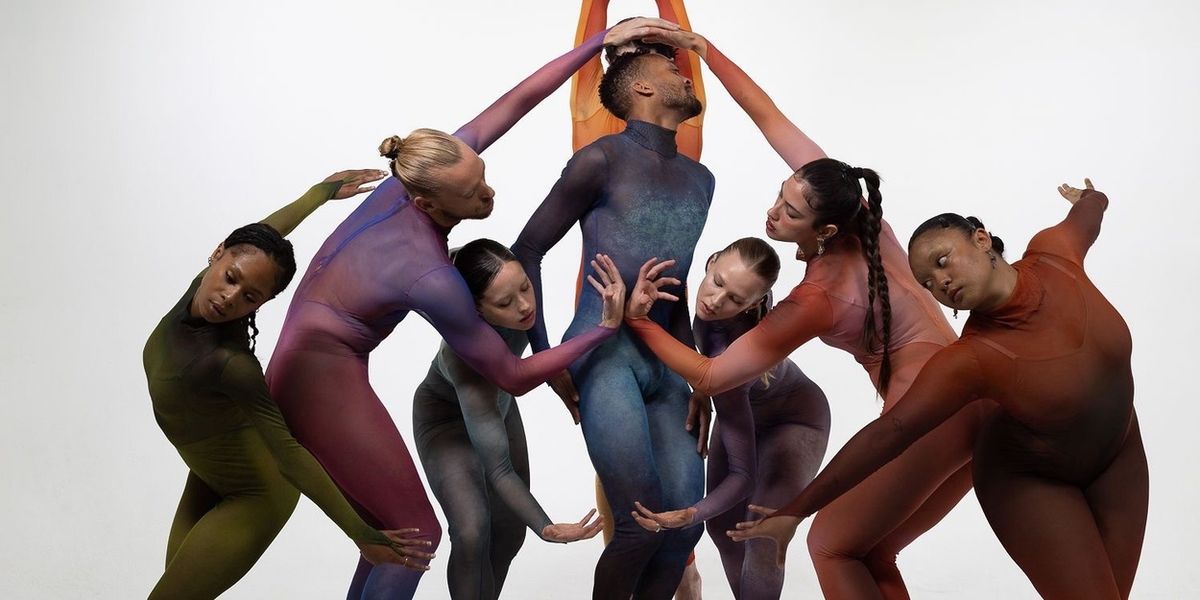
AM: I have an incredible group. The lighting designer, Vinny Vigilante, [is] who I did all of my early works with. Everything I could ever do, I would do with him. And then he [went to] Jacob's Pillow, so we came back to working together now for the first time on a new work in a long time...I trust everything he does. The composer (Frédéric Despierre) is actually a dancer with Hofesh Shechter, and this is our third third collaboration. It's the biggest in scale...He's just a genius and amazing. He's very dynamic in that he can go from something that feels like techno, to something that feels like a beautiful acoustic guitar moment, so it's been really nice working with him. And then Orly Anan, this is our second collaboration together. [Anan] comes from a very special part of Colombia where there's a lot of mysticism from Barranquilla. And they live with this magical realism in their DNA: All life is just colorful and changing, and it shows. I said I would like it to feel like the dancers are blushing these costumes, so there's just a color that they blush from their bodies. And she just nailed it.
Q: You had this quote that I loved, you said, "I wanted to confront the paradox of creation with MOTHER, its beauty and its hardship. My hope is that audiences leave sensing that same immensity inside themselves..." In your ideal world, what do you hope for people to be able to achieve with that immensity?
AM: I don't know. I feel I have to walk a very light tread around purpose when it comes to audiences, because I think sometimes when I go to that place, the work can become preachy, or "this is what should happen," you know? What I'm really interested in is seeing if I can touch on the beauty of that mystery. Sometimes, it means that I can't have any attachments to what I want people to experience.
My husband is kind of like a philosopher, and he taught me something that I didn't know how to explain to myself, which is the difference between Plato and Socrates. Plato wants to put a form to things, and Socrates is [more] "I don't know, and that's all I know." I love to learn and ask questions. We are [always] in motion and the second you define something, five seconds later you're wrong about that. You might have been right in the moment that you said that, then one rehearsal later, it's something else that makes complete sense.
Q: What are you most excited about for opening night?
AM: I don't know if audiences realize this, but many times, opening night is also the first time I'm seeing the piece. We're going to get in the theater on Tuesday, we're gonna do some lighting, and then Wednesday we do a [rehearsal], and then they have a show a few hours later. I just can't wait to see the dancers, and see all of this love and effort that's been poured into this process have its moment to be realized. I'm just excited about it. I'm nervous—but I'm very happy.
Photo Credit courtesy of GALLIM.