


Review: THE CHINESE LADY at Stages Houston
Another Lloyd Suh work pulls heartstrings this time at Stages.
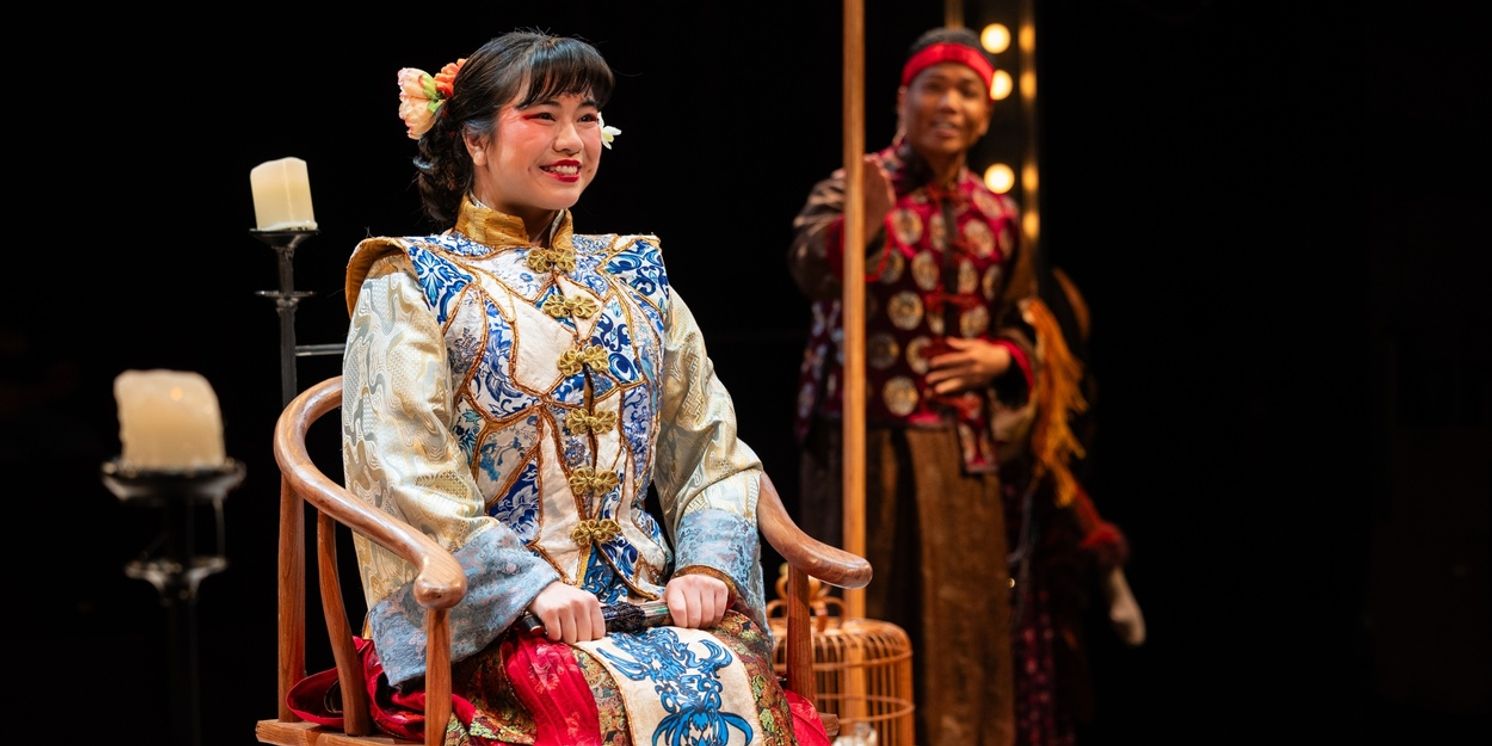
Inspired by true events, Afong Moy, believed to be the first Chinese woman in America, finds herself put on display, touring the country as a living curiosity. She tells us her story, making use of witty and heart-wrenching observations that cover sexuality, non-consensual touch, historical cruelty and anti-Asian racism. Playwright Lloyd Suh explores these themes with empathy, humor, and a surprising amount of wit.
Always the insightful dramaturg, Stages has set up the usual museum-quality context in the lobby to prepare and frame the production before we even enter the theater. The program is also filled with historical information that is both broadly global and specifically Houstonian. For instance, in 1910 there were reportedly only 30 people of Asian descent in Houston: 20 Japanese, and 10 Chinese. There was a specific board dedicated to the known timeline of Afong Moy, who was 14 years old at her 1834 arrival. The last reported exhibition was in 1850, meaning that she “performed” until she was at least 30.
As mentioned, this story is based on real events, but only the facts of the matter, since nearly all real evidence has long been lost to history and well over 150 years has elapsed. That is why Suh has structured THE CHINESE LADY as a “performance within a performance.” All of Afong Moy, the titular character’s dialogue, is closer to what she might be thinking in the moment rather than any actual conversation she was having with the people who had come to see her. More than likely she barely spoke at all, and when she did it was in Cantonese, translated by her handler Atung.
Alexandra Szeto-Joe plays Afong Moy, and she is absolutely sensational. While she does interact and have dialogue with Atung, the entire show is essentially monologue after monologue, spanning years of her life. Right from her first line, Szeto-Joe presents a very specific and clear characterization of Afong Moy that is engaging, funny, endearing and filled with wonder at her new American surroundings. As the play goes on, and Afong Moy grows older, Szeto-Joe maintains that original spark and earnestness she gave us at the start.
.jpg?format=auto&width=1400 "Review: THE CHINESE LADY at Stages Houston")
While Afong Moy was brought to America as a Chinese “exhibit,” it is her interests, appraisals and reactions to American culture that make up most of what she is saying. She does “educate” her audience on different Chinese history, manners and customs, but they always act as a mirror held up against what she encounters when she gets here. Suh does an incredible job writing the dichotomy between the beautiful and evocative language Afong Moy uses to describe things and the broken, oversimplified translations from Atung. The longer we watch, the more heartbroken we become as the new adventure slowly loses its sparkle for Afong Moy.
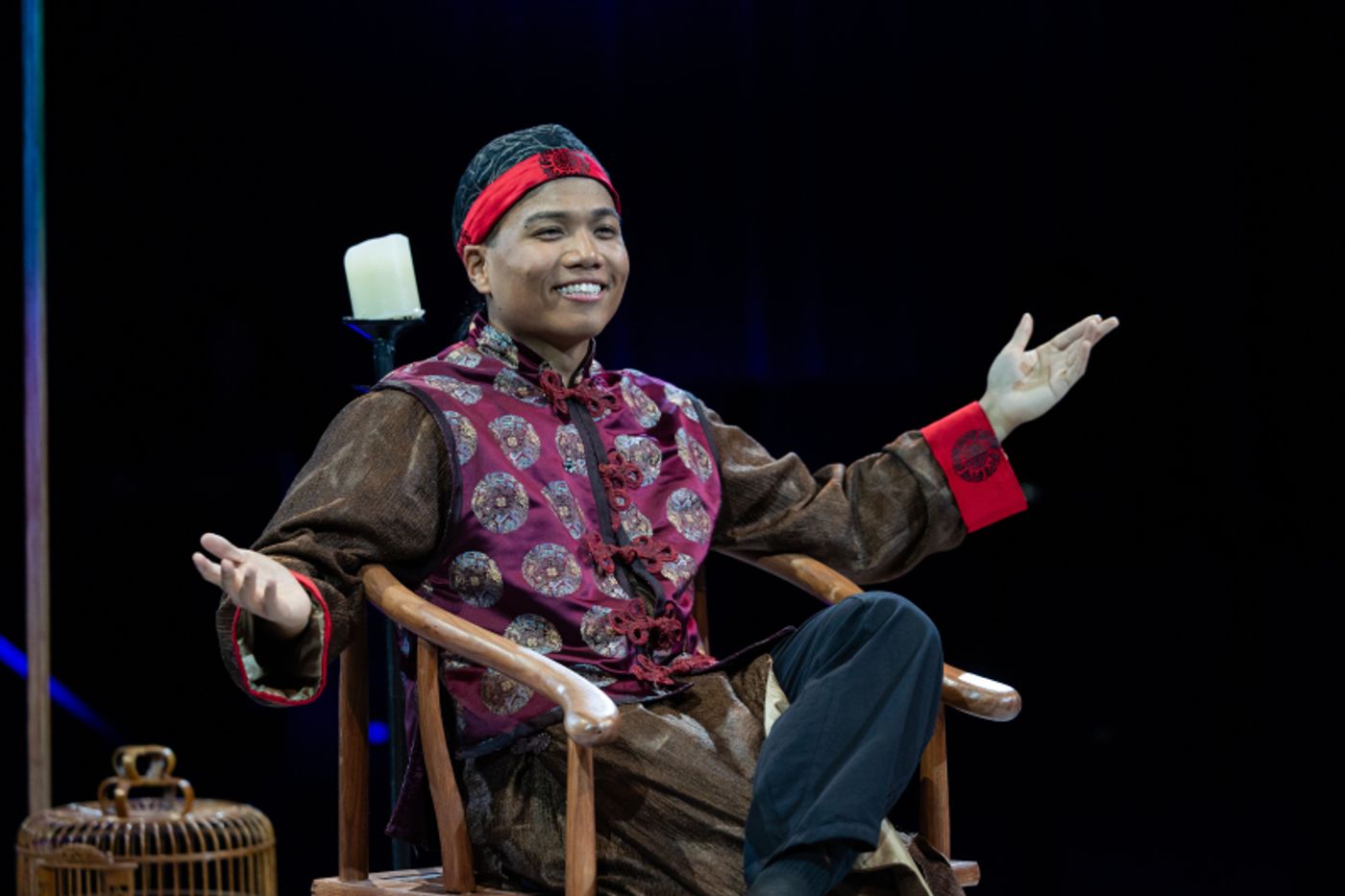
Atung is played by Lloyd Wayne Taylor, who sits on the other side of the spectrum from Afong Moy but matches her in exuberance and liveliness. He has been in America longer, one of the many Chinese men who came over in search of fortune. Set up as Afong Moy’s translator and caretaker, we soon see that not only does he struggle to communicate her deeply introspective thoughts and feelings, he also has to set aside much of his own life for her. We feel Taylor’s intensity to our core, and while his reactions are often the source of laughs for us, his monologue about the dreams he once had rooted me to my seat, clutching the mezzanine railing, unconsciously leaning forward.
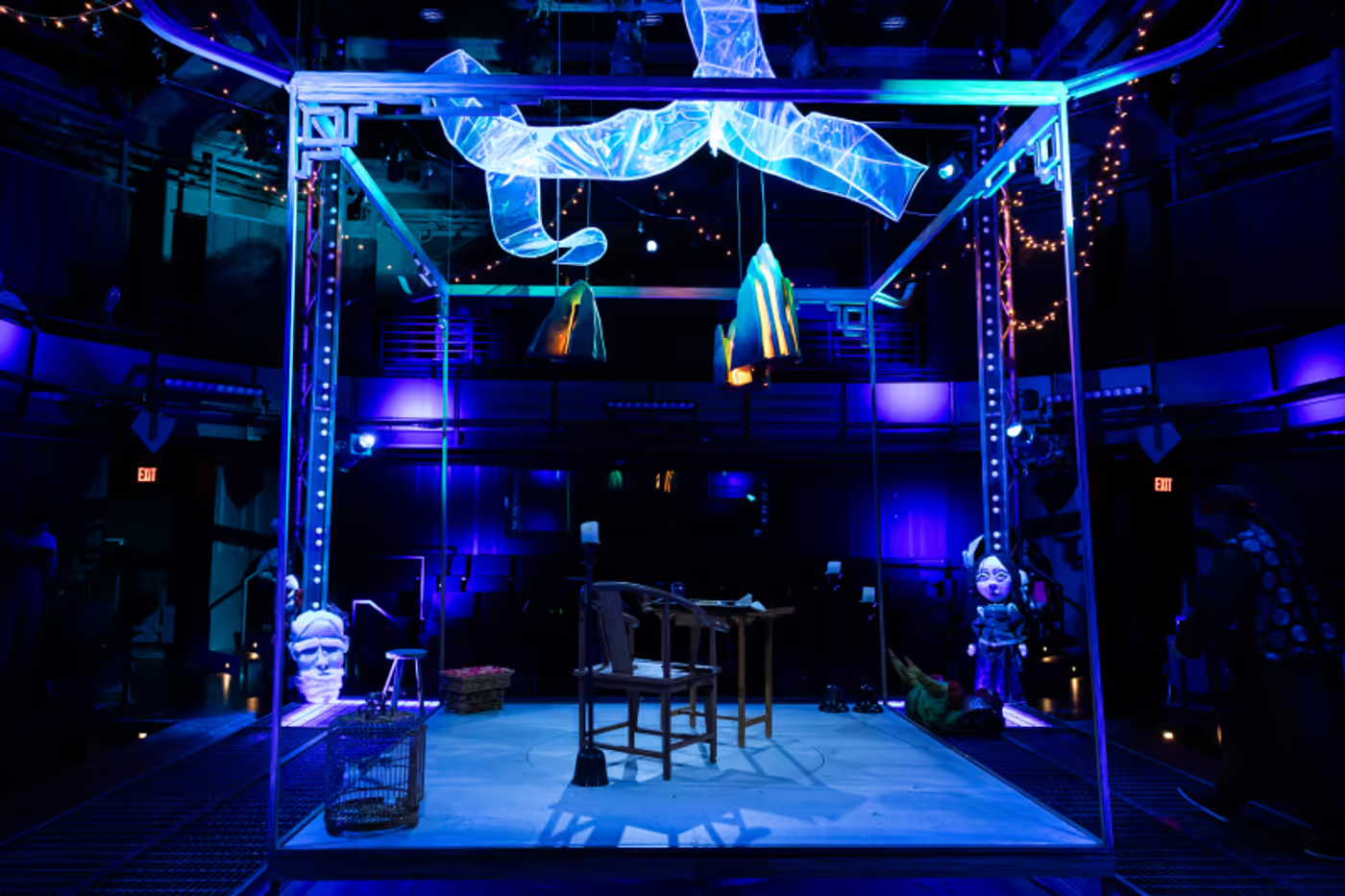
In her pre-show speech, Director Sarah Shin said that they rehearsed up to the last moment to provide an experience where everyone brought their A-game, and it truly was exceptional. Shin deftly balances the heavy material by focusing initially on humor. As things become more real for Afong Moy, we see the tone grow darker and more serious. The production is also set in the round, which was another brilliant choice, as it draws us in to feel like the very people who once gathered to observe Afong Moy. Scenic designer Inseung Park accomplishes this wonderfully. In truth, the set (or exhibition room) becomes the third unspoken character in the show—more Afong Moy’s adversary than Atung. The blending of set and props (by Jodi Bobrovsky) is seamless and is further enhanced by a turning circular set piece and chair that allows Atung to spin Afong Moy for all to see. I could go on and on about the wonderful attention to detail of the set in the space.
Other production qualities are also integrated seamlessly. Lighting (Madeleine Reid) sets off the set beautifully in color, and the hanging lights from the scaffolding give the illusion that we have entered a special and secretive lair in which to behold wonders. Firat Kazbek Ozsoy incorporates sound that is both alarming and subtle depending on the effect needed, and the traditional Chinese garb (by Sandra Zhihan Jia) is beautiful, and quietly tells its own story as Afong Moy passes through time. There are several puppets hanging at the four corners of the set, yet only one is used (to portray a president whom Afong Moy meets on her tour). I found myself curious about the others, as they were never used and could have been ignored completely had they not been so distractingly creepy.
This is yet another story, sadly and once again prescient today, that I am proud of Houston theatre for telling. Through what appear to be naïve observations, Afong Moy offers pointed commentary on the experience of Chinese people in the 1800s, including a brief but emotional lesson on the Chinese Exclusion Act. What is most heartbreaking is that she is the one who feels compelled to apologize to us, believing that if she had simply done her job better, been a better cultural bridge, perhaps Americans would have understood her people more and history might have unfolded differently. In the end, we’re left with the tragic feeling that this beautiful soul’s passage through life was all for naught, merely a curiosity to observe until the next new thing comes along.
THE CHINESE LADY runs through Sunday, March 22nd on the Lester & Sue Smith Stage. Performances are Wednesday through Saturday at 7:00pm, and a 2:00pm matinee on Saturday and Sunday. The show is a little over 100 minutes, with no intermission. More information on the theater and the production can be found here.
Reader Reviews

Videos