


Review: STRIFE at Tarragon Theatre
MacKenzie's cathartic play is a space for healing in an angry world
Why is the default state of discourse immediate rage?
Why do we spend so much time reading other people’s motives in bad faith?
How do we avoid letting our inner anguish or desire for vengeance take over?
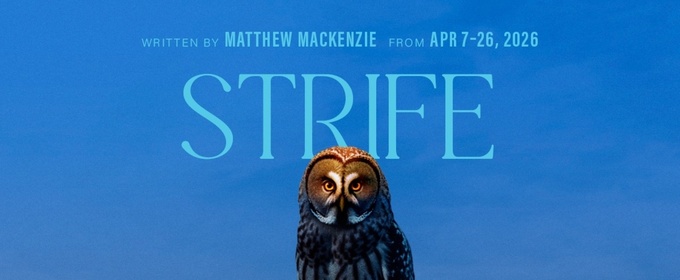
These questions are at the forefront of Dora-winner Matthew MacKenzie’s gorgeously complex new work, STRIFE, a Punctuate! Theatre production in association with Tarragon Theatre.
Anyone who’s spent ten minutes online in the past decade knows that we live in an age of anger and polarization when it comes to the issues and identities we hold dear. Stories abound about families who can no longer speak to each other or even share a meal, with jagged cracks in the foundations of relationships that only widen as news cycles churn.
STRIFE is filled with this sort of ideological conflict and pain, but the overwhelming feeling that emanates from the work is love—deep, abiding love between people who care for each other, which may not be enough to prevent the initial rift, but which slowly fills in the cracks of what’s left behind. The show feels like an antidote to the present moment, a place to sit and decompress, to feel and breathe healing.
There’s a hole at its heart, in the shape of a bright young Indigenous man. A promising Master’s student and activist, Nathan falls from a bridge on his way home from a bar after a climate change protest.
The discovery of his body and suspicion of foul play opens fissures amidst his loved ones: his older sister Monique (Teneil Whiskeyjack) and long term significant other Eddy (Jesse Gervais), oil and gas industry workers who raised him until ideological tensions tore them apart; his mentor Eleanor (Valerie Planche), a professor of Indigenous Studies who persists in holding vigils in Nathan’s name to further his cause; and Sarah (Grace Lamarche), his girlfriend and fellow student, who obsessively searches for clues when the police seem unable to locate the perpetrators.
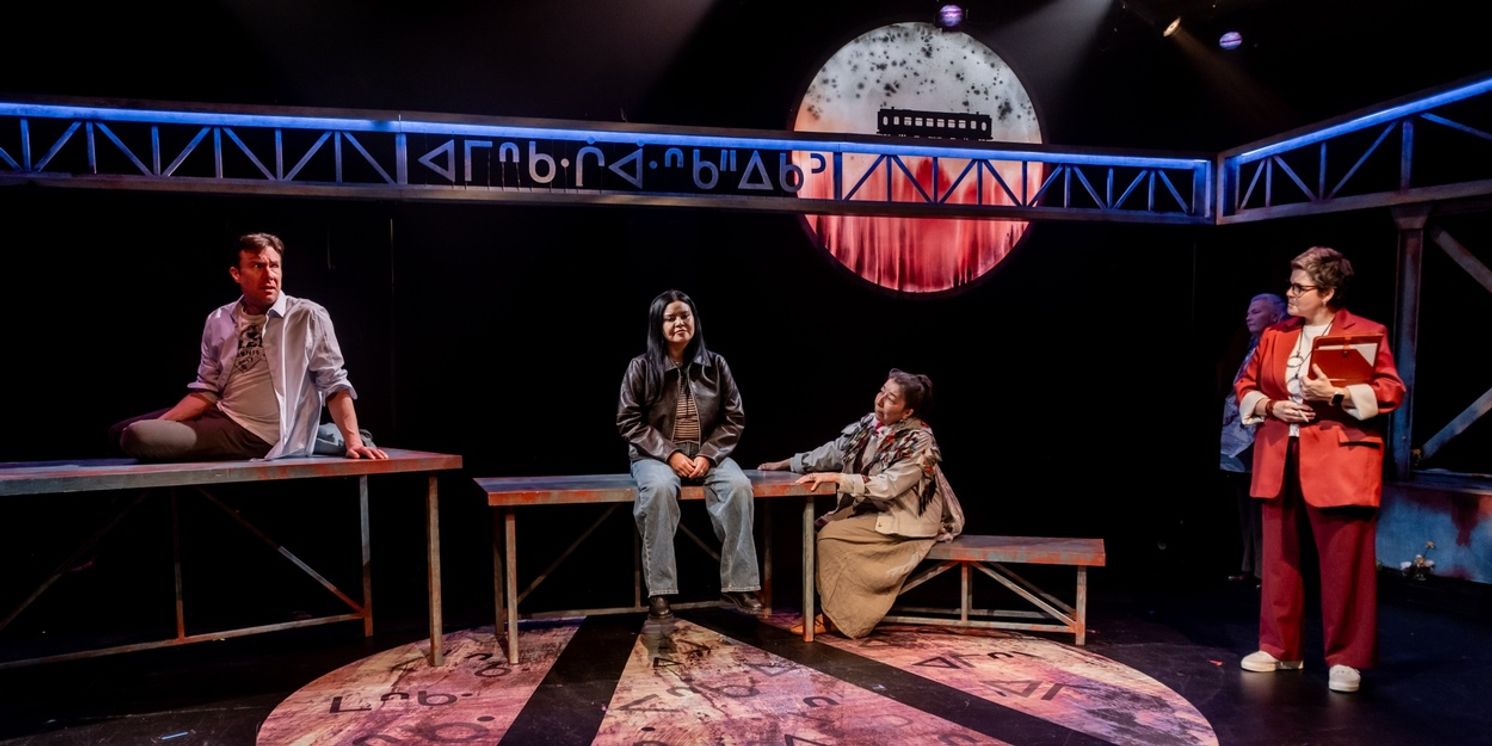
In the arresting shadow of the full moon that illuminates a beautifully atmospheric miniature trestle and train (set by Jackie Chau), a wisecracking Great Grey Owl (Tracey Nepinak) provides Puck-ish commentary on the human foibles that create chaos.
Time stops for Monique after she hears the news. A month later, she’s having sessions with a therapist (Michaela Washburn) to certify her return to work, but emotionally, she’s in stasis, stuck under the fog that’s rolled into town. Eleanor and Sarah want her to lend her voice to their vigils, but she finds public speech impossible. Whiskeyjack’s stillness is arresting; one can see her turning the past over and over in her mind as the world revolves around her fixed stance.
The vigils quickly become a flashpoint for more questions, none of which has an easy answer.
Who gets to speak for a community? Who gets to speak for the oppressed? Who gets to speak for the dead?
And who loved Nathan best? Those who raised him? His ideological mentor? His partner? Those whose values aligned most closely with his, or those who took him in at his most vulnerable?
What’s so striking about McKenzie’s work is its refusal to simplify issues or cast anyone as the villain, while at the same time acknowledging the choices the characters make have impact and meaning, for good or ill. He doesn’t shy away from the fact that the Albertan oil sands are the country’s largest employer of Indigenous people, and makes it clear that no community speaks with a single voice.
He explores pertinent issues of academic infighting that often overshadow real action, such as a heated discussion about what it means to be a “white-presenting” vs. “white-passing” Indigenous person, or Eleanor’s fear that her documented heritage won’t be enough to save her career if her identity is questioned. He examines whether “witnessing” is the same as “experiencing,” and questions our shifting definitions of what constitutes harm, violence, and assault when it comes to speech.
And yet, with skill and the occasional subversion of our expectations, no discussion comes off as a talking point or checklist item, just the real concerns of complex people in pain. He questions systems without taking easy potshots at them; in lesser hands, Washburn’s psychiatrist would have been a company stooge, but here she’s measured, humane, and genuinely trying to help Monique move forward.
Even the rough-edged Eddy, who director Yvette Nolan cleverly introduces when he pipes up from a platform within the audience spouting some choice words about La Belle Province, and who continues to put his foot in his mouth at every opportunity, proves that he feels deeply and shows his love in nuanced ways. Gervais, a fantastic comic actor whose turn in Women of the Fur Trade similarly had me in stitches, does awkward to perfection, cringing at his own verbal missteps and blunders, but when he finally drops the bluster and lets us see the pain of Nathan’s death, it’s devastating. He wonders when they went from genuinely enjoying their heated conversations to Nathan suddenly cutting them out, with no chance to explain.
To keep things from feeling completely raw, Nepinak’s Owl provides moments of necessary distance and humour that act as a refuge from the painful moments on display.
Catharsis may be an overused word in theatre circles, but STRIFE feels like a genuinely cathartic work, one of the most emotionally moving and relevant plays I’ve seen on a Toronto stage in recent years. When we stop talking to each other and start talking past each other, it says, we risk a furious, helpless stasis, forever mourning what we can’t take back.
Love isn’t enough to solve massive geopolitical issues or fundamentally incompatible worldviews. But in a world of angry absolutes, it’s a start.
Photo of Jesse Gervais, Teneil Whiskeyjack, Tracey Nepinak, Valerie Planche, and Michaela Washburn by Jae Yang
Reader Reviews
Videos