


Review: CYRANO at CAA Theatre
Virginia Gay's queer adaptation takes a chance on radical optimism
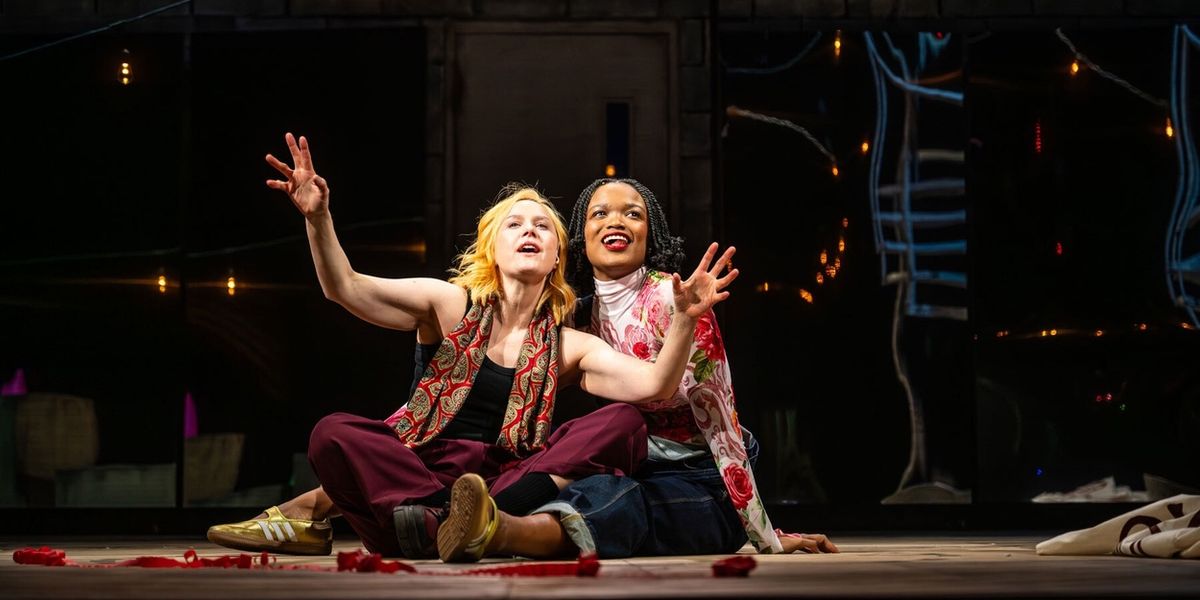
When it comes to adaptations of French playwright Edmond Rostand’s romantic tragedy Cyrano de Bergerac, you can take your pick of the nose.
The tale of a man with a predilection for poetry but a pronounced proboscis, Rostand’s play helped to popularize the now classic trope of a tortured soul who, believing his crush will never reciprocate his affections, lends his talents to the suit of a more classically handsome but dull-witted contestant in order to experience the romance vicariously.
The play has had hundreds of productions and adaptations since 1897, including several films, many TV episodes, and at least nine musicals. Virginia Gay’s CYRANO isn’t even the only version to gender-swap the titular character or to queer the central relationship. But her play’s questioning and exploration of its own existence might make you ponder more deeply why the original remains so popular, and why so many people, believing themselves to be unlovable, preemptively close themselves off from the possibility of happiness.
A combination of metatheatrical deconstruction, psychological study, and romantic comedy, CYRANO finds compelling dimensions in the classic story by shading in its character types and considering love from a variety of angles.
The show was originally produced by Melbourne Theatre Company in 2022 after its initial 2021 opening was shuttered by a lockdown, and in Roast Productions’ staging at Mirvish’s CAA Theatre, you can feel its desire to inhabit a room of living, breathing people. To that end, Gay and director Clare Watson immediately break the fourth wall and leave it broken, using small amounts of mild audience participation to eventually foster a sense of community in the room.
But before we get there, the characters first have to decide what kind of play this is going to be. A small “Greek chorus” of actors are set to play all of the minor roles, from cooks to soldiers, but the trio seems much more intent on commenting on the action (#1, Mona Goodwin, the leader), inflating their resumes (#2, David Tarkenter, the grumpy older man with Opinions), or just being excited to be there as the newbie (#3, Mackenzie Gilbert, a wide-eyed wisecracker with terminal foot-in-mouth disease). The place where all this is happening, of course, is the liminal space of a theatre, with three acting cubes, a mirrored screen, and a rolling metal balcony creating minimalist locations (sets and costumes by Amanda Stoodley).
Gay’s otherwise lively script gets into the weeds a bit in this opening discussion, which introduces us to the charming dynamic of the chorus but might lose some audience members who are otherwise patiently waiting for things to get started, or at least for the titular character to appear.
When Eryn Jean Norvill’s Cyrano does take the stage, she does so with aplomb, swaggering and exploiting her vocal range to its fullest as she swings from poetry to vulgarism and back. Norvill plays her speeches like an instrument, a flute going breathy with nerves when first encountering her crush giving way to the strings of a deft barrage of affronted wordplay and then a throaty, low drum when dissecting a taunter or rival. (Gay changes the premise so that Cyrano only meets Roxanne in adulthood, for reasons that aren’t completely explored.)
Cyrano’s actual visible schnozz, by the way, is completely ordinary, constant references and exaggerated gestures to an imagined nose he the only indications that it’s supposed to single her out. The absent nose becomes a metaphor for queerness, but the show is more successful and emotionally resonant when it tackles the subject head on.
Norvill’s fire is matched by Madeline Charlemagne’s curious and audacious Roxanne, whose development into a more three-dimensional character with needs and prickles and flaws, allowed to sometimes be shallow as part of her depth, is one of the most welcome updates. Charlemagne rocks a rendition of “Try a Little Tenderness,” a throwback amidst an appealingly clubby soundtrack from sound designer Toby Young, and has oodles of chemistry with both Norvill and George Ionnides’ Christian, here going by the hipper moniker of “Yan.”
A man with the body of a Greek god and the brain of a Greek yogurt, Yan bursts in swaggeringly to Donna Summer’s “I Feel Love,” flexing his biceps and sliding across the stage like a Backstreet Boys video on steroids. Yan gets a little less shading than other characters, and his complaint that he’s mostly comic relief is largely accurate, but Ionnides’ hilarious utter blankness when things get too complicated makes the most of that designated role.
CYRANO’s more in-depth exploration of its title character as a person with both a superiority and inferiority complex, and a penchant for self-rejection to avoid getting hurt, rings psychologically true. The show’s message that fear of social failure or exclusion isn’t a justification to manipulate and hurt others feels very topical in a charged time when the first inclination of many, faced with the imagined potential of a future slight, is to attack. It doesn’t romanticize naïveté, but encourages audiences to take a chance on radical optimism. If we take a leap, it says, things just might work out.
The play does paint itself into a corner with an ending that feels lovely and magical but doesn’t completely stand up to scrutiny, simply because the theatrical medium doesn’t allow us to watch a character spend years working out her issues in a way that feels truly earned. While its concept that actions often speak louder than words is rousing, any solution to a betrayal that involves a grand romantic gesture is also a cliché that wouldn’t work at all if this were a more well-trodden heterosexual love story.
But the thing is—this isn’t a more well-trodden heterosexual love story, and the simple fact that most queer stories in media don’t get a chance at happiness makes a potential cliché seem instead like that radical act of optimism. It’s warm, and it’s fuzzy, and it’s a bit of a party, and maybe we could all stand to try a little tenderness.
In that vein, I’d say you’ll leave CYRANO singing a happy tune—but unlike some characters, I don’t want to put words into your mouth.
Photo of Eryn Jean Norvill and Madeline Charlemagne by Dahlia Katz
Sign up for all the news on the Fall season, discounts & more...
|
Moonstruck Comedy Bar (10/09-10/30) |
|
Saturday, Sunday, Monday Stratford Festival (8/04-10/24) PHOTOS |
|
2627 PAC Present Season First Ontario Performing Arts Center (9/22-5/22) |
|
MOZART REQUIEM Meridian Arts Centre (6/19-6/19) |
|
Goodnight Desdemona (Good Morning Juliet) Canadian Stage (11/06-11/22) |
|
The Rainbow Fish Musical Wychwood Theatre (9/19-10/18) |

|
Bee Gees Celebration - Soirée du jour de l''an Théâtre Capitole (12/31-12/31) |

|
Cabaret Canadian Stage (2/13-2/28) |

|
Common Ground Dance Days Lee Lifeson Art Park (9/25-9/26) |

|
THE PIRATES OF PENZANCE Terminal Theatre (6/18-6/20) |

Reader Reviews
To post a comment, you must register and login.