


Interview: Carolyn Lucas Talks Trisha Brown Dance Company
Vivo Performing Arts brings iconic dance company to Boston Arts Academy Theater, February 13-14
By: R. Scott Reedy Feb. 11, 2026
Carolyn Lucas was studying dance in college when a friend took her to see iconic postmodern dance choreographer Trisha Brown (1936–2017) and her eponymous company at the Brooklyn Academy of Music. The experience changed her life and launched her career, according to Lucas.
The dancer-turned-choreographic assistant – who attended the North Carolina School for the Arts before earning her BFA from SUNY Purchase – has been with the New York-based Trisha Brown Dance Company for 42 years. As a dancer, Lucas originated roles in some of Brown’s most acclaimed works including “Lateral Pass” (1983), “Carmen” (1986), “Newark (Niweweorce)” (1987), “Astral Convertible” (1989), “Foray Forêt” (1990), and “Astral Converted” (1991). A fall on ice led to surgery and a lengthy recovery that ended Lucas’s dance career in 1995. Since 2013, she has served as the company’s associate artistic director.
Vivo Performing Arts will bring the Trisha Brown Dance Company back to Boston, 15 years after it last performed in the city, for two shows only, on February 13 and 14 at the Boston Arts Academy Theater. The program will include works from decades of Brown’s legendary career, with each performance including three works by Brown, representing the various stages of her long career. These will include:
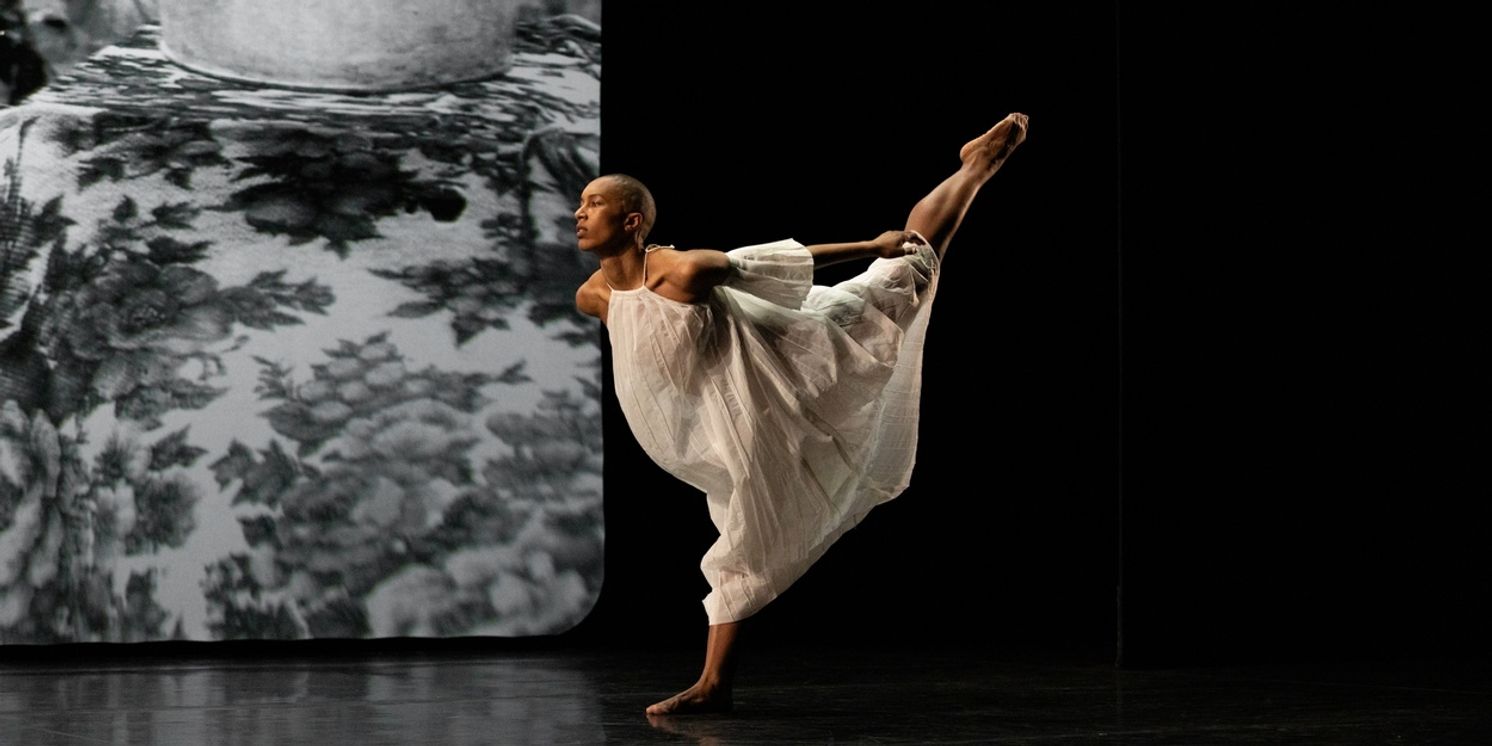
Brown and artist Robert Rauschenberg’s 1979 “Glacial Decoy,” the choreographer’s first work for the proscenium stage. A landmark blending of dance and visual art commissioned by the Walker Art Center in Minneapolis, the piece features Rauschenberg’s black-and-white photographic projections and translucent costumes, transforming everyday images into a poetic landscape. Danced to silence, the work is a mesmerizing fusion of continuous, abstract movement and visual rhythm that, upon its premiere, expanded the possibilities of contemporary dance.
“Son of Gone Fishin’,” a signature excerpt from Brown’s “Unstable Molecular Cycle,” a series rooted in memorized improvisation, which premiered in 1981 at the Brooklyn Academy of Music. From six dancers, precise yet ever-shifting patterns emerge and dissolve in a balance of structure and volatility, described by Brown as being like ripples spreading across water, set to music by Robert Ashley and illuminated by lighting inspired by Donald Judd’s sculptural designs.
And Brown’s late-career work “Rogues,” from 2011. Featuring two dancers in a playful yet deliberate exchange of mirroring and variation, “Rogues” showcases the late choreographer’s gift for structured spontaneity. The duet premiered at New York’s Fall for Dance Festival following an intensive studio process involving Brown, former company dancer Lee Serle, and Neal Beasley, and grew out of Serle’s mentorship with Brown through the Rolex Mentor and Protégé Initiative.
 By Zoom recently from her New York apartment, Lucas spoke of Trisha Brown, the company that bears her name, the upcoming Boston shows, and more.
Tell me about your first time seeing Trisha Brown?
It changed the trajectory of my life. Every cell in my body felt something. I was 19 years old and so blown away by the performance. It was just an amazing experience. I was overwhelmed by the beauty of the movement, being a young dancer – there was so much to take in.
How did you react to that experience?
I knew almost immediately that I wanted either to be a dancer who could do that or to make my own work. I was like, this is it, or I have to do my own thing. And, amazingly, there was a workshop audition just as I was leaving school, and I got into the company.
What was that like?
It was a nice way to enter – through a workshop, so it was two weeks of learning, and actually the first movement that I learned was in the workshop, which Vicky Shick was teaching, was a phrase from “Son of Gone Fishin’.”
Did you then begin learning material directly from Brown?
I began working with Trisha right after joining the company, and she was so kind, and also very active in making phrase material. So I came in and very quickly learned the works from the “Unstable Molecular Cycle” – “Opal Loop,” “Son of Gone Fishin’,” and “Set and Reset” – right away, because I took on those roles to replace someone who had departed the company.
Was that period daunting, exhilarating, or both for you?
I would say it was exhilarating.
Did you feel ready?
I was anxious, of course, but also ready. I think that was because it was such a very supportive environment. I was learning repertory roles, but Trisha was just finishing “Lateral Pass,” the first piece in “The Valiant Cycle.” So the movement vocabulary in that one was very different from something like “Son of Gone Fishin’” or “Set and Reset.” It was more athletic, and exploring different forces than the “Unstable Molecular Cycle.”
Did your time as a dancer overlap with Brown’s?
When I was learning repertory, Trisha was still dancing the repertory pieces, so I would go into rehearsal with the company and be like, “Okay, hi!” It was so amazing, but Trisha was very welcoming, although everything she did was really about the work. For Trisha, everything was about the work.
Were there times that the two of shared the stage in performance?
Yes, in the “Unstable Molecular Cycle,” Trisha just did the entrance, but I danced with her in “Set and Reset,” “Opal Loop,” and “Glacial Decoy” I think.
When you were a young dancer with the company, was Brown building new numbers on you?
I joined Trisha’s building process at the tail end of “Lateral Pass,” but really, started building new work with her for “New Work.” It was quite an experience, too, because Trisha was so present as a dancer. I can still feel that to this day, how present she was in everything we did. I miss that very much and sometimes I still speak about it. She would look you right in the eye and she was feisty but precise. She was just a delight to dance with.
What can Boston audiences expect from this return appearance of the company?
It's a repertory program including three pieces choreographed by Trisha for the stage.
Are these programs that you would have brought to Boston previously? Or are any of them being performed for the first time here?
You know, I didn't research that, so I'm sorry to have to say I don’t know. I do, however, remember performing in Boston when we were doing something from “The Valiant Cycle.” It's been quite a long time, though, since we've been in Boston. And we’re very happy to be coming back now.
Have the three pieces being done here been chosen for the appeal to longtime followers, new fans, or both?
We have audiences of all ages, which is what's great about these programs. You have the long-time loyalists and then you'll have all these young people who are studying dance and falling in love with Trisha’s work. I don’t know if I can say what they can expect. Trisha’s work is complex and there’s a lot going on, much of which is familiar to the company’s older followers, and so they’re always thrilled to see a piece again because they're like, “I saw more! You know, I saw more.” I hear that over and over again, and they’re thrilled because Trisha’s work means so much to them.
And with the younger generation, I’m not getting a sense that they feel the work is dated. In fact, when I’m coming out of the theater, young people will approach me and tell me they're so inspired by the work. I think what many of them mean is that they’ve been creatively inspired in their own work. It’s often that they’re a visual artist, or they might be a musician. It’s not only dancing. It’s about having their eyes opened to something.
Can you connect with that – that they're so inspired though they may not necessarily be dancers, that they find the dance inspiring to them as creative or visual artists?
Trisha was a graphic artist herself and had lasting, productive relationships with visual artists – like Robert Rauschenberg, Donald Judd, and Nancy Graves – as collaborators who were a huge part of her process of getting something to the stage, as were the costumes, the sets, and the music. She had really amazing relationships with musicians, too, especially when she went into the opera. So I think the Trisha Brown Dance Company offers something for people of all ages and interests.
Photo caption: Catherine Kirk in “Glacial Decoy” (above); photo by Joyce Baranova. Headshot of Carolyn Lucas (at left) courtesy of the Trisha Brown Dance Company.
Videos