
Review: THE MARRIAGE OF BETTE AND BOO at Hideaway Performing Arts Center
This production runs though April 26.
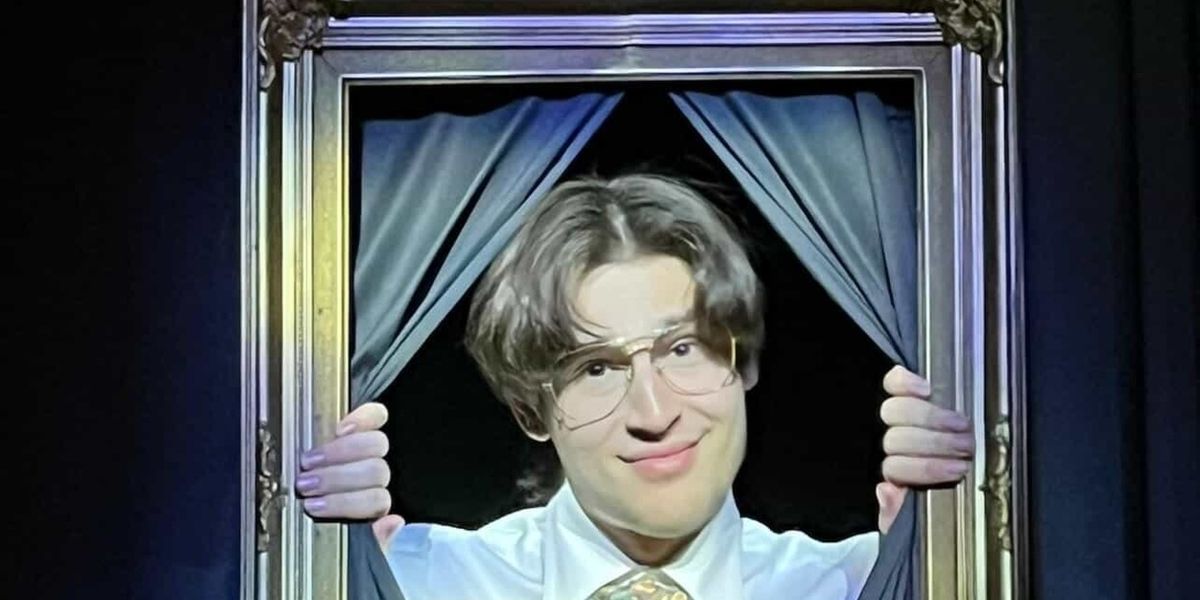
The Marriage of Bette and Boo is a play written by Christopher Durang, a playwright who rose to prominence in the 1980s and is best known for his absurdist comedies. His most famous work is Vanya and Sonia and Masha and Spike. I was invited to review this production by the actor playing the narrator. While I don’t love plays as much as I love musicals, I am making a conscious effort to expand my knowledge of plays. Despite Durang being a critically acclaimed playwright, I’ve realized that his work may simply not be for me.
This production was presented at the Hideaway Performing Arts Center in Eustis, Florida, located in a small shopping center inside a converted movie theater. The space itself had a great deal of charm. As a theatre director who works without a permanent performance space, I am always aware of the effort it takes to transform a nontraditional venue into a functional theater. Because of that, I truly appreciated what Hideaway has created and would happily return to see another production there based on the venue alone.
As for the play itself, I found myself unsure of how to feel by the end. The performances were strong, and the cast clearly understood the tone and style of the piece. The set was minimal but effective, serving the story without distraction. With only ten actors in the cast, each performer was able to fully embody their character, bringing every neurosis and eccentricity vividly to life.
That said, the characters were just a bit too neurotic for my personal taste. While this level of exaggeration is clearly intentional and very much in line with Durang’s writing, it made the play difficult for me to fully connect with emotionally. Still, the cast committed wholeheartedly, and none of my issues with the script had anything to do with the performances themselves.
Describing the premise of The Marriage of Bette and Boo is surprisingly difficult, beyond what the title already implies. The play follows a couple through the course of their marriage, along with everything that entails—children, extended family, and layers upon layers of dysfunction. Throughout the play, the characters often turn to their priest for guidance, but he proves to be just as flawed as everyone else and becomes especially memorable for his strange habit of performing an impression of bacon cooking.
Much of the humor in the play is dark and intentionally unsettling. Stillborn babies are treated cavalierly, even tossed around like footballs, and the roles of women are portrayed as being centered almost entirely on maintaining the home, producing children and being dumb, whiny and/or needy. While one could say the play is a product of its time, the tone feels strangely timeless, despite a specific year being mentioned (I believe 1951). The themes and exaggerations could easily exist in multiple eras.
There were also aspects of the script that didn’t make sense to me. For example, the title character, Bette, calls an elementary school friend she hasn’t spoken to in decades—late at night, no less. The use of a landline suggests a time period well before social media, making it difficult to believe she could so easily locate this person after such long estrangement.
None of the marriages portrayed in the play seemed stable, and the only seemingly normal character was the narrator, whose role appeared to be simply trying to function in a world filled with dysfunction. Again, these concerns stem from the script rather than the cast, who delivered committed and capable performances throughout.
If I were in the mood for dark humor and deeply dysfunctional characters with a storyline that doesn’t necessarily lead anywhere, I might opt for an episode of Seinfeld. However, for those who appreciate Christopher Durang’s work and his particular brand of absurdist comedy, The Marriage of Bette and Boo is certainly worth checking out. The show runs through April 26.
Weekly top stories - unsubscribe anytime.
|
REDRUM The Unauthorized Parody Musical of The Shining Dr. Phillips Center (10/22-11/01) |
|
The Best Halloween Ever Orlando Family Stage (10/10-11/01) |

|
Feltman: World's First Hot Dog Orlando Family Stage - Black Box Theater (10/23-10/23) |
|
A Texas Carol Daytona Playhouse (12/11-12/20) |
|
Jekyll and Hyde Little Theatre New Smyrna Beach (10/08-10/25) PHOTOS |
|
Gothic Attitude Gothic Attitude (4/16-1/16) |
|
Disney's Finding Nemo Athens Theatre (1/22-2/27) |
|
Hadestown King Center for Performing Arts (4/20-4/21) |
|
Ted Swindley’s Honky Tonk Angels Athens Theatre (2/26-3/21) |
|
Walter Cronkite is Dead Daytona Playhouse (6/10-6/13) |
Reader Reviews
To post a comment, you must register and login.