


Review: Make Farce Funny Again with POTUS at Theater West End
Theater West End have culled together a company of players who help elevate the material of POTUS into a comedy that now exists thanks to their approach to the characters.

Is it genuinely funny, or am I reacting to shock?
I found myself asking that upon the conclusion of POTUS: Or, Behind Every Great Dumbass Are Seven Women Trying To Keep Him Alive, a mouthful of a title for the farcical Broadway play that’s now playing at Theater West End. The play, penned by Selena Fillinger, ran on Broadway for four months, earned three Tony nominations, and proved that a musical-heavy industry like Broadway could still find time to laugh once in awhile in a production that’s not The Play That Goes Wrong or Noises Off. The characters are wildly over-the-top, but all the more lovable for it. The mid-show turn from “Designing Women Meets The West Wing” into “Veep Meets Weekend at Bernie’s” takes us all by surprise. And the sheer amount of physical comedy asked of the performers have the audience gladly rising for the standing ovation by the end.
But is it funny? Are lines in POTUS written for their cleverness in its turn of phrase, or simply quipped out to an audience for an easy laugh? The problem with comedy stems from the simple fact that something funny on paper isn’t always funny in practice. Likewise, something that draws a laugh during a performance shouldn’t always be an indicator of its success at comedy. Audiences laugh at everything. A funny line. A flubbed line. A dog wandering on stage when it should have stayed in the wings. A child’s unscripted reaction from the balcony. If POTUS can be believed, audiences will also laugh at an Iowa farm girl spitting cum onto the floor of the First Lady’s office.
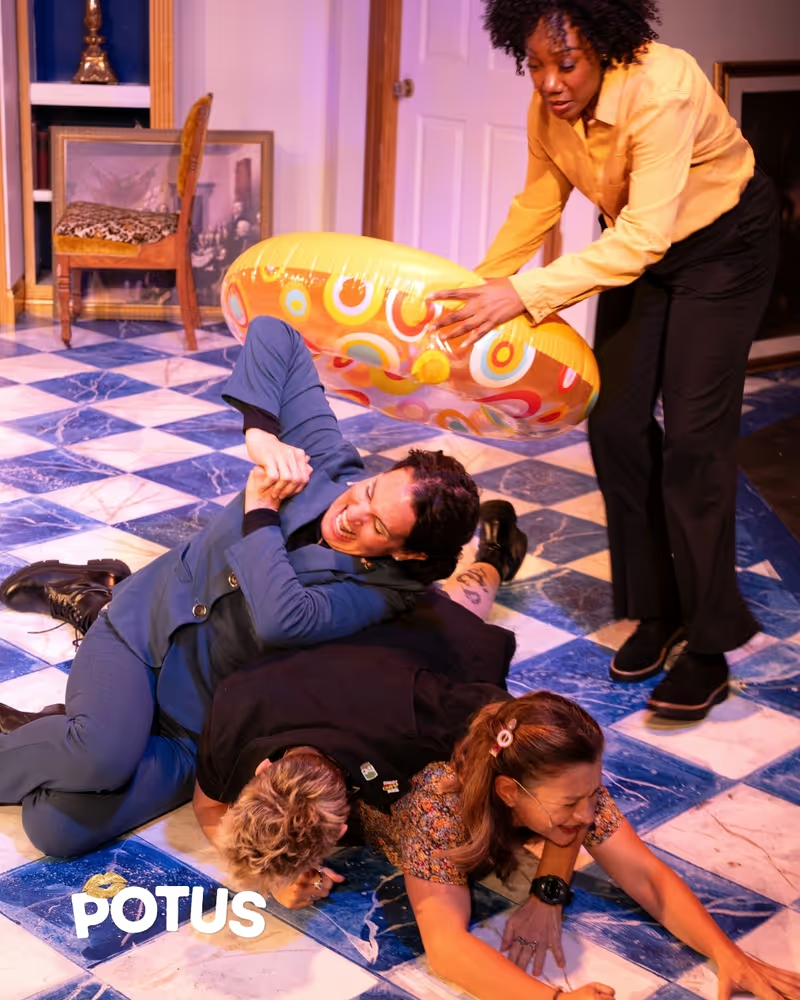
Look, I’m no prude by any means. I may blush at a George Carlin joke here and there, but I’m not going to raise picket signs and demand that we return to the wholesome humor of “The Brady Bunch.” Rather, I like my comedy to mean something more than a cheap laugh at bawdy situations in otherwise high-profile places. Politics can be funny, don’t get me wrong. I’ve enjoyed my fair share of “Veep” episodes and consider “The Secret Diary of Desmond Pfeiffer” to be a guilty pleasure. Even a largely-dramatic program like “The West Wing” could drop a clever line or two in the middle of an episode. POTUS is a comedy that isn’t funny. It’s a murder that isn’t a homicide. It’s figure of authority who’s entirely powerless. Calling this play a comedy stems less from its zingers and one-liners and more from the audience reacting with unexpected laughter to a two-act play that begins, quite frankly, with the word “c-nt.” And the word gets thrown around liberally throughout the rest of the play, so much so that any shock and impact from the first time is lost by the time we reach the c-nty conclusion less than two hours later.
As a result, POTUS sacrifices their chance to say something important in order to shuffle seven women in different couplings and see how they cook. Throw the neurotic secretary together with the ditzy farm girl. Give the uptight press secretary a secret past with the anarchist drug dealer. Make the First Lady and the Chief of Staff post-menopausal bitches. Have the divorced journalist argue with her professional rival and declare herself a lesbian just to distract him from the real story. It’s an embarrassment that you have these seven capable women bending over backwards to protect the POTUS, a Godot-like character who we never actually see, whose mere existence drives these characters into unbelievable situations, and who somehow still makes all of them feel inadequate by the end. POTUS as a play could have created a dynamic, hilarious, and relevant comedy with these characters if it weren’t so fixated on repeating, at least three times, the exchange of dialogue, “Why aren’t you President? / That is the eternal question,” without asking the audience to think more on it. The libretto expects the audience to nod in agreement, snap their fingers thrice, and say, “right on, sister” at quips that I’d expect from a “Saturday Night Live” skit.
What makes this more frustrating is that the material has glimpses of a message, hintings at a theme they’re all working towards, but never delivers. This could be a contemplation on how women have always been sidelined in history. Playwright Alan Bennett penned what could have been the entire thesis of this play back in 2004 when, in The History Boys, he wrote, “History's not such a frolic for women as it is for men. Why should it be? They never get around the conference table. In 1919, for instance, they just arranged the flowers, then gracefully retired. History is a commentary on the various and continuing incapabilities of men. What is history? History is women following behind with the bucket.” It’s such a powerful line in the play, one that’s biting with commentary and humor and tired resignation by Mrs. Lintott. And POTUS could have taken that idea – that it’s always women who clean up the messes of men – and run with it through its own farcical lens with the storyline we get in this play. Instead, we spend two acts of POTUS watching seven women yell at each other because their boss/husband/affair partner has somehow screwed them all over and they’re still trying to fix the problem as if it were their fault.
In that respect, POTUS also draws to mind the hit musical Six, in which the six ex-wives of Henry VIII throw a concert and each present a musical number explaining how they were wronged by their collective husband. All six wives are in competition with each other over who was wronged the most. Unlike POTUS, Six manages to find a sense of a resolution by the end, a chance for the characters themselves to reconcile with the shared trauma of being an ex-wife sidelined to footnotes in history books. In POTUS, these characters don’t reach any such conclusion. There is a slight, dramatic turn towards that conclusion when Harriet, the Chief of Staff, brandishes a gun. But it’s over before anyone can fully think about what she might do. And by the end, all the women simply sigh, then allow the man that made their life hell for two acts take the credit and the bows in their world.
I wanted to like POTUS, I really did. But I left that theater feeling like feminism had taken a great leap backwards all for the sake of, among a myriad of sins, a joke about prostate stimulation. If the audience is meant to cheer for these women when it comes to cleaning up the mess of their lord and master, it should at least be for a purpose other than, “The president may or may not be dead and had an anal kink that we don’t want the public to know about.” I can’t believe I’m even writing that line in a professional review, but here we are. POTUS as a play, I would probably never watch again. But as an experience? Well, that’s a horse of a different color. And this is where Theater West End succeeds at bringing in the crowds, justifying the laughter, and making even a grumpy critic like me still enjoy himself in the audience. POTUS is definitely not funny, but it’s oh so good at being not funny.
There’s a strange dichotomy that exists in live theater. I may not like the material, but will still find reason to love its execution. And at Theater West End, they’ve culled together a company of players who help elevate the material of POTUS into a comedy that now exists thanks to their approach to the characters. They form a symbiotic relationship with the audience throughout the two acts to make us still care for them, for their arcs, and for their resolutions – no matter how far-fetched it may seem. This is where the production of POTUS shines. Not through the material itself, but through how we experience the material. From the moment you step into Theater West End’s black box, you see just how easily they’ve recreated the White House interiors. The set design is gorgeous in a fairly atypical-for-Theater-West-End way. Over the years, I’ve loved how the venue will often design sets in creative, actor-focused fashions. Previous productions like A Chorus Line or American Psycho went for the abstract, with sets suited towards surreal and suggestive atmosphere. With POTUS, we have a set that clearly could have been pulled from the Warner Bros. Studio warehouse, easily fitting the same aesthetic and design as any “West Wing” space might have occupied. Chief among it is the Seal of the President of the United States, hand-painted prominently right on the theater floor itself. That was the work of scenic painter Bonnie Sprung, whose expertise at not just the seal, but the entire floor made the entire set feel lifted out of real life. Presidential portraits adorn the wings, and the multiple-door backdrop still felt organic to any White House room, real or imaginary.
Lighting design also felt very much “West Wing” inspired. For anyone familiar with the show, the first four seasons (those led by creator Aaron Sorkin) opted for soft, almost hazy lighting that embedded warmth and coziness into the episodes. This was achieved by putting a light netting material over the camera lens, so that when it captured the imagery with overexposed lights on the slightly-darker set, a fairly diffused look would help make the series feel candlelit and cozy. Theater West End, under the lighting design of Amy Hadley, manage to recreate that feel in a live theater. It must be the way the set’s paint scheme interacts with the filtered lights, as everything on that stage definitely had nice, homey feel to it. As if we were wrapping ourselves in a warm blanket while watching the farce unfold on the stage. The realism of the set, combined with the coziness of the lighting, and the clearly-energized performances on stage, helped make POTUS come alive in ways that justified the audience’s delight and laughter.
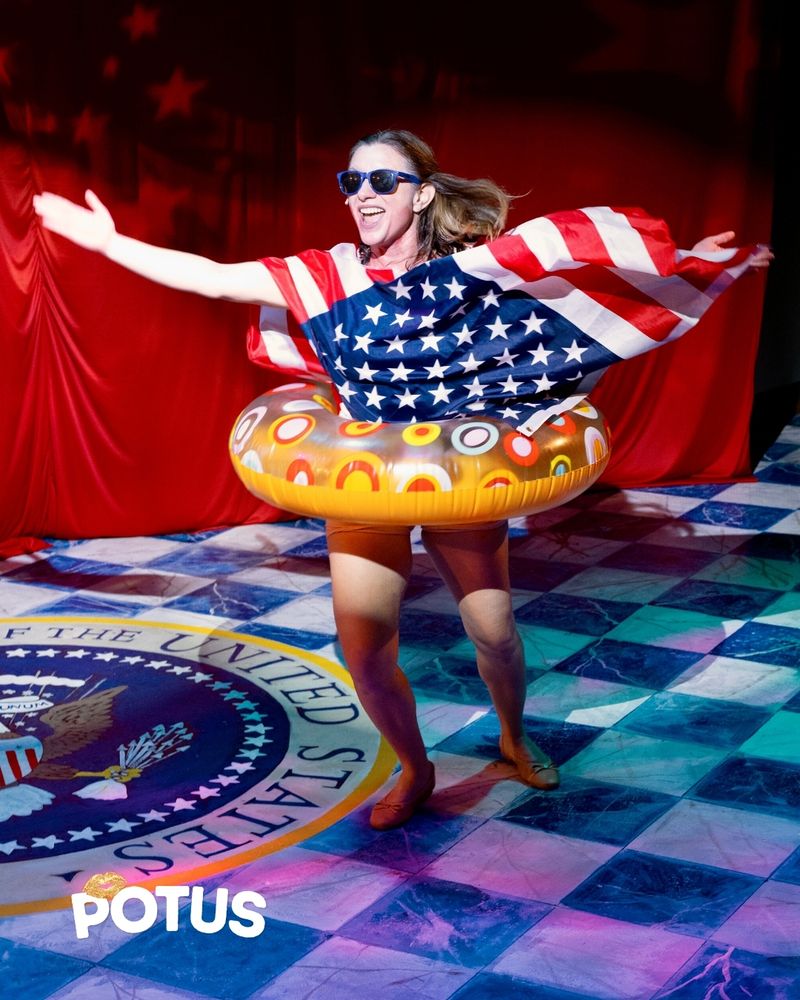
Director Tara Kromer and fight choreographer Alessandra Almanza both had the unenviable task of making the typical pratfalls and physical gags in a farce land on this stage. It’s a physically-challenging production when you factor in the precise timing needed for doors opening and closing on seemingly random whims, or when they drag a body across the stage without being caught, or when a secretary on an LSD trip strips to her skivvies and dances with the American flag as a poncho. And Kromer and Almanza help guide the seven performers to pitch-perfect delivery of lines and stage action that keep the energy constant, keep the flow natural, and keep the audience just as engaged.
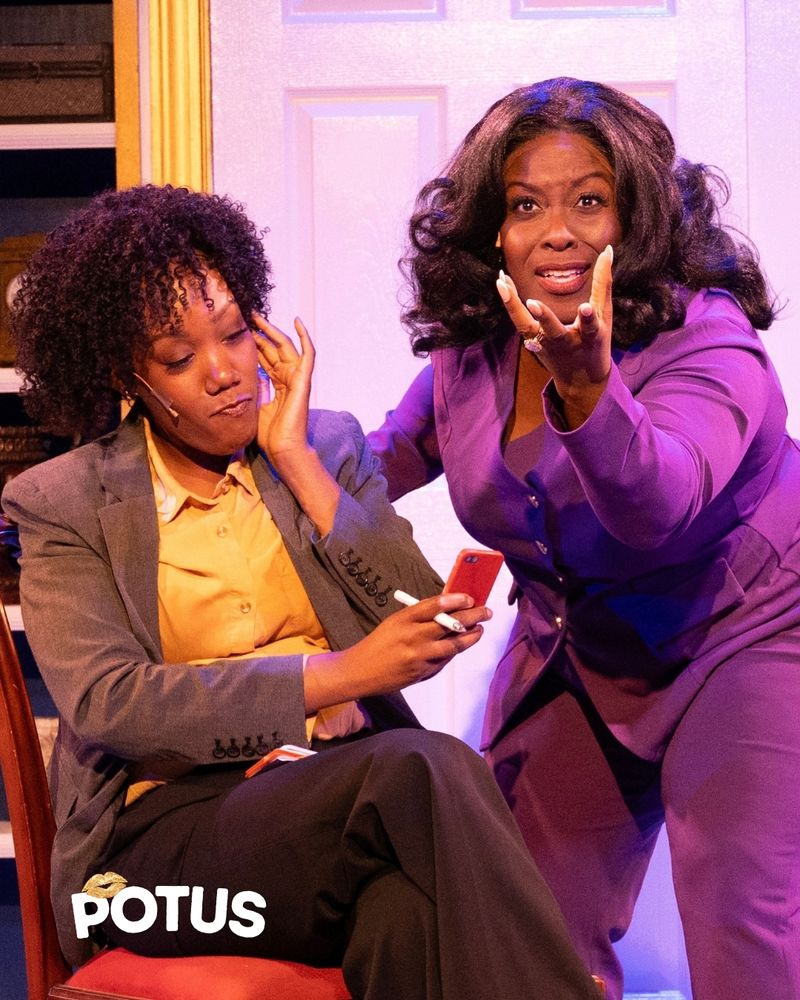
Each performer also gets moments within their character’s arc to shine. Chief among them is Kelly Wells, who plays Harriet, the Chief of Staff. Wells makes sure the audience is aware how Harriet, long-suffering handler of POTUS for years, simply wants the recognition that she deserves after years of service. And she ensures that the character never feels like an overlooked shrill, but rather as someone who has more than earned her chance to sit in the President’s Chair. By the end of the play, it’s Harriet who has the most extreme reckoning among the characters, and the one chance to justify POTUS as a play about something important. Wells, as a result, sells that singular dramatic moment within the farce, the one that lets the audience know: this woman has suffered, and still carries on.
Following Kelly Wells, we have familiar Theater West End performer Ame Livingston (previously of Angels in America) as the fairly uptight press secretary Jean. Where Harriet has to concoct the excuses to give to the press, it’s Jean who has to actually talk to them. As a result, Livingston has managed to perfect both Jean’s public face and private face. She can maintain the professionalism while explaining to the press why the President stormed out of a meeting with the representative from Bahrain, while also freaking out off-camera upon learning that the President’s sister, and her ex-girlfriend, has returned. Livingston helps make Jean feel relatable for anyone who’s ever worked in customer service, delivering the front-facing face and voice meant to soothe and appease the public, but easily slipping into her own, frazzled and aware private self behind closed doors.
It especially becomes useful when both Harriet and Jean have to deal with the President’s sister, Bernadette, as played by Rebekah Lane. Bernadette is chaos incarnate. An anarchist who is wanted in three countries, but has finagled a Presidential Pardon from her brother, even if she’s still wearing the court-mandated ankle monitor. Lane makes Bernadette a fun wild card of a character, the kind who always “has a guy” for something, without ever offering explanation why. Of the seven characters, Bernadette was my favorite, simply because she functions within POTUS as the one most aware of how ridiculous everything is around her, and she thrives in it as a result. She moves about the stage as if it were her own personal dance floor, with an awareness for the space that helps make the physicality of her role and others’ actions feel well-choreographed and natural.
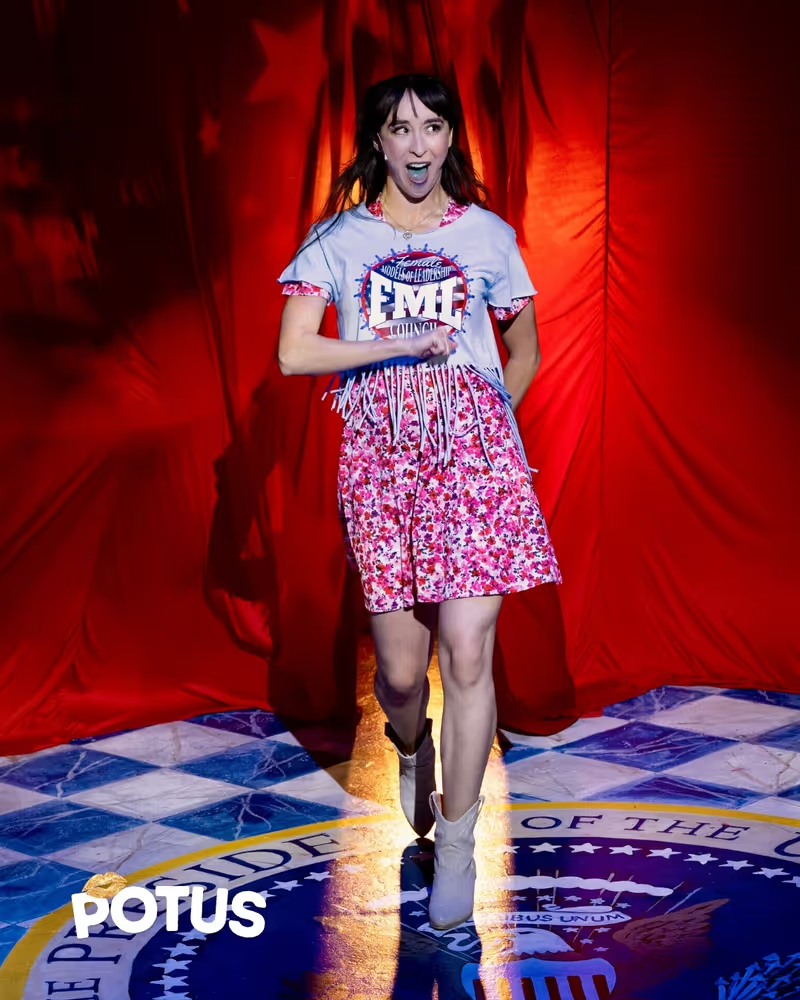
Nearly catching up to Lane’s energy on that stage is Anneliese Moon as Dusty, the ditzy Iowa farm girl that everyone clearly underestimates. Moon makes Dusty feel less like a caricature than the script would suggest, playing the role with earnestness and a vibrancy to allow the audience to warm up to her over time. While the character’s introduction has the audience laughing at her – she vomits blue raspberry slush into a trash can – by the end, they’re cheering her on at saving the Female Models of Leadership (FML) Council. I honestly was surprised at Dusty’s arc in this play, though perhaps that might have been the intent of the character. Someone seen as a light and fluffy character with an easily-fixable “problem” is given more depth than POTUS himself. And Moon makes sure that Dusty never comes across as the bumbling Middle American girl that folks would have simply assumed her to be.
Sarah Lockard’s character of Stephanie, a neurotic secretary afraid she’ll be replaced, was the character that earned Rachel Dratch a Tony nomination in the original Broadway run. After several scenes trying to assert her strength and dominance against authority, Stephanie then goes on a trip (taking six tablets assumed to be Tums, but likely LSD or some other hallucinogenic drug), and spends the duration of the play there-but-not-there. The physicality involved in it, to Lockard’s benefit, makes Stephanie an audience favorite for the sheer will in playing up The Trip at every possible moment. And I love how Lockard keeps Stephanie in a perennial “what can I do to mess things up next?” state. Even if I didn’t care for the content of the play itself, part of me wants to revisit the production over the next two weekends to see how Lockard might vary her performance, especially given how crowd-pleasing Lockard was at mining comedy from a role that otherwise felt underwritten.
Likewise, Lauren Muller’s role as Chris, the journalist, carries with it a sense of a character who has just enough details to be interesting, but relies more on the performance than the subtext to make her memorable. Chris serves a vital role within the world of POTUS as the outsider to the goings-on of the White House, but one that has a responsibility to the American public to report on it. Muller is able to turn this character, a divorced mother who balances professional responsibility with personal ambition, into something more than just a broadly comedic funny woman. Her lines of dialogue, to the play’s credit, do feel the most real in terms of how a journalist would work the room – getting on-the-record comments even when she’s functioning off-the-record. And Muller makes sure that the audience remembers that she’s the least complicit to the borderline-illegal actions happening in this White House. It allows the audience to also see in Chris a sense of recognition. Chris serves as the ideals of America for the people, by the people, with Muller tuning into that approach perfectly.
Finally, we have the woman behind the man herself. First Lady Margaret, as played by Jade L. Jones, is the most memorable of the seven performers. Of the seven women, Margaret has suffered the most under POTUS. Overqualified, underappreciated, invisible to a room of reporters except when they want to know what she’s wearing. She truly is the Great Woman behind a “Great” Man. Jones, thus, creates a strong persona in the character. One who shows herself capable, committed, and confident at whatever is being thrown at her. At one point, Margaret frustratingly even takes a hallucinogenic pill just as Stephanie did, but even under its effects, she manages to concoct and enact a plan to move a body, give a speech, and serve lewks all at once. Of the seven, it’s Jones who makes sure the audience is always kept up to speed. She has a commanding presence that ensures everyone pays attention throughout the play, even when it veers in some of the more outlandish paths in the second act.
In all honesty, POTUS shines in all the technical and performance categories. Theater West End has turned out a truly hilarious production that left much of the audience in happy tears from laughing across two hours. After a season that’s been fairly heavy in drama (Angels in America) and existential crisis (Company), it felt great to sit back and laugh at the absurdity of POTUS from beginning to end. While I took great delight in criticizing the weakness of its script, that’s not something within Theater West End’s control. It’s a fault of the material, but definitely not those who must bring that to life. It takes a lot of talent from the cast and crew to make this material work for an audience; for that, they should and are commended. They have made a production worth attending, one which I still enjoyed because of their execution of the material rather than enjoyment of the material itself. POTUS as a play may fail in narrative ways for me, but its cast and crew at Theater West End did not fail in making me laugh. And sometimes, getting a chance to laugh at fictional renditions of the civil servants for our country is the best medicine. Goodness knows, if this POTUS can take a joke, hopefully a real-life one can, too.
POTUS plays at Theater West End May 1 through 17. Tickets can be acquired online or at the box office, pending availability. Photography by Randy Roberts, used with permission.
Sign up for all the news on the Summer season, discounts & more...

|
Havana Hop Orlando Family Stage (9/19-9/19) |

|
THE RAT PACK LOUNGE Winter Park Playhouse (9/24-10/18) |

|
Ted Swindley’s Honky Tonk Angels Athens Theatre (2/26-3/21) |

|
The Mouse & The Mustache Riverside Theatre (1/28-2/21) |

|
Golden Girls The Laughs Continue Dr. Phillips Center (11/01-11/01) VIDEOS |

|
Blanco Temblor (White Tremor) Open Scene at the Maitland Art Center (10/18-10/18) |

|
Disney's Finding Nemo Athens Theatre (1/22-2/27) |

|
Madame Butterfly Dr. Phillips Center for the Performing Arts (10/02-10/04) |
|
Deer Tick Revolution Live (11/11-11/11) |
|
DELORIS SCRUD MOVIN' ON UP: My Meteoric Rise to Fame & Fortune Starlite Room @ SAVOY (9/25-9/27) |

Reader Reviews
To post a comment, you must register and login.