


Review: DON PASQUALE at Opera Theatre of St. Louis
Plays at Opera Theatre of St. Louis through June 27
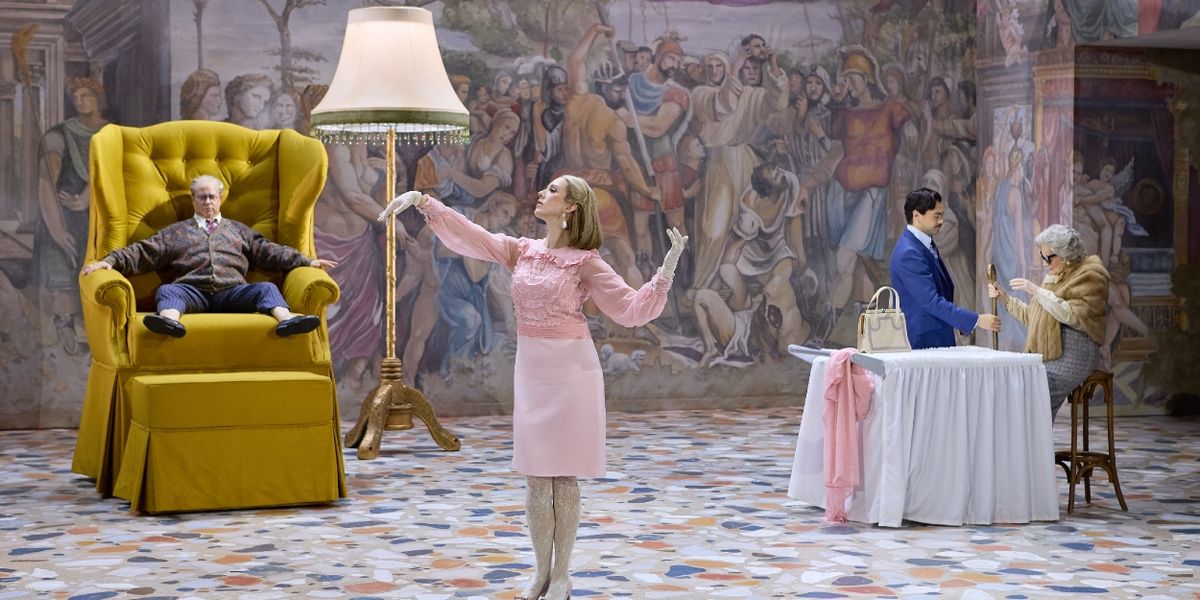
Don Pasquale at Opera Theatre of St. Louis is delight stem to stern! Susanne Burgess sings Norina, the quintessential bel canto soprano role. She’s astonishing! She defines that vocal style.
This latest offering in the company’s fiftieth season is a kind of matching book-end as Don Pasquale was the company’s very first production back in 1976. It’s been a glorious half-century!
Don Pasquale, which premiered in 1843, is a classic opera buffa. It is the acme of comic operas in the bel canto style. Gaetano Donizetti was a master of this genre, and Don Pasquale along with Donizetti’s L’elisir d’amore and Rossini’s Barbiere di Seviglia comprise the marvelous three that survive and thrive in today’s operatic canon.
The plot of Don Pasquale is ancient, tracing back thru Commedia dell’arte to the Greeks. Two young lovers yearn to be married, but a grumpy old guardian disapproves. A very clever trickster (friend or servant) helps them to foil the obstructing guardian. Happy ending!
Here we find young Ernesto in love with Norina, a beautiful young widow. But Ernesto is totally dependent on his uncle, Don Pasquale, whose estate he expects to inherit. But Pasquale insists that Ernesto marry a woman with some money. Neither of these stubborn men will give in, so Pasquale decides to disinherit Ernesto and find a young bride for himself, thus enabling him to beget a lot of little heirs. Dr. Malatesta is Pasquale’s physician, but he is also good friends with Ernesto. It is he, Malatesta, who devises the clever scheme to thwart Pasquale and bring the young lovers together. It involves a mock marriage between Pasquale and “Sofronia” (who is really Norina). After the “wedding” she instantly turns from a modest convent-school girl into the shrew of all shrews.
Looking back fifty years we can see many differences between these two OTSL productions. That maiden voyage Pasquale was very traditional, while last night’s version brimmed with imagination; it went happily surrealistic. Yet charmingly (amazingly) the two productions share two talents:
- Christopher Alden was Stage Director for both productions. Talk about not being stuck in the past!
- Sheri Greenawald, who sang Norina in 1976, returns to sing The Notary. It’s a small role, but she is a pervading presence in this production. And, in the end, she shares an aria with Ms. Burgess.
As the (so-to-speak) curtain rises we find ourselves in an Italian coffee-house/bar in perhaps the early 1960’s. The walls are filled with a vast mural crowded with classical figures. As the overture proceeds we watch the owner (Ms. Greenawald) and a Waiter (Patrick Wilhelm) prepare for the day. Soon all the tables are filled with what I can only call “DOIDs” (“doddering old Italian duffers”)—drinking, smoking, playing cards, dozing. They’re all wearing slightly grotesque rubber masks which mark them unmistakably as DOIDs. Throughout the evening they serve as a chorus—in both the Greek and the operatic senses, and I had a growing awareness that these DOIDs were, in fact zannis from commedia dell’arte. The zannis were a class of underlings or servants, usually funny, sometimes clever—but whose identity was unimportant.
Under Maestro Kensho Watanabe the orchestra sensitively supports the singers and the comedy in this challenging bel canto piece. Such subtle dynamics, such perfect timing!
The voices here are all splendid. Patrick Carfizzi brings great clarity and lucidity to the role of Don Pasquale. He’s wonderfully pompous and his amorous dreams are suitably ludicrous.
As Dr. Malatesta Kyle Miller’s bold baritone guides the plot as he deftly handles both Pasquale and the love-sotted Ernesto. He gives an energetic—even athletic performance, bounding gracefully about the stage.
Charles Sy brings a very sweet tenor voice to the role Ernesto. His serenade to Norina leads us into a world of romantic magic. Their duet is sublime.
Baritone Patrick Wilhelm deserves special praise for his delightful portrayal of the Waiter/Servant/factotum who bounces through the scenes setting tables, managing the long train of Norina’s gown, and (like a faithful dog fetching the morning paper) bringing a message in his teeth. (I told you this got surrealistic.)
But in the world of bel canto comedy it is usually the soprano who gets to dazzle us. Here “dazzle” is too mild a word. As Norina, Susanne Burgess is perfection incarnate. Such sweet power, such a gem of world-class gift and highly-honed skill! A tall, slender beauty, she presents all those immensely challenging vocal decorations and flourishes and warbles and stratospheric notes with such ease and gracious humor. It is clear that when Norina sings “I like having fun” Ms. Burgess sings not only for the character but for herself as well.
Stage Director Christopher Alden and set-and-costume designer Marsha Ginsberg give us a rather realistic first act. Alden takes great care in handling his chorus, giving individual business and motivation to each old duffer. Later in the play we abandon reality. At one point the entire cast unfurls a great banner with the motto “VIVA LA RESISTENZA”. (I can only imagine this to be a last minute political comment.) In one scene Don Pasquale sits Edith-Ann-like in a huge chair. (A childish personality in a seat of authority?) A heavily veiled “Sofronia” is rolled in on a dessert cart. (Like a dancing girl inside a birthday cake?) “Sofronia” races through Pasquale’s wealth by purchasing every recognizable luxury brand one could imagine—from Armani to Dolce & Gabanna to Farrari. The ritzy friends she invites to a lavish party cover a world of chic nationalities and styles and genders. She replaces all his furniture with bland sectionals in a variety of pastels. Pasquale and Malatesta move them around to make a sort of kid sofa-cushion-fort; they hide in it. For serenading his sweetie Ernesto wears an Elvisy shiny blue sports-coat. Their love duet involves bringing on a projection screen and showing a black-and-white silent movie of them strolling through a wooded glen. There is silhouette play which shows Pasquale much smaller than Norina.
Much of this nonsense is silly, some seems just random. But it’s fun. And in the end we have the lovers together. Poor Pasquale is discomfited but content as he lets go of power—and libido—and relaxes into the role of DOID.
Donizetti’s Don Pasquale continues at the St. Louis Opera Theatre through June 27. It shimmers with great music and bright, refreshing comedy.
(Photo by Eric Woolsey)
Reader Reviews
To post a comment, you must register and login.