Interview: Celebrating 45 Years of MARK MORRIS DANCE GROUP with Mark Morris
Catch the company at their Joyce Theatre residency from July 15-26!
“The most successful and influential choreographer alive, and indisputably the most musical” (New York Times).
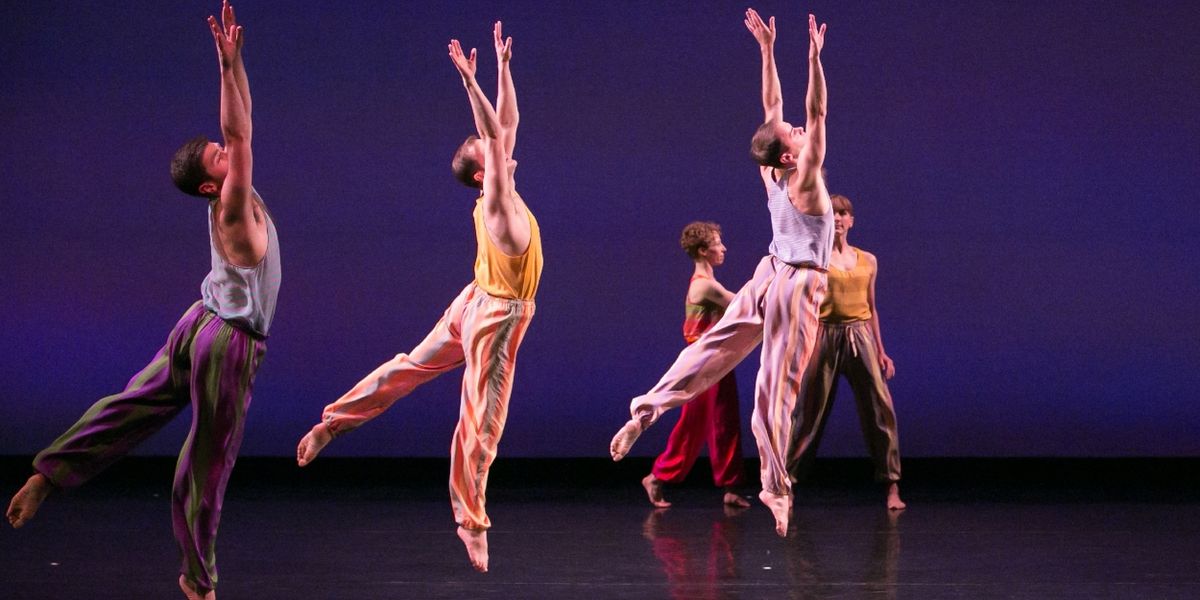
This is just one of many similar accolades Mark Morris has received throughout his illustrious 45+ year career. Known for innovative choreography and specific musicality, the Mark Morris Dance Group will be performing a 2-week residency at the historic Joyce Theater (Program A from July 15-19; Program B from July 22-26) to commemorate its diverse repertory. But perhaps even more exciting, the company will debut 2 world premieres: You’ve Got To Be Modernistic and Northwest. I recently sat down with Mark to discuss this exciting milestone and the joy of this residency.
Q: You’re celebrating your 45th Anniversary Season. First of all, how does it feel?
MM: I’ve been doing the same thing for 45 years or more. So, I’m delighted that it’s still happening, I’m still doing what I do until I can’t. But you know, there are very few dance companies at all, and there’s zero funding from a lot of places that used to give to the arts and don’t—every museum, theatre, restaurant—everything. And so, we’re doing well, but we’re just starting to get more work after these last 5 years.
The Joyce Theater—it’s a very specific theatre. And it’s a small theatre, which I like—I go to a lot of shows there. But, we work on a big scale a lot of the time, so I very much appreciate [this setting]. It’s work that I love; I love smaller, shorter pieces. So, that’s why we’re doing eight different pieces over two weeks. I see it as one program that everybody should come to one week, and then come back because it’s entirely different musically and historically. It’s wonderful: it’s not nostalgic, but there’s a certain element of retrospect involved...so, it’s great to still be [doing it].
Q: You’re presenting two distinct programs at The Joyce during this residency. What decisions went into designing each program and how do you characterize them?
MM: My new dances are for small musical scores—there’s piano in one, and harp and percussion in the other, so it fits there. Bob Wills, his Texas Playboys, that piece, Going Away Party, is to recordings of old men at the end of their career recorded in the 70’s. I love that—that was the way I wanted it to sound.
So that, and frankly, completely pragmatically, [we had to decide] what dance has a crossover, what dances can we do back-to-back and not have to have a big intermission, and what dancers are in each piece. It was exciting…it was all put together specifically for this theater. It’s a lot going on: everybody dances quite a bit, and stylistically, it’s difficult to switch gears so many times for the dancers. It was really a puzzle and we did it, I think.
Q: In Program A, you're showing the World Premiere of You’ve Got To Be Modernistic. Talk to me about the early threads of inspiration that led to its creation.
MM: It always starts with the music. This particular music [began] with Ethan Iverson, who was my music director for a number of years before my current one, who is Colin Fowler. I’ve always wanted to do something to rags without the cliche of the 70's of the Scott Joplin movement. James P. Johnson [the composer of this piece] was Scott Joplin’s teacher. He was a brilliant pianist and composer, and he played with a lot of different bands. His solo stuff is recorded, but he’s a great improviser, so no two recordings are the same. He didn’t officially notate a lot of the music, [but] Ethan is a jazz player and he’s a genius pianist. Many years ago, we talked about doing the piece and he, pragmatically and very intelligently, has spent a long time just transcribing it.
I’m the first person to hear the music. He proposed the suite, we went through what pieces might be great, he used his arrangements, and we’ve been adapting them for my dance as I work on it. It’s really difficult technically, and it’s a transition from Ragtime into what is now generally known as jazz. So, it’s playable now by other people, thanks to Ethan writing it down and knowing the way to notate it. We’ve adapted some things [regarding] tempo, because we’re doing it live — so that is great, and that is why that piece is on there. It always comes from music.
Q: You’re also showing a second world premiere in Program B—Northwest. What led to the creation of this piece?
MM: Same thing—it’s music I love. The composer is a good friend of mine, John Luther Adams. He writes really big, and this [piece] is [from] earlier on, so this is basically an homage to indigenous music—the relationship between all of the West Coast indigenous people from Alaska to California. I grew up in Seattle and I was surrounded by a big variety within the cultures. John Luther lived in Alaska for 30 or 40 years, and because of his relationship with the tribal people, he adapted some of their tunes, rhythms, and songs from the Athabascan and Yup’ik Indian tribes.
These particular songs, he scored them for harp and drum, and most of the music would be sung. These [songs] are based on games—so, there’s a juggling one and a jump rope one that are wonderful little dances that are playful—and it has 10 people in it. I’m thrilled, because he’s a very good friend of mine. Chamber music is rarely heard, and he was all for the idea.
Q: As a trained ballet dancer, I grew up admiring Silhouettes for the interplay between classical technique within the framework of modern dance. Is there a particular piece that your relationship to has changed over the years?
MM: Well, I just watched a rehearsal of a dance that I used to do, and I did it with my company and with the White Oak Dance Project. They put it together without me, [and] I haven’t seen it in years! First off all, I didn’t remember it—[it’s set] to this fabulous Schumann music, and my dancers do it great. The piece itself is frankly better than I thought it was.
Q: If you could talk to the version of yourself who was starting the company back then, what advice would you share?
MM: I had advice early on from another choreographer who said ‘You’re not going to start a company, are you?’ And I ended up starting a company and it’s still here—and we’re still good friends, that fellow [and I]. I’m just doing what I’ve always done, and I’m delighted that it’s been this long. But, I still work in the same way I did, because I think it works.
As a classicist and a musician in my head, I’m doing exactly what I want and it works, and so I draw very good dancers who, because of the nature of the work, have very long careers. I want everybody to be at the same quality: my dancers, my excellent band, my musicians are great, and I want all of it to be of equal, very high value. That’s my main interest, and I’ve maintained that for a long time.
You can buy tickets to the Mark Morris Dance Group residency at The Joyce Theater here.
Photo Credit: Beowulf Sheehan