


Feature: AT THE EDGE OF NOWHERE at Hyde Park Theatre
AT THE EDGE OF NOWHERE playwright Sabrina Wallace talks with BroadwayWorld about Sadie, agency, motherhood, and bringing her timely new play from page to stage.
What happens when a seventeen-year-old girl discovers she is pregnant and suddenly realizes that nearly everyone around her has an opinion about what should happen next?
That question sits at the center of AT THE EDGE OF NOWHERE, the debut one-act play by Austin-based Argentine-American playwright and producer Sabrina Wallace. Set in a small rural Texas town in the weeks following the 2022 Dobbs v. Jackson Women’s Health Organization decision, which overturned Roe v. Wade, the play follows Sadie, a teenager carrying a secret with the potential to reshape her future. Family expectations, religious beliefs, town gossip, politics, and fear surround her, creating a growing chorus of voices while Sadie struggles to hear perhaps the most important one: her own.
For Wallace, Sadie’s story began not with a political speech, but with a conversation between a mother and daughter. Wallace’s daughter, Emma, was twenty when the Dobbs decision was handed down, and their conversation began with a frightening hypothetical: what goes through the mind of a young woman who discovers she is pregnant? From there came more questions. Does she want to become a mother? Does she want to remain pregnant? What choices are available to her? How much time does she have to make them? And when family, faith, law, community, and personal hopes all enter the conversation, how does she determine which choice is truly her own?
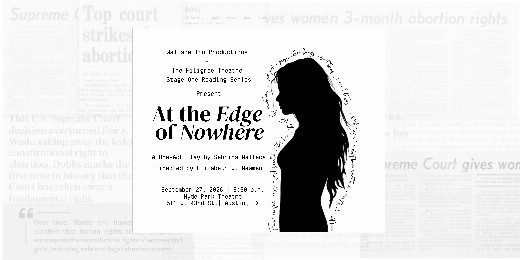
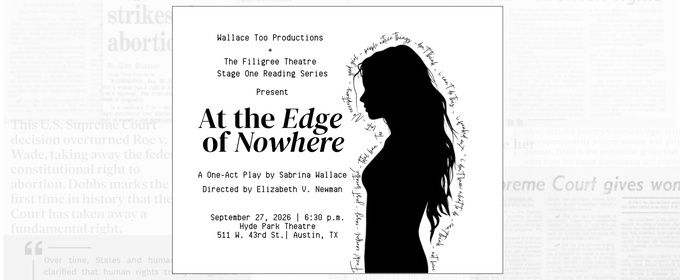
Wallace Too Productions and The Filigree Theatre will bring those questions into the room with audiences through a staged reading of AT THE EDGE OF NOWHERE, directed by Elizabeth V. Newman. The presentation is part of The Filigree Theatre’s Stage One Reading Series, a workshop program designed to help established and emerging playwrights and screenwriters develop new work while bringing writers, directors, actors, and audiences into the creative process.
A staged reading seems particularly appropriate for a play built around questions rather than easy answers. Without the distance created by elaborate scenery or production elements, the words and characters take center stage, allowing audiences to encounter Sadie and the competing voices around her while Wallace and her collaborators hear how the play lives outside the written page. The audience, in turn, gets the unusual opportunity to meet a new work while it is still becoming.
Newman brings considerable experience in developing and directing work for both stage and screen. As Producing Artistic Director of The Filigree Theatre, she has helped establish the Austin-based company as a home for classic plays, contemporary work, and world premieres. Its name comes from the idea of filigree—something intricately made by hand—and the company describes its mission through the word’s roots of “thread” and “seed”: originating work in Austin while building creative connections with artists and audiences elsewhere.
That idea of planting something and allowing it to grow is also at the heart of Stage One. Presented in partnership with EVN Productions, the reading series provides a workshop environment where playwrights can hear their work performed, discover what is already resonating, and continue shaping what comes next. For AT THE EDGE OF NOWHERE, that process marks an important beginning: this is Wallace’s first stage play and the first in a developing series of works centered on women’s experiences.
Wallace describes her approach as intimate and character-driven, with interests extending beyond reproductive rights to family, marriage, divorce, immigration, and the seemingly ordinary moments capable of changing the direction of a life. AT THE EDGE OF NOWHERE begins that exploration with one young woman in one small Texas town, facing a deeply personal decision while a much larger world seems determined to speak.
Perhaps that is where the title becomes most evocative. Sadie may live at the edge of nowhere, but the questions surrounding her are anything but remote. In this Stage One reading, audiences have an opportunity not only to encounter her story, but to witness the beginning of a new play and the playwright’s theatrical voice.
BroadwayWorld Austin spoke with Wallace about the conversation that began the play, finding Sadie’s voice, writing within a politically charged landscape, and what she hopes to discover when AT THE EDGE OF NOWHERE moves from the page into the room.
BWW: You’ve said that AT THE EDGE OF NOWHERE began with a conversation with your daughter after the Dobbs decision. What stayed with you from that conversation, and when did you realize those questions wanted to become a play?
Wallace: What stayed with me was how personal the conversation became so quickly. We didn’t talk about politics in the abstract. We talked about girls and women, about bodies, futures, fear, and what happens when a decision that should be personal is shaped by laws, institutions, and other people’s beliefs.
My daughter said something that really stayed with me: people who support these laws often think this will happen to someone else. She said, “This could happen to anyone.”
That was the beginning of Sadie. Not because Sadie is an exception, but because she is not. She is a regular seventeen-year-old girl with school, friends, a boyfriend, parents, plans, and a future she thought she understood. Then one pregnancy test changes everything. What happens to her then? Who can she tell? Where can she go? What is still available to her? Those questions stayed with me, and eventually they became impossible not to write.
BWW: Sadie is only seventeen, yet she suddenly finds herself surrounded by adults, institutions, beliefs, and laws that all seem to have something to say about her future. How did you approach writing her voice so that she remains at the center of her own story?
Wallace: Sadie was born out of conversations with my daughters, so her personality and voice were shaped by them too. As a mother, I have always cared about my girls’ thoughts and voices, so giving Sadie that same space felt essential.
I did not want Sadie to become a symbol or a political argument. She had to be a teenager first. She is smart, scared, funny, overwhelmed, and trying to understand something that is too big for her to process all at once.
Whenever her voice started sounding too much like mine, I would stop and ask myself, “Would Emma say this? Would Julia say it this way?” If the answer was no, I changed it. Sadie had to sound like Sadie, not like me making a point through her.
BWW: The play is set in a small rural Texas town, where family, faith, politics, and community can be deeply intertwined. Why was that particular setting important to the story you wanted to tell?
Wallace: A small town in the Bible Belt felt like the right setting for a pressure-cooker story. In a place where everyone knows everyone’s business, privacy can disappear very quickly. Gossip travels fast, faith and politics are often woven into daily life, and there are fewer places to hide.
That mattered because Sadie is carrying a secret that no one else knows yet. The town is not talking about her pregnancy specifically, but everything around her begins to feel connected to it: what people believe, what they judge, what they say about other girls, what they think is right. The outside world starts getting inside her head.
The setting also makes her options feel smaller. She is not in a place where help is easy to find. She has to work very hard to see a way out.
BWW: This is a story connected to one of the most politically charged issues in the country, but you’ve described your work as intimate and character-driven. How did you keep the play focused on human beings rather than allowing the characters to become representatives of particular arguments or positions?
Wallace: There are enough stories that focus on the politics. I wanted to focus on the human story.
These are seventeen-year-old kids facing a life-changing decision. Politics affects them, of course, but the story is about them: Sadie, her boyfriend, her parents, her friend, the people around her, and the way fear and belief can shape even the most private moments.
I was tempted many times to make an ideological statement, but every time I did, the play became less interesting to me. It became more honest when I stopped trying to win an argument and just stayed with Sadie.
I wanted to show the consequences of the overturning of Roe v. Wade without pushing my judgment on other people’s personal beliefs. That is not always easy when we each have very strong feelings about this. But if we could respect each other’s beliefs without forcing our own onto others, we would not be here.
BWW: One of the tensions in the play seems to be the difference between having people who care about you and having people who believe they know what is best for you. How does that tension shape Sadie’s relationships with the people around her?
Wallace: That tension is at the heart of the play. Sadie is not surrounded by monsters. She is surrounded by people, many of whom love her, but love does not always provide a safe haven.
Sadie knows her father loves her, but his beliefs are so firm that she can’t imagine telling him. Her mother may be the only person capable of hearing her, but Sadie is terrified of disappointing her. Her boyfriend cares about her, but his future is already moving in a different direction, and he is also scared. Even her friend lives in the same town, with the same gossip, the same assumptions, and the same fears.
For Sadie, the pressure does not come from one person. It comes from the accumulation of doors closing around her. Some people close them out of fear. Some out of judgment. Some because they believe they are doing the right thing. But the result is the same: Sadie feels more and more alone with a decision she is not ready to face.
BWW: In writing for this theater production, what have you discovered about writing dialogue, silence, pacing, or simply putting characters together in a room that surprised you?
Wallace: I’m a very visual person, so I wrote the play as I saw it in my head. I saw the kitchen. I saw the clinic. I saw Sadie sitting there, not knowing what to say. Then I started hearing the characters.
The dialogue came more easily than I expected. The characters became very real to me. They have been living with me for a year now. They show up when I’m walking the dogs, when I’m driving, sometimes even in my dreams. Crazy, I know, but true.
The harder part has been pacing. I love silence. I love the moments when someone wants to say something and can’t. But I also know I may have too many beats. That is one of the things I’m looking forward to learning from the reading: where the silences help, where they slow things down, and where the actors find something I did not even know was there.
BWW: You’re developing the play through The Filigree Theatre’s Stage One Reading Series with director Elizabeth V. Newman. What are you hoping to learn by hearing actors speak these words in front of an audience, and is there anything you’re particularly listening for during the reading?
Wallace: I feel incredibly lucky to be on this journey with The Filigree Theatre and Elizabeth V. Newman. Elizabeth read the first draft of the script and understood it to the last word. That was an incredible confidence boost! I have a lot of respect for her work as a director and a creative. She understands that this is a political world, but an intimate story, and that balance matters a lot to me and to her as well.
The reading will be an eye-opener for me. This is new territory, and I know that hearing actors speak the words I wrote will change everything.
I am ready to listen for Sadie’s story and how the audience receives her journey. Does the audience understand how overwhelmed she becomes? Does the ensemble feel like the town first and then like the noise inside her head? Do the family relationships feel real? I also want to learn where the play gives the audience enough space to think and where I may be pushing too hard.
The Stage One Reading Series gives the play a real chance to live in front of people, and that is a gift. This is my first play, so having that kind of artistic support from Filigree and Elizabeth means a great deal.
BWW: You’ve said that AT THE EDGE OF NOWHERE is the beginning of a larger series of plays exploring women’s experiences. What questions about women’s lives and choices do you find yourself wanting to explore next?
Wallace: I seem to keep coming back to women at moments when ordinary life becomes complicated: pregnancy, marriage, divorce, motherhood, family secrets, immigration, aging, change. These are everyday experiences, but they can completely alter the way a woman sees herself and the world around her.
At the Edge of Nowhere is my first play, and it made me realize how much I want to keep writing about women’s lives. Not just the big public moments, but the private ones: the things women carry, the things they do not say, the choices they are expected to make quietly.
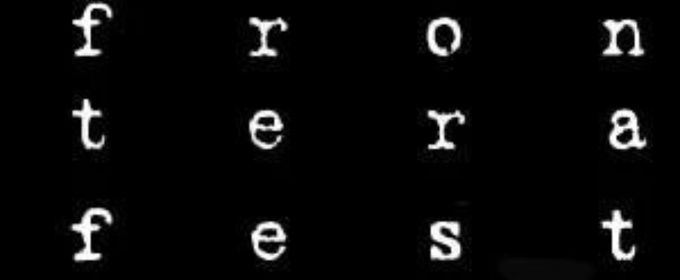
I have a few other stories I’m working on, including one about mothers and daughters, one connected to immigration, and a short piece for FronteraFest that is a political satire. That one is teaching me that being funny is hard.
BWW: The title AT THE EDGE OF NOWHERE carries several possible meanings. What does “the edge of nowhere” mean to you, and has its meaning changed as you’ve written Sadie’s story?
Wallace: At first, the title was connected to Sadie’s literal world. She lives in a town called Nowhere, and by the end of the play she is standing at the edge of everything she knows, with nowhere left to turn.
But as I kept writing, the title became bigger to me. It started to feel like America is at the edge of nowhere too. Where are we going from here? Are we moving toward banning IVF? Defining life at conception? Tracking girls’ menstrual cycles or pregnant women? Restricting travel to access medical care? Encouraging people to report on each other for money? Denying medical care to single pregnant women or trans people? Deciding which people are allowed to exist safely and freely in this country?
That is the crazy part to me. Sadie’s story is fictional, but the fear around her is not. Every time I think, “No, we would never go that far,” another headline makes me wonder if we already have.
So yes, Sadie is literally at the edge of Nowhere. But the title also asks a bigger question: where are we going from here as a collective species?
BWW: Is there anything else you'd like BroadwayWorld readers to know about AT THE EDGE OF NOWHERE that I've not thought to ask about?
Wallace: I would want them to know that the play is not really about abortion. It is about agency.
As a playwright, and as a woman, I did not want to make Sadie’s decision for her. That felt important. Sadie deserves time and space to think, to be afraid, to be confused, and to make a decision that is hers.
I also want to acknowledge how personal this process has been. The play began in conversation with my daughter, and now my daughter Emma is part of bringing Sadie to life in the reading. That collaboration means more to me than I can probably explain. It has made the work feel even more intimate, because the original question that sparked the play is now being carried back into the room through her performance.
I hope the attendees of the reading leave thinking less about what they would tell Sadie to do, and more about whether they would give her enough room to hear herself.
I thank Sabrina Wallace for the opportunity to get to know her and this new play a little better. AT THE EDGE OF NOWHERE is still taking its first steps from page to stage, and there is something exciting about being invited into that process while the work is still growing, listening, and finding its theatrical voice. I hope Central Texas audiences will take the same opportunity to meet Sadie, to hear her story, and perhaps most importantly, to make room for the questions the play asks us to carry with us after the reading is over.
AT THE EDGE OF NOWHERE
Theater Company: Wallace Too Productions and The Filigree Theatre
Venue: Hyde Park Theatre, 511 West 43rd Street, Austin, TX, 78751
Sunday, September 27, 2026 | 6:30 p.m.
Tickets: free, but RSVP encouraged
Ticket Link: https://tickets.atxtheatre.org/events/at-the-edge-of-nowhere-9-27-2026
Sign up for all the news on the Fall season, discounts & more...
|
All My Sons Patti Strickel Harrision Theatre (9/29-10/04) |
|
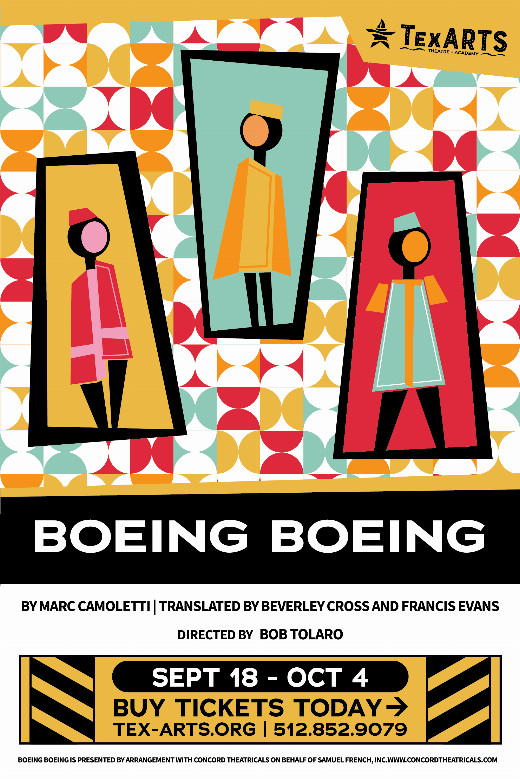
Boeing Boeing TexARTS: Theatre & Academy (9/18-10/04) |
|
The Miraculous Journey of Edward Tulane Oscar G. Brockett Theatre (10/08-10/18) |
|
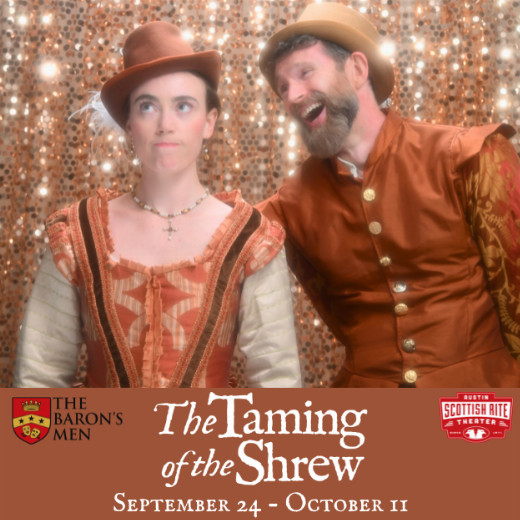
The Taming of the Shrew Scottish Rite Theater (9/24-10/11) |

|
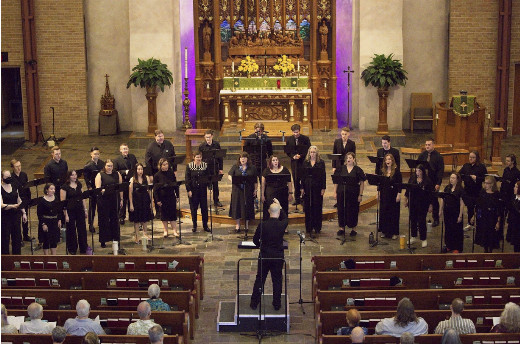
The Unknown Tour Julie Rogers Theatre (11/07-11/07) |
|
Journeys First English Lutheran Church (10/24-10/25) |

|
TUBU Fest: Theatre for Us by Us, A Disability Short Fringe Theatre Festival Ground Floor Theatre (9/24-9/26) |

|
TCU Horned Frogs vs. West Virginia Mountaineers Amon Carter Stadium (10/24-10/24) |

|
The Second-To-Last Chance Ladies League Georgetown Palace Theatre-Doug Smith Performance Center (10/16-11/15) |

|
Best Little house in Texas BASTROP OPERA HOUSE (5/28-6/13) |
