Student Blog: Fangs, Feelings, and Fight Calls- Not Your Typical Vampire Musical
Finding humanity inside the mechanics of a vampire’s touch

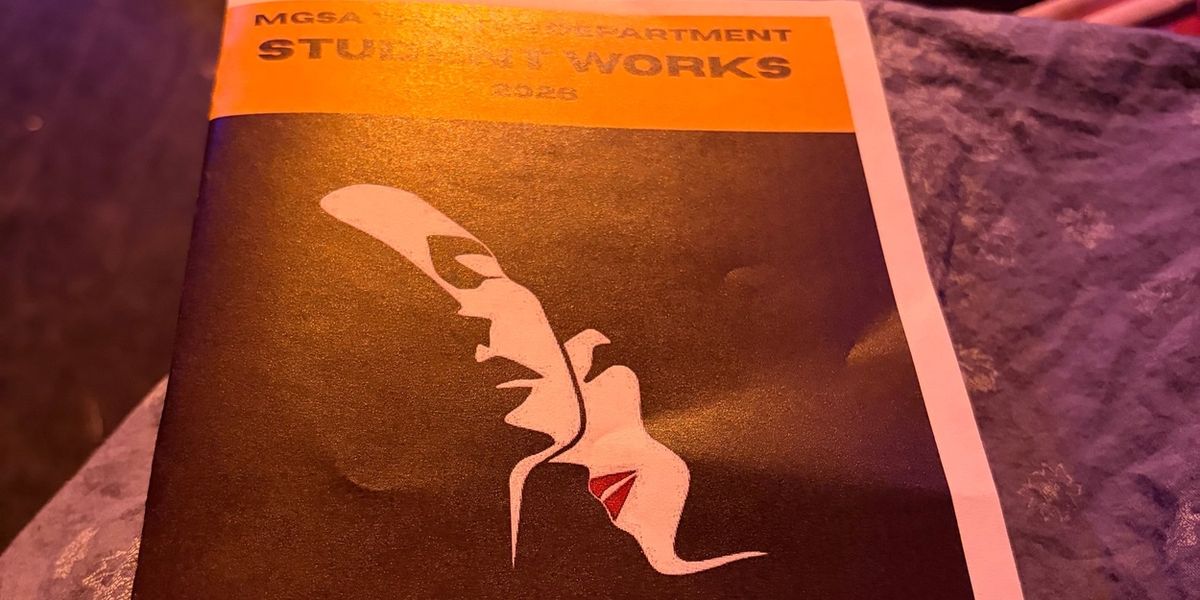
Fangs, Feelings, and Fight Calls- Not Your Typical Vampire Musical
When people hear “vampire musical,” their reactions usually come with some sort of disappointment, or comments like “Not everything needs to be a musical.” It’s typically capes, camp, and maybe a few ironic blood packets tossed in for laughs. That’s exactly the assumption I was battling as the fight choreographer on this production of Carmilla, The Musical.
I had the opportunity to work on this musical through Mason Gross’s Student works program. For us, this is about resurrecting something that’s been buried—not just a vampire, but a legacy of queer storytelling that predates the genre’s most famous works.
It’s impossible to work on this piece without thinking about the long shadow cast by Dracula. J. Sheridan Le Fanu wrote Carmilla decades before Bram Stoker introduced his now-iconic count, and yet history largely handed the spotlight to the latter. You can see the lineage clearly: the Central European setting, the use of journals and firsthand accounts, even the early blueprint for the vampire hunter figure. In many ways, Carmilla established the language that Dracula would later popularize. Carmilla walked so Dracula could stalk.
But where Stoker’s work leans into Victorian anxieties about outsiders and control, Carmilla centers something far more intimate and subversive– Carmilla isn’t as in control as Dracula is due to her relationship with Laura. The horror becomes quieter, and honestly, more unsettling because of it.
Working on an adaptation of Carmilla means inheriting a very specific kind of tension. This isn’t the bombastic world people associate with Dracula. There are no grand, sweeping confrontations where good and evil clash in obvious ways. Instead, everything lives in the body—in glances, in proximity, in the slow collapse of trust between two people who are drawn to each other.
That creates a unique challenge for fight choreography. Because the “violence” in Carmilla isn’t always legible as violence. The physical language has to sit right on that knife’s edge—too aggressive, and you lose the emotional truth; too subtle, and the stakes disappear entirely.
There’s also the musical element, which complicates everything—in a good way. Violence in a musical can’t just interrupt the flow; it has to be the flow. Every grab, every fall, every moment of contact has to live inside the rhythm of the score. If I’m off by even a beat, the illusion breaks. And when you’re staging something as delicate as a vampiric encounter that doubles as a love scene, timing isn’t just technical—it’s emotional.
What’s interesting is that vampire stories have a history of struggling on stage. You look at shows like Dance of the Vampires, which leaned heavily into spectacle and still couldn’t sustain an audience. That history hangs over us whether we like it or not.
What Carmilla does differently than other vampire musicals—and what makes my job both harder and more exciting—is that it treats the relationships as human versus other-worldly. That means the physical stakes have to feel real too. When someone is overpowered, it can’t look theatrical—it has to look inevitable.
And then there’s the added layer of queerness, which isn’t subtext here—it’s text. In the original 19th-century context, that desire had to be coded, hidden between the lines. Now, it’s front and center. That changes the choreography entirely. It’s both conflict and connection.
There’s a line the director shared early in the process—about the show being, above all, an earnest love story between two souls who find each other across time. That idea reframed everything for me. It means the choreography can’t treat Carmilla as just a predator or Laura as just a victim. Their physical relationship has to evolve, to blur, to complicate itself.
So yes, there’s blood. There’s struggle. But the real challenge is making sure the audience isn’t just watching a fight—they’re questioning whether it’s a fight at all.
That’s the tightrope.
Sign up for all the news on the Fall season, discounts & more...