


If you’re not up on your Greek Mythology, and don’t know the tale of Medea, written by Greek playwright Euripides in 431 BC, she figures heavily in the quest of Jason and The Argonauts. Thankfully the program for Wichita Community Theatre’s production brings you up to speed quickly. Jason sails his ship, the Argo, to find the Golden Fleece, when he meets Medea, a sorceress and daughter of the king who has all the fleece. The goddess Hera makes Medea fall in love with Jason so Medea will help him. Medea completes near impossible tasks, they get the fleece, but before her journey with Jason is done, Medea commits some pretty heinous crimes to keep Jason safe and happy. If it weren’t for Medea, Jason’s quest for the Golden Fleece would not have been so successful. Medea and Jason get married, have two sons, and live happily ever after in Corinth. That is, until Jason is titillated by a royal princess half his age, and Medea gets thrown over for a trophy wife.
Director Misty Maynard taught Medea for 50 years, and also helped students direct this play. When she finally had a chance to direct it, she pondered what she might do with it. Misty found a modern adaptation and translation by Robin Robertson and it occurred to her that the themes of domestic violence, a controlling patriarchy, cheating on your partner, and getting thrown over for a trophy wife were universal themes that have persisted throughout history to this day. So it made sense that a modern adaptation called for modern clothes, themes, dialogue, and modern attitudes. Maynard has also given a direct nod to the greek chorus, giving them some classic greek choreography, notably the strophe and antistrophe movements as the chorus renders prayers to Zeus and Helios. The Greek Chorus, you remember, are members of the community that give advice, make observations on behavior, and comment on the proceedings.
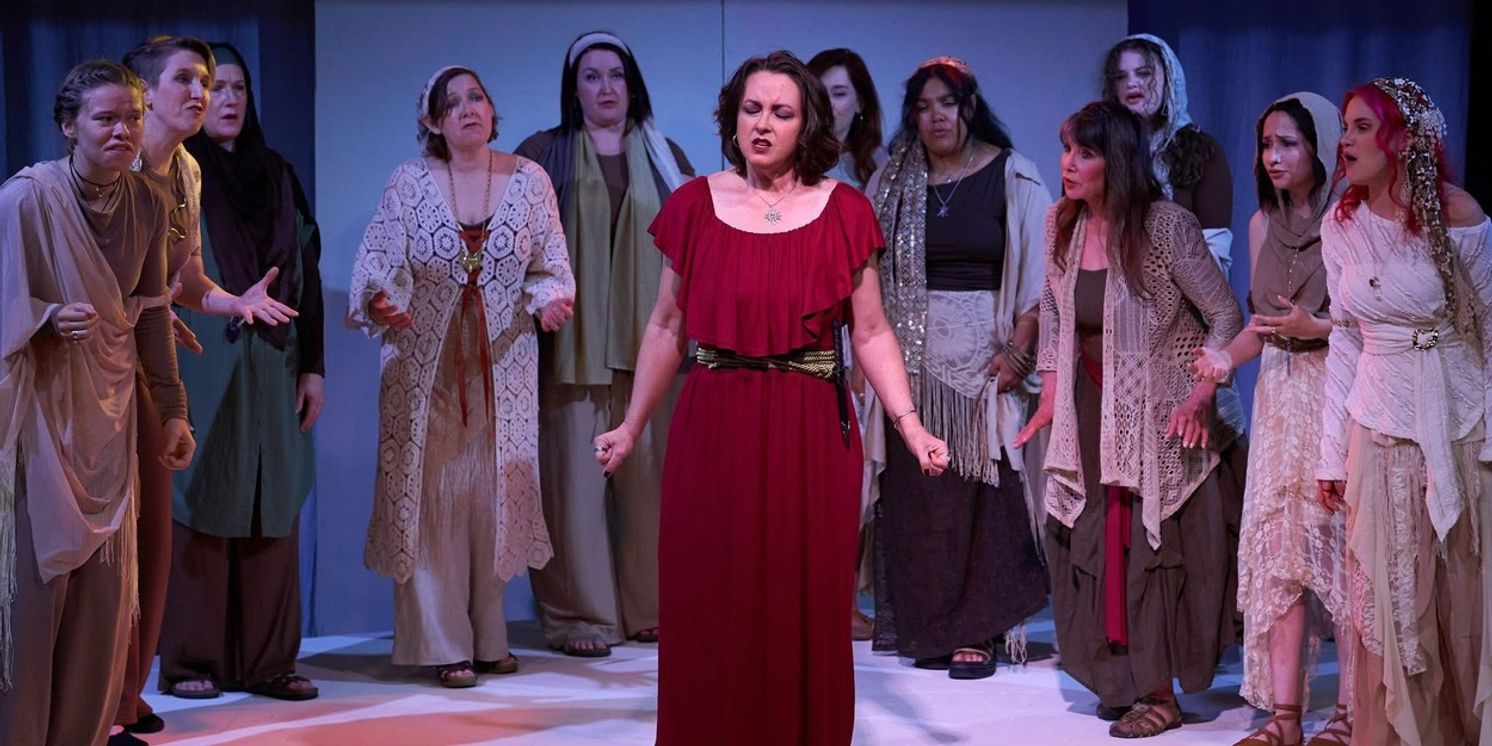
If ancient unapproachable poetry and language has kept you away from the classics, WCT’s Medea is a good way to immerse yourself in Greek intrigue without worrying that you won’t understand it because of the language! Medea runs 90 minutes with no intermission, which is ideal for modern attention spans. The play is well supported by some tasty technical support. The suspenseful preshow music by Ben Eldridge keeps us on the edge of our seat. The set, designed by Director Maynard, consisted of a round raked and elevated white platform in the center of the proscenium, with white garden benches on either side of the stage. The background was 2 white flats with diaphanous scrim on either side. The rest of the stage was surrounded by black flats, so there was great contrast, allowing the lighting designer Joseph Heil full reign with color. There was ever changing set colors to fit the ever changing moods. Costume Designer Christy Railsback does a beautiful job here, particularly with the loose, flowing clothing of the female Greek Chorus, which had a strong Jessica McClintock/Gunne Sax feel with lots of tan and off-white lace and beading, which gave a very feminine but strong 70’s women’s lib hippie chick vibe.
Linda McDonald Nurse opening monologue was leisurely and mournful, setting the scene for the tragedy. Caleb Jamal Manuel introduced Medea’s children as their Tutor, brings the bad news that Creon will banish the children and Medea from Corinth. The young boys were well focused and played by I.A. and his sister, A.B. Eldridge. The Greek Chorus was very strong, let by WCT Veterans Crystal Meek, Charlene Grinsell, Chelsea Daniel, and Jerusha Lofland. Rounding out the chorus were lots of new to me female faces I hope to see more of. Their ensemble work was wonderful, as everyone was listening carefully and reacting with each other.
Jami Thomas, WCT Veteran, played Medea in a gorgeous witchy red dress, again with a 70s vibe. She exploded onto the stage, and the pace picks up considerably after a languid start. Medea’s first speech is loaded with 70s women’s lib rhetoric, lamenting her fate. She explained how strangled women are by the patriarchy, that “men are masters to us,” informing us that she no kin to turn to since she has estranged her family because of Jason, and also that he has taken a trophy wife.
Medea is interrupted by Creon and his beefy goons. Creon, played well by Chris Welborn, exiles Medea, as he is afraid of she’ll harm his family. Medea begs Creon to let her stay; “How will I provide for my children?” Creon gives her an extra day (a decision he will soon regret), and bathed in red light, Medea plots her bloody revenge.
Anthony Larkin Valdez then enters as Jason, a tall good looking hunk with long hair, in another nod to the 70s. Medea confronts Jason and an intense argument ensues. Medea tries to reason with him, but to no avail. Jason says he’ll give her money and letters of introductions, but this is madness to Medea, as she cannot understand why he disrespects both his marriage and his children.
Aegeus, King of Athens enters, played by Joe Parrish. This is the best thing I’ve seen Joe do all year. Bathed in royal purple light, Medea tells him her story, Aegeus invites Medea to Athens. She promises to cure him of his childlessness. Aegeus cannot give Medea safe passage, so she must find her own way. This was one of my favorite scenes, very tender and beautiful, full of deep feeling. Aegeus’ costume was beautiful, white, gold and purple robes.
Aegeus leaves and Medea hatches her plan of revenge. She will kill her children so no one can ever take them from her, and poison the princess and Creon. She tells us “Passion is all the root of our sin and suffering.” The chorus is privy to this plan and being to pray to Zeus in classic prayers to the gods, using the idea of strophe and antistrophe.
The Messenger, portrayed by Kiera Abrienne, a local playwright, actor, and director, delivers a powerful, very detailed description of the Princess and Creon’s death. Behind the Messenger we see the Princess and Creon deliver an interpretive death dance behind the diaphanous scrim. It’s difficult to see any detail, which makes the presentation very abstract. Kiera’s monologue is punctuated by her facial display of emotions and thoughts of the horrible thing she has just seen.
As the chorus offers a prayer to Helios, we hear screams and stage again is bathed in red light.
Jason’s final monologue is an ode to his ignorance and selfishness. The flats behind him open to reveal Medea and her two dead children bound in white cloth and laid like saddlebags across the backs of two white and gold merry-go-round horses, again bathed in red light. This Deus ex Machina, the Chariot of Zeus, is ready to provide her escape. Medea has a new blood red dress, and is ready to be transported to Athens.
There is one more performance left of Medea, which is Sunday, May 3 at 2pm. For tickets and more information, check out their website at www.WichitaCT.org
What’s up next for WCT? Lost Girl, which runs June 4 - 14, 2026!
Reader Reviews
Videos