



My guest this week is author Deborah Phillips whose new book is titled: AND THIS IS MY FRIEND SANDY — SANDY WILSON’S THE BOY FRIEND, LONDON THEATRE AND GAY CULTURE. Sandy Wilson's The Boyfriend — for which he wrote the book, music, & lyrics — is one of the most successful British musicals of all time.

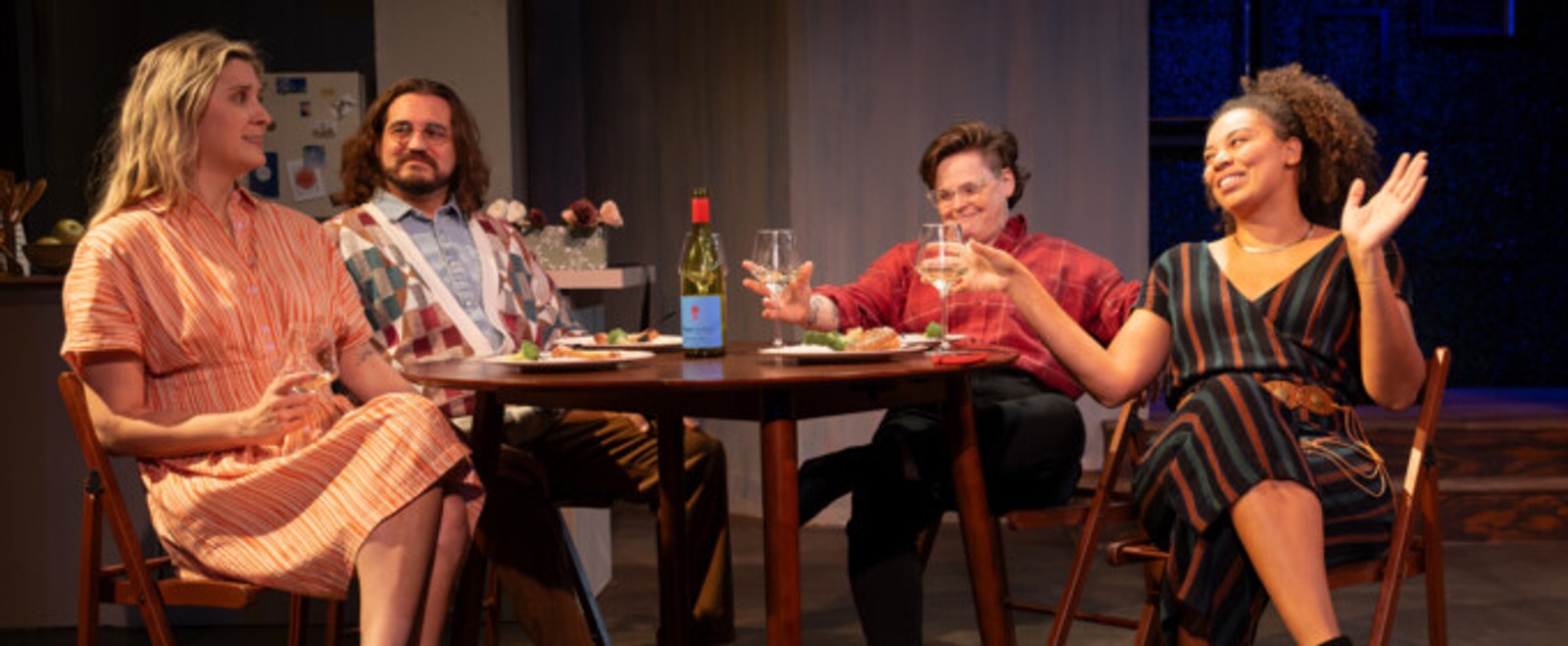
It’s true. BISEXUAL SADNESS is funnier than it sounds. Written by already prolific 29-year-old playwright India Kotis, whose pedigree includes father Greg Kotis of URINETOWN fame, the play addresses, well—bisexual sadness. It’s exactly what the play is about. Our bisexual, cisgender protagonist Faye is marrying cisgender, straight Alex. Faye is working through all this with her BFF and ex, Genevieve. Genevieve has moved on romantically to be in a polyamorous relationship with Lillian. Faye’s sister Miranda is working through a classic midlife divorce, while her daughter Naomi is working through an adolescent crisis of gender identity. This is the regional premiere and only the second production of Kotis’s play, presented for us by the consistently polished Jarrott Productions.
The characters in this story represent just about every letter in the LGBTQIA+ family. In one scene, they’re all in the same room. BISEXUAL SADNESS is a complex study, really, of how our identities intersect and the friction that arises when those identities encounter one another within our closest relationships. As a bisexual playwright who is also an anthropologist, Kotis addresses her own experience of being erased in the queer community by putting her protagonist in a relationship with a man.
As Faye, Kelsey Mazak carries the weight of this show. She’s at the center of this intersecting cast of characters, and Mazak successfully conveys Faye’s authentic experience of loss and confusion. Faye’s feelings land on those around her in a quiet emotional spillover. It mostly affects her fiancé, a gentle and affable Alex (Christopher Gonzalez). CB Feller plays a present and attentive Genevieve. Even in her quietest moments, Feller is a remarkably attuned listener. Faye can come across as self-absorbed, and Alex and Genevieve do reach breaking points. They are trying to love someone who is actively agonizing over a choice she herself made. I sometimes found myself feeling frustrated in the same way about this otherwise perfect life the character happens to have. However, Kotis has given an explicit note in the script: Every character must show profound love and acceptance toward one another. Even when the characters disagree, argue, or express confusion over Faye’s shifts, the baseline of the performance must be rooted in deep affection.


This ethos is also evident in the interplay of the supporting characters, Miranda (Catherine Woodiwiss), Naomi (Violet Bolton), and Lillian (Jacqui Calloway). Woodiwiss portrays Miranda with an emotional timbre quite like her sister Faye’s, and Calloway’s Lillian is a breath of fresh air in the middle of the show. I was especially impressed by Violet Bolton as Naomi, not just by her skill, but in her ability to convey an emotional intelligence many people twice the character’s age don’t have.
Director Will Gibson Douglas seems to have taken Kotis’s notes deeply to heart. Never do we experience anything short of the affection this playwright has asked of the direction and cast. I do wish to note, though, that it can be a liability when one is accustomed to friction that helps move a play along to a satisfying conclusion. The antagonist here is the interior work of Faye. There is both resolution and revelation in BISEXUAL SADNESS, though neither arrives through a conventional dramatic arc. The play raises meaningful questions about identity and belonging, but Faye takes a circuitous route toward a realization that some in the audience may reach well before she does.
Sitting in that liminal space with Faye is, I suspect, the reason playwright India Kotis has given such specific notes for those who produce this show. These characters must live with contradictions that aren't easily reconciled, and the audience is asked to do the same. It’s pretty lifelike in that way. But this isn’t necessarily a traditional way to tell a story. BISEXUAL SADNESS asks its audience to hold the tension between several opposing thoughts at once, and that may be its contribution to our ability to understand the whole point.
Bisexual Sadness
by India Kotis
directed by Will Gibson Douglas
Jarrott Productions
November 05 - November 22, 2026
Trinity Street Players
Black Box Theatre, 4th floor, First Baptist Church
901 Trinity Street
Austin, TX, 78701
Photos by Steve Rogers Photography
See more BroadwayWorld in Google
Make us a preferred source and our stories show up more often in Top Stories and Google’s AI answers.
Breaking Broadway alerts by text
Get the biggest stories sent straight to your phone.
More on Jarrott Productions
Recent Articles
Broadway news in your inbox
Weekly top stories - unsubscribe anytime.
Weekly top stories - unsubscribe anytime.

|
Leslie Odom Jr. Long Center (11/29-11/29) |

|
Pulse Oscar G. Brockett (11/13-11/20) |

|
Winter Wonderettes TexARTS: Theatre & Academy (12/04-12/20) |

|
ALL MY SONS by Arthur Miller The Filigree Theatre (10/30-11/14) |

|
9 to 5 BASTROP OPERA HOUSE (9/10-10/03) |

|
The Curious Savage Genesis Creative Collective (11/06-11/22) |

|
An Enemy of the People by Henrik Ibsen November 5 –15, 2026 Mary Moody Northen Theater (11/05-11/15) |

|
Murders & Moontowers Ground Floor Theatre (11/19-11/21) |
|
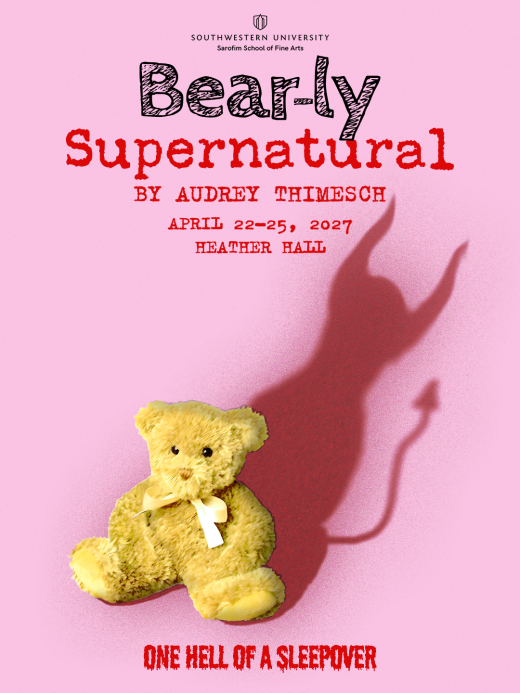
Bear-ly Supernatural by Audrey Thimesch Southwestern University Theatre Department (4/22-4/25) |

|
Annie BASTROP OPERA HOUSE (12/04-12/20) |
Reader Reviews
To post a comment, you must register and login.