


Review: BBC PROMS: AMERICAN CLASSICS, Royal Albert Hall
Legendary conductor Marin Alsop returns to the Proms at the helm of the Philharmonia Orchestra
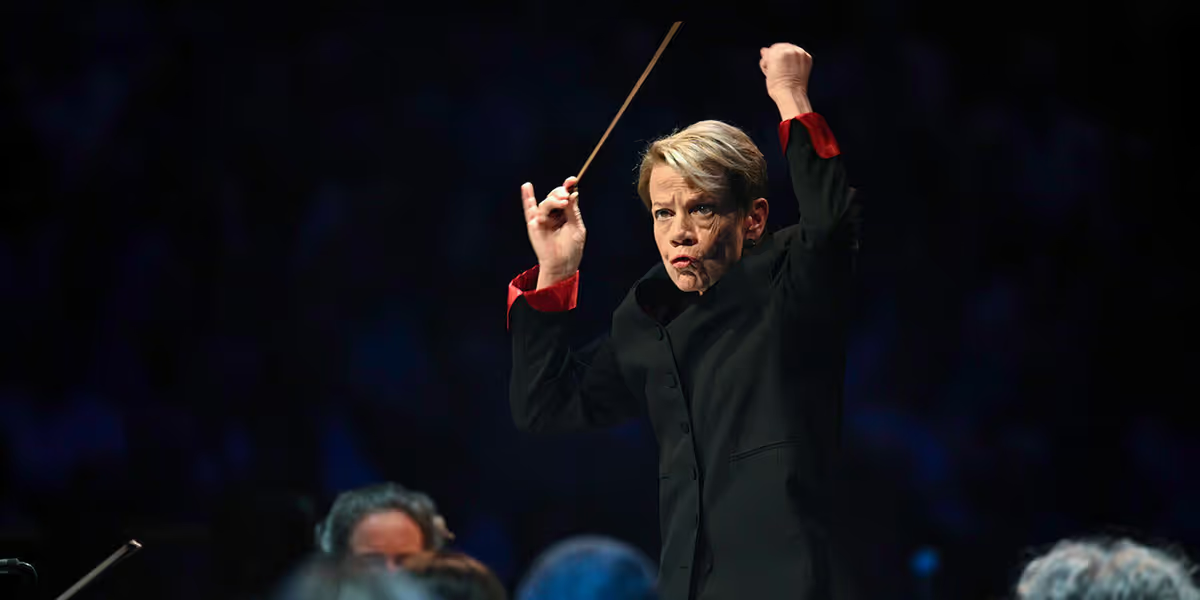

This year’s Proms season has been awash with commemorations of America’s 250th anniversary, the entire season beginning with Aaron Copland’s “Fanfare for the Common Man” - and that piece featuring at several other points in various ways across the festival. So it was about time that there was a concert wholly focused on American composers, and celebrating the country’s more romantic aspects. It was only fitting that Marin Alsop curated the programme and was there to conduct the Philharmonia Orchestra.
I have started to slightly question the focus on this particular Copland piece, rather than choosing more of a range of different (and perhaps lesser known) American composers to celebrate instead. There’s no room at the inn for the likes of John Philip Sousa, John Cage or Philip Glass - let alone for anyone such as Amy Beach. A bit of a missed opportunity across the entire season.
However, as far as the programme for this Prom goes, it’s understandable how the majority of it came together. Joan Tower latterly dedicated “Fanfare for the Uncommon Woman No.1” to Alsop, so it was a natural choice with which to open the concert; the recognisable flashes of Copland’s original interspersed with dynamic flourishes which mark it out with an identity of its own. Opening with a fanfare was a statement in and of itself, setting the tone for the entire evening.
Moving from this into a suite from Copland’s “Appalachian Spring” was inspired; you can really sense the classic American vision of wide open spaces, with delicate touches that nod to the awe-inspiring untouched areas of natural beauty. Given that Copland was a Brooklynite, you can’t help but get an extra sense of the American Dream in his romanticisation of the pioneers and vivid landscapes as you head from east to west. A ballet originally composed for 13 instruments, the arrangement for full orchestra provides the required sense of scale - the Philharmonia Orchestra were particularly dazzling in their rendition of this suite.
.jpg?format=auto&width=800)
It was only right to pay tribute to one of America’s most well-known composers, with the Marcus Roberts Trio joining the Philharmonia for a performance of George Gershwin’s “Rhapsody in Blue” that harked back to its inception. Although it may not have suited some more conservative members of the audience, having Roberts (blind since the age of 3) improvise on the piano around the recognisable themes was not only impressive but also stays true to Gershwin’s own musical ad-libbing in the piece’s première. It was a refreshing way for a 21st century audience to hear the composition, with the known melodies left intact and sheer musicality coming through to fill the gaps. Their encore performance of James P. Johnson’s “Victory Stride” was a statement of its own, as the orchestra transformed into a big band for a few minutes.
“The Big Country - prelude” from Jerome Moross was the ideal way to restart proceedings after the interval, its swirling violins and brass fanfares instantly conjuring up images of the Wild West and old school Hollywood cinema (this piece comes from the score of the film The Big Country, starring Gregory Peck). What could be more American than that?
Marin Alsop counts Leonard Bernstein as one of her mentors, so it’s no surprise that there were not one but two sets of dances of his included in the programme: from West Side Story and On The Town, respectively. The flourishes from Alsop and the Philharmonia in the former evoked knowing smiles from the audience, as the musicians gave ominous finger snaps which echoed Jerome Robbins’s famous choreography - and cries of “Mambo!” later on added to the lively atmosphere created by the music. Both musicals represent different aspects of New York City, but it’s West Side Story’s ode to America’s diversity (whilst re-telling Shakespeare’s Romeo and Juliet) that really packs a punch. It was important to include this representation in this particular Prom, as a reminder that the United States of America was made by immigrants - and that story continues to this very day.
.jpg?format=auto&width=800)
In between these two suites was a beautifully brief moment of calm, in the form of William Grant Still’s “Three Visions - No. 2: Summerland” - effectively a duet between the orchestra and solo violin, in this case the Philharmonia’s leader Zsolt-Tihamér Visontay. Possibly a meditation on heaven, this elegant piece allowed the audience a moment of grace amidst the whirlwind of Bernstein. It feels remarkable to me that this was its first ever performance at the Proms.
Despite it making the concert overrun more than expected, it was a treat to witness another encore to round off the entire experience. Finishing with the “Hoe-Down” from Copland’s ballet Rodeo was a moment of light-heartedness that lifted us after some of the intense moments of the “monstrous town” in On The Town. Another example of Copland’s curiosity in things outside his own experience, and also another opportunity for the orchestra to make some noise other than via their musical instruments.
Whilst the American celebration could have been more wide-reaching - and perhaps focused more intently on this concert rather than the entirety of the season - Marin Alsop’s charismatic conducting and general presence brought an extra spark to this Prom, making for a memorable evening of musical adventures.
The BBC Proms run at the Royal Albert Hall until 13 September
Photo credit: Chris Christodoulou
Sign up for all the news on the Fall season, discounts & more...

.jpg?format=auto&width=365)





Reader Reviews
To post a comment, you must register and login.