


Next Festival of Emerging Artists Reveals 14th Season Lineup
The festival will present world premieres by Andrea Casarrubios and Adeliia Faizullina at National Sawdust
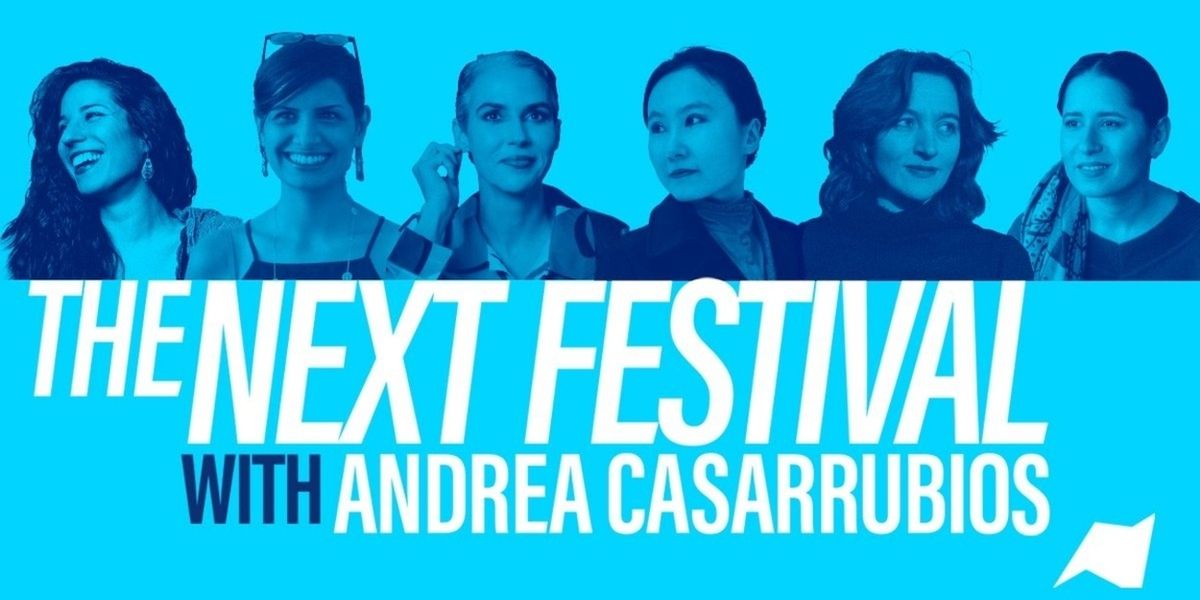
The Next Festival of Emerging Artists has announced details of its 14th season, taking place from May 29 to June 12, 2026 at PS21: Center for Contemporary Performance in Chatham, NY; National Sawdust in Brooklyn, NY; and Gibney Dance in New York City. A trailblazing arts immersion program for early-career string musicians, composers, and choreographers from around the world, NextFest 2026 season celebrates the vital contributions of women immigrant composers to the American musical landscape. In commemoration of the 250th anniversary of the Declaration of Independence, this landmark Festival continues the organization's longstanding advocacy for diverse, global voices through a series of evocative world premieres and features GRAMMY-nominated cellist and composer Andrea Casarrubios as the guest artist/ composer.
Highlights of the 2026 Festival include Casarrubios' newly commissioned double concerto for cello, percussion, and strings, The Book of Signatures, a world premiere she will perform as soloist alongside percussionist Garret Arney and the festival fellows. The program also includes the world premiere of a new work by Adeliia Faizullina (Tatar from Uzbekistan), world premiere string orchestra arrangements of existing works by Wang Lu (China) and Niloufar Nourbakhsh (Iran), the U.S. premiere of a string orchestra arrangement of a work by Aleksandra Vrebalov (Serbia), and excerpts from a timely work by Clarice Assad (Brazil). During the second week of the Festival, a collaboration with Gibney Dance featuring a choreographer/composer workshop mentored by Pulitzer Prize and GRAMMY-winning composer Aaron Jay Kernis and Bessie-nominated choreographer Sidra Bell.
The Book of Signatures
On Friday, June 5, 2026 at 7:30pm at PS21: Center for Contemporary Performance in Chatham, NY and Saturday, June 6, 2026 at 7:30pm at National Sawdust in Brooklyn, NY, Artistic Director Peter Askim leads a string orchestra of talented early-career string players in the world premieres of Andrea Casarrubios' The Book of Signatures, featuring the composer as soloist; and Adeliia Faizullina's 6, before she knew and after. The program also includes the world premieres of new string orchestra arrangements of Wang Lu's Tangrams and Niloufar Nourbakhsh's for love seemed easy at first; the U.S. premiere of a string orchestra arrangement of Aleksandra Vrebalov's Ur Song; and two excerpts from Clarice Assad's Impressions.
Ur Song
A work drawn from her opera Mileva (2011), Aleksandra Vrebalov's Ur Song distills the work's final and most inward moment. Set in 1948, at the end of Mileva Marić Einstein's life, the scene unfolds in a hospital where memories, loss, and ghostly presences converge. In a moment of late clarity, Mileva reflects on her life, recognizing in the infinity of the Universe a boundless potential for human happiness. Vrebalov composed Mileva for the 150th anniversary of the Serbian National Theatre in Novi Sad, for which she received the 150th Anniversary Gold Medal of The National Theatre for her contribution to the field of opera, as well as the Mokranjac Prize for the best premiered work in Serbia, awarded by the Society of Composers of Serbia. In addition to its string orchestra arrangement, which will receive its U.S. Premiere at Next Fest, Ur Song has also been choreographed by Dominique Dumais for Oper am Rhein in Düsseldorf and arranged for string quartet for the Kronos Quartet.
6, before she knew and after
Adeliia Faizullina's 6, before she knew and after was written as a tribute to her formative years, when music first revealed itself as something essential in her life. Named for the age at which the composer left Uzbekistan with her family for Tatarstan, Russia, the work expresses the sadness, farewell, and bittersweet uncertainty of leaving her home and beloved piano behind. The piece also incorporates the melody of a Tatar folk song whose title translates as “Apple Tree,” reflecting the traditional songs she heard as a child from her grandmother, a bearer of her culture. Faizullina said, “This composition reflects those earliest memories: my childhood's unconscious delight in touching musical sounds, my first encounters with music theory - such as the IV–V–I chord progression - and piano lessons with repeated passages, practiced slowly a few times and then faster.”
Impressions
Clarice Assad's Impressions was commissioned by the New Century Chamber Orchestra in 2008 as a season opener. The purpose of the piece was to showcase the orchestra's performers' diversity and uniqueness and create a musical portrait of the first impressions between the musicians and the composer herself. This Next Fest program features two movements from the suite: Affection. Slow Waltz, inspired by the film noirs of Hollywood, and Precision. Perpetual Motion, which showcases skill and proficiency.
Tangrams
Wang Lu's Tangrams is the finale of a four-part commission celebrating the September 2024 grand opening of the Community Music Works Center in Providence, an organization that offers free string lessons to underserved local children. Inspired by the Chinese geometric puzzle tangram, the piece reflects the endless possibilities inherent in both the puzzle itself and in teaching young, exploring musicians. Throughout the work, distinct musical motifs act collectively as geometric shapes that are continuously repeated and reassembled into new contexts, creating a piece defined by playful, rapid transformations and invigorating energy.
for love seemed easy at first
Originally commissioned in celebration of National Sawdust's 10th season for the Kronos Quartet and Jeffrey Zeigler, Niloufar Nourbakhsh's for love seemed easy at first began as a tribute to the community National Sawdust has cultivated, and organically shifted into a more intimate exploration of family, including the bonds that hold, fray, and stretch across distance and time. Since the passing of the composer's mother in 2019, her family relationships have undergone profound changes. Now dispersed across three continents, they continue to navigate how to remain connected despite their separation. Nourbakhsh said, “The title of this piece is a literal translation of the opening line of a ghazal by the 14th-century Persian mystic poet Hafez. It is also the name of our family's WhatsApp group chat — a humble but enduring thread that ties us together.” This new version for string orchestra was commissioned by The Next Festival of Emerging Artists and co-commissioned by National Sawdust and PS21: Center for Contemporary Performance.
The Book of Signatures Double Concerto
Andrea Casarrubios' The Book of Signatures Double Concerto honors the value of what is made by hand. The first movement, Pulse, creates the space required for authentic human expression, with the cello emerging as a voice that both seeks out and constructs the meaning of its perception. The second movement, Screen, embodies the speed, allure, and saturation of the digital world, the exhausting magnetism of information overload. It is this disorienting sprint that evolves into the final movement: a reflection on the act of writing by hand, symbolizing in the “signature” an intimate and tangible gesture of human connection and identity. Casarrubios said, “The title evokes the intimacy of an autograph book — a collection of names, drawings, and fleeting messages that preserve encounters across a lifetime. At a time when the handwritten self is vanishing in a digital world, the act of writing by hand takes on new poignancy. A signature, once common, now feels like an emblem of authenticity, a physical trace of presence, at once fragile and enduring.”
The following week, 2026 Choreographer, Composer, and Performance Fellows take up residence at Gibney Dance in New York City, where they are mentored by choreographer Sidra Bell and composer Aaron Jay Kernis to create new works at the intersection of music and dance, exploring new possibilities in equitable and collaborative art-making. The residency culminates in a pay-what-you-can showing on Thursday, June 11, 2026, featuring discipline-crossing works-in-progress and world premieres of new compositions by composer fellows.
Prefer BroadwayWorld in Google Search?
Add us as a preferred source so our stories show up more often in Top Stories and Google’s AI answers — for you.
Sign up for all the news on the Fall season, discounts & more...
.jpg?format=auto&width=300)
.png?format=auto&width=365)




