


Ballet Hispánico Asks Dance to Carry the Weight of Cultural Survival
Mujeres: Women in Motion honors the late Tina Ramirez's belief that dance preserves dignity, but the program's ambitious centerpiece can't keep pace its premise.

Art as survival was, for many, the core lesson of the last decade. For Ballet Hispánico, it is a mission statement. The company's second all-female program, Mujeres: Women in Motion at the New York City Center now through April 26th, suggests that art grounded in our history, our community, and our diversity is what will allow us to persevere in perilous times.
The spring program includes two world premieres—Trança (Braid) by Brazil's Cassi Abranches, a contemporary take on Brazilian dance, and Reactor Antígona (Reacting to Antigone), a re-envisioning of Antigone by Cuban choreographer Marianela Boán—alongside Stephanie Martinez's Otra Vez, Otra Vez, Otra Vez, a piece inspired by Picasso's "The Old Guitarist." Select programs feature work from frequent Ballet Hispánico collaborator Annabelle Lopez Ochoa. The programming honors the late Tina Ramirez, the company's founder, whose belief was clear: art survives strife.
Martinez's Otra Vez, Otra Vez, Otra Vez—Again, Again, Again—is an auspicious start and a beautiful way to honor the texture and complexity that defines Ballet Hispánico's commissioned work. The piece plays with the boundaries between classical ballet, contemporary, and Spanish dance, weaving divergent threads around a single idea: that we touch and are touched by everyone. A castanets section requires razor focus; a heartbeat section didn't allow a single beat to be missed. Spanish classical guitar calls back the work's inspiration, and while the folksy, emotional sound was often note-perfect, a live track with applause felt jarring.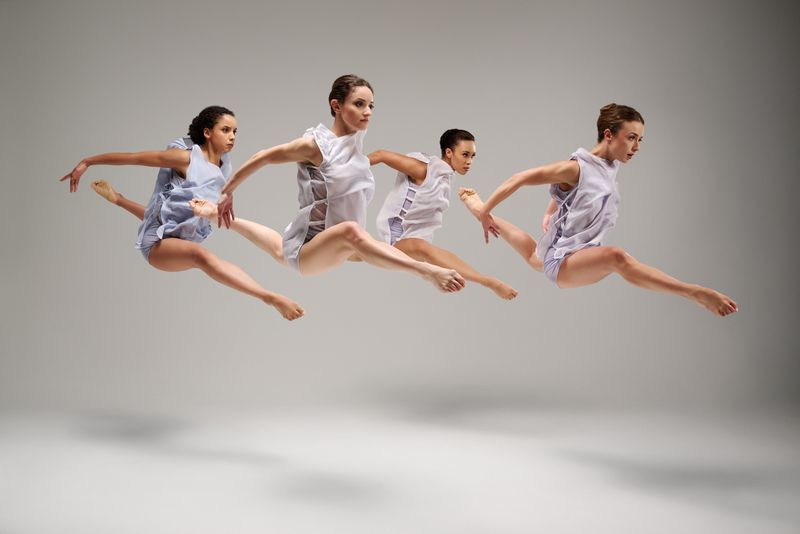
If Otra Vez proves the company can commission work that balances spectacle with substance, Reactor Antígona proves it still struggles with storytelling ballets. Boán reimagines Sophocles' Antigone through Caribbean cosmology. The story is carried loosely: Oedipus appears as a blind man who cross-dresses in memory of Jocasta. Antigone is cast as a caregiver. Polynices, her brother, becomes a boxer—perhaps confused with Polydeuces? Underneath the murky storytelling is a tale of migration and loss, but the staging undercuts it. Fall-colored leaves evoke an odd happiness in a piece so dark. Giant duffels are treated like boxing bags—the dancers literally punch them. "The work is under-choreographed at its core—too much emoting, very little dancing—and the dancers, however committed, can't sustain a piece this long on anguish alone.
Abranches' world premiere Trança revives the evening. This is Ballet Hispánico at its most familiar: sassy, culturally grounded, dynamic. It's the perfect palate cleanser and a callback to what made Otra Vez keep audiences in their seats. The work is structurally intriguing, with overlapping themes that resolve in beautiful ensemble movement, and it showcases the company's ability to make 12 dancers look like 24. A less neutral color palette—something that doesn’t duplicate the opening number's visual style—would have enhanced the work.
Ballet Hispánico's commitment to the artistry has always given it the space to prove Ramirez was right. Mujeres asks audiences to believe that the stories carried in our bodies will outlast the forces that threaten them. On the strength of Otra Vez and Trança, this belief rings true.

Sign up for all the news on the Fall season, discounts & more...
