


Japan Society to Present Film Series on Ryuichi Sakamoto's Music
The weekend series spotlights rare films featuring scores from the influential composer and producer.

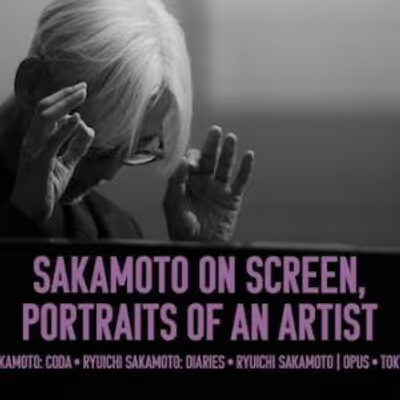
With special thanks to HarperCollins and The Estate of Ryuichi Sakamoto, Japan Society is presenting the weekend program Music By Ryuichi Sakamoto, highlighting six rare films scored by 'The Professor,' in celebration of Music Sets You Free (HarperVia, 2025)—his bestselling autobiography, now available for the first time in English. The series runs September 11–12, 2026.
The late, influential musician, composer and producer Ryuichi Sakamoto (1952-2023) once, in the exuberance of youth, believed himself to be the reincarnation of Claude Debussy, whom he considered 'the door to all 20th-century music.' Classically trained and educated in ethnomusicology, theory and composition, Sakamoto—a student not just of the 20th century but of all those that came before it—came to redefine and further the sound of his own. From the futuristic chorus of synthesizers, drum machines and sequencers he arranged as a member of the pioneering Yellow Magic Orchestra (alongside bandmates Haruomi Hosono and Yukihiro Takahashi), to his pursuit of avant-garde experimentation and exploration of world music, his was a seemingly prescient career marked by constant reinvention as a soloist and collaborator. Dedicating himself to a life of discovery and the embrace of new sounds and textures, Sakamoto dreamed up new musical idioms, always guided by the ethos that 'anything could be music'—a trickling stream, melting ice caps or the urban sounds of a rush-hour commuter train.
On the occasion of the publication of his autobiography Music Sets You Free, Japan Society presents a selection of rarely-seen films from Sakamoto's rather sprawling 40-year career as a film composer—a trajectory propelled by his film score debut in Nagisa Oshima's Merry Christmas Mr. Lawrence. Series highlights include the North American premiere of the 4K restoration of seminal 1980s anime Royal Space Force: The Wings of Honnêamise—the film debut of Evangelion studio Gainax and Sakamoto's first animation score; and the long lost posthumous director's cut of Donald Cammell's Wild Side, starring Christopher Walken and Joan Chen, screening on one of only two 35mm prints ever struck. Other selections include All Star Video and Adelic Penguins, two experimental, shot-on-video Sony projects from Nam June Paik, Kit Fitzgerald and Paul Garrin; a mystery Sakamoto-themed screening on celluloid; and Ryu Murakami's lurid descent into Japan's BDSM underworld Tokyo Decadence—a rarely-seen predecessor to its better-known sequel Love & Pop.
Exclusive copies of Ryuichi Sakamoto's upcoming autobiography Music Sets You Free, translated by Sam Bett, will be available at select screenings ahead of the book's publication on September 22nd. Filled with candid photos, Music Sets You Free is the incredible chronicle of a life excitingly lived: an intimate, contemplative, and fascinating recounting of his life story as a musical journey, from his first childhood encounter with a piano to his rise as a global pop star and award-winning composer. Both a self-reflective testament and thought-provoking meditation on life, mortality, and the enduring power of art, it is the memoir of a visionary whose life and work embodied the aphorism Ars Longa, Vita Brevis ('Art is long, life is short').
Ticket Information
Tickets: $16 / $14 students and seniors / $12 Japan Society members
Weekend Pass: $60 Series Pass / $50 Japan Society Members
Screenings take place in Japan Society's landmarked headquarters at 333 East 47th Street, one block from the United Nations. Lineup and other details subject to change. For complete information, visit japansociety.org. Tickets are available now.
Film Descriptions
Adelic Penguins
Saturday, September 12 at 4:00 PM
Dir. Kit Fitzgerald, Paul Garrin, 1986, 33 min., digital, color, in Japanese with English subtitles.
Commissioned by Sony and performed live on a fourteen-story TV set aptly named the JumboTRON at the Expo in Tsukuba, Adelic Penguins is a six-part video art mesh of diving penguins, chroma key composites and propulsive rhythms. Sakamoto, not merely credited with composing the music, appears on screen dancing, twirling and performing in the expanse of Fitzgerald and Garrin's radiating, polychromatic overdrive.
Screens with All Star Video.
All Star Video (『電子の拓本 ALL STAR VIDEO』/ Denshi no Takubon: All Star Video)
Saturday, September 12 at 4:00 PM
Dir. Nam June Paik, 1984, 32 min., digital, color, in English and Japanese. With Ryuichi Sakamoto, Allen Ginsberg, Charlotte Moorman, Laurie Anderson, John Cage.
Opening with Ongaku Zukan era Ryuichi Sakamoto in a technological haze, All Star Video breaks out into a series of interviews, documenting 'All Stars' of the New York art scene—John Cage, Allen Ginsberg and Charlotte Moorman among them—many of whom are interviewed by Sakamoto himself. Re-enacting Fluxus performances, from cello concertos to a piano's destruction, and interspersed with musical interludes throughout, Paik's All Star Video pays an indelible tribute to the collaborative spirit of Fluxus and the avant garde.
Screens with Adelic Penguins.
Mystery Screening
Friday, September 11 at 9:15 PM
Approx. 90-120 min.
Introduction by Jawni Han. Leave it up to chance and come watch a Sakamoto-affiliated picture, presented on film.
Royal Space Force: The Wings of Honnêamise (『王立宇宙軍 オネアミスの翼』/ Oritsu Uchugun: Oneamisu no Tsubasa)
Friday, September 11 at 7:00 PM
Dir. Hiroyuki Yamaga, 1987, 119 min., DCP, color, in Japanese with English subtitles. With Leo Morimoto, Mitsuki Yayoi, Aya Murata.
North American Premiere of 4K Restoration. The debut of animation studio Gainax (Neon Genesis Evangelion) and a seminal work of cel animation, Hiroyuki Yamaga's Royal Space Force: The Wings of Honnêamise launched a new generation of animators with its conceptual, Promethean ambitions. Set on an alternate Earth in the kingdom of Honnêamise, where space travel has not yet been achieved, Bandai's first foray into film production finds intrepid pilot Shirotsugh Lhadatt, a member of the country's oft-ridiculed space program, making one last attempt to man a flight into space. Determined to reach the heavens despite corrupt political machinations and the looming shadow of war, Lhadatt struggles to reconcile his mission with the ramifications of mankind's progression to the stars. Featuring the talents of Hideaki Anno, Yoshiyuki Sadamoto and Hiromasa Ogura, with music by Ryuichi Sakamoto, Royal Space Force was envisioned as an art film, with rich world building that countered the conventions of contemporaneous anime—an outsider work 'to make anime fans reaffirm reality'.
Tokyo Decadence (『トパーズ』/ Topazu)
Saturday, September 12 at 6:00 PM
Dir. Ryu Murakami, 1992, 113 min, DCP, color, in Japanese with English subtitles. With Miho Nikaido, Sayoko Amano, Yayoi Kusama.
Based on Ryu Murakami's 1988 short story Topaz and lesser known than Hideaki Anno's point-and-shoot adaptation of its sequel Love & Pop: Topaz 2, Tokyo Decadence marks the fourth feature directed by the transgressive author behind Audition and In the Miso Soup. A murky descent into Tokyo's seductive underworld of BDSM, Murakami's erotic drama whisks lovesick callgirl Ai (Miho Nikaido) between clients amid the empty spaces of high-rise lofts and dimly lit hotels in Tokyo's nocturnal cityscape. Murakami formulates a bleak indictment of Japan's bubble-era excess as Ai struggles to find purpose and meaning in catering to the degrading desires and hedonistic fantasies of an anesthetized elite.
Donald Cammell's Wild Side (Director's Cut)
Saturday, September 12 at 8:30 PM
Dir. Donald Cammell, 1995/2000, 111 min., 35mm, color. With Anne Heche, Christopher Walken, Joan Chen, Steven Bauer, Allen Garfield, Adam Novak.
Archival 35mm Import. The fourth and final film of eccentric filmmaker Donald Cammell, best known for his brilliant 1970 debut Performance co-directed with Nic Roeg, Wild Side was butchered by studio interference, re-cut and taken away from Cammell who subsequently took his own life. A pulpy, erotic neo-noir starring Christopher Walken in one of his most over-the-top performances, Wild Side indulges in a rapacious world of power, sex, crime and money. Walken's paranoid Bruno, a notorious money launderer, is the subject of an undercover sting operation that pulls in Anne Heche's Long Beach investment banker-turned-prostitute, who in turn becomes enraptured with Bruno's elegantly seductive wife (Joan Chen). Painstakingly re-cut by Cammell's widow and longtime editor using Cammell's notes and a personal cut, this posthumous director's cut restores much of its original vision: its humor, avant garde leanings and non-linear plotting, along with a new score by Ryuichi Sakamoto. Screening on one of only two 35mm prints ever made.
Screening Dates
Friday, September 11
7:00 PM Royal Space Force: The Wings of Honnêamise
9:15 PM Mystery Screening
Saturday, September 12
4:00 PM All Star Video / Adelic Penguins
6:00 PM Tokyo Decadence
8:30 PM Donald Cammell's Wild Side (Director's Cut)
The series is curated by Alexander Fee. Film programs are generously supported by Anime NYC and ORIX Corporation USA. Endowment support is provided by the Lila Wallace-Reader's Digest Endowment Fund and The John and Miyoko Davey Endowment Fund. Additional season support is provided by Jono Abrams and Elizabeth Linn, Ayumi Arafune, Darin Arita and Kanako Arita, Mike Audet, Shizuka Bernstein, Gabriel Bianconi, Mr. and Mrs. Jeffrey Catanzaro, The Globus Family, Satoshi Harris-Koizumi, Kazumi Hayama, George and Hillary Hirose, Timothy Hower, Eriko Ishikawa, Akiko Koide and Shohei Koide, Marc Mailhot, Kurt Nickels, David Toberisky, Joseph Rajaratnam and Dharshini Iolanthe Sivakumaran, the Japan Society Film Council, and other Film supporters.
Transportation assistance is provided by Japan Airlines, the official Japanese airline sponsor of Japan Society Film Program. Housing assistance is provided by the Prince Kitano New York, the official hotel sponsor of Japan Society Film Program.
About Japan Society Film
Spurred on by the success of the 1970 Donald Richie-curated MoMA retrospective The Japanese Film: 1896-1969, Japan Society committed to making film one of its key programs in the early seventies—quickly becoming the premier venue for the exhibition of new Japanese cinema as well as career-spanning retrospectives on seminal directors and actors. In 1979, Japan Society established the Japan Film Center, formalizing film as a full-fledged, year-round program aimed at cultivating a deep appreciation and understanding of Japanese film culture among American audiences. Over the years, Japan Society Film has hosted numerous high-profile premieres and programs, presenting works by the era's then-new giants such as Shohei Imamura, Seijun Suzuki, and Hiroshi Teshigahara upon their first release, and groundbreaking retrospectives on now canonical figures such as Kenji Mizoguchi and Yasujiro Ozu. The historic department continues to critically evaluate the legacy of Japanese cinema by highlighting the works of underseen talents, organizing the first American retrospectives of Kinuyo Tanaka and Shinji Somai among others. Japan Society Film has hosted visits from Akira Kurosawa, Toshiro Mifune, Hideko Takamine, and Nobuhiko Obayashi. In 2007, Japan Society Film launched JAPAN CUTS: Festival of New Japanese Film, the largest festival of its kind in North America.
About Japan Society
Japan Society is an organization connecting Japanese arts, culture, business, and society with audiences in New York and around the world. The organization describes itself as inspired by the Japanese concept of kizuna (絆)–forging deep connections to bind people together, and committed to telling the story of Japan while strengthening connections within New York City and building new bridges beyond. In over 100 years of work, Japan Society says it has inspired generations by establishing itself as a pioneer in supporting international exchanges in arts and culture, business and policy, as well as education between Japan and the U.S. Japan Society's New York headquarters is a landmark building designed by architect Junzo Yoshimura that opened to the public in 1971.
Photo Credit: Neo Sora
Photo Credit: Neo Sora
Prefer BroadwayWorld in Google Search?
Add us as a preferred source so our stories show up more often in Top Stories and Google’s AI answers — for you.
Sign up for all the news on the Fall season, discounts & more...
.jpg?format=auto&width=300)
.png?format=auto&width=365)




