


Interview: Adapter/Director Bart De Lorenzo of ENEMY OF THE PEOPLE at Odyssey Theatre Ensemble
Running August 22 through September 27.
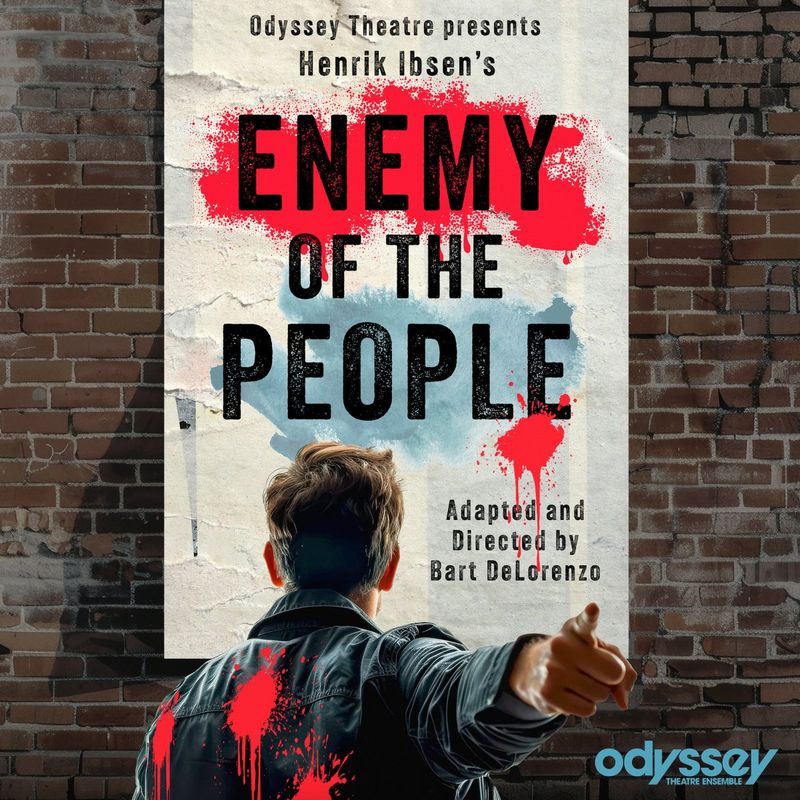
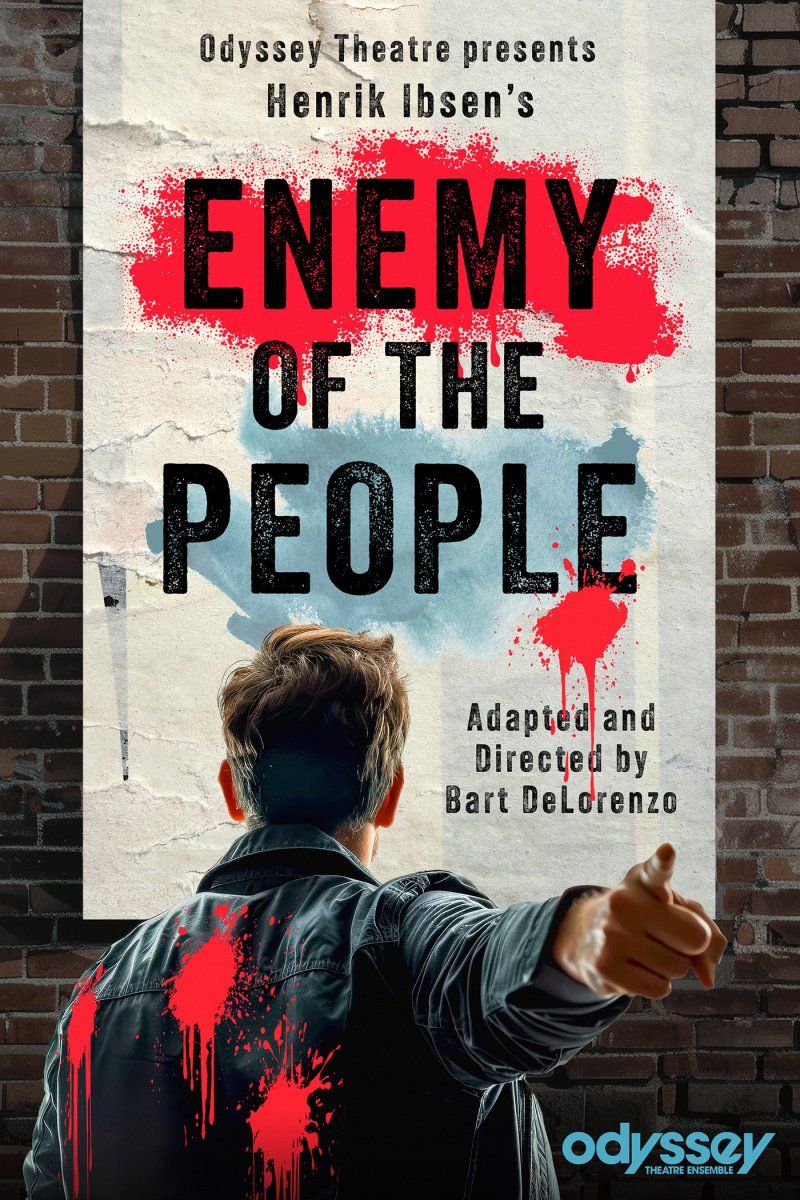
Henrik Ibsen wrote Enemy of the People after the firestorm surrounding his groundbreaking drama Ghosts, which scandalized audiences by openly discussing adultery, venereal disease and the hypocrisy of respectable society. Vilified by critics and moralists alike, Ibsen responded with a play about what happens when someone speaks an uncomfortable truth and discovers that facts alone are rarely enough to change minds.
Ripping Ibsen’s classic out of the 19th century, Adapter/Director Bart DeLorenzo relocates the action to America in 2026, where battles over public health, economic survival, misinformation and political polarization have become defining features of American life. His bold new adaptation thrusts the play’s central conflicts into sharp contemporary focus.
“This is not a simple story of one righteous man facing off against a corrupt society,” shares DeLorenzo. “Every single character in this play is flawed and forced to compromise their values in profound ways. Ibsen exposes a society in freefall that feels astonishingly close to our own, where nearly every issue, from public health to immigration, becomes another battleground in an increasingly polarized culture.”
Here’s my interview with Bart about his vision for the play, how it reflects today’s political environment, and how he hopes modern audiences will see themselves reflected in the story.
Thanks for speaking with me, Bart, about your new adaptation in which you’ve relocated Enemy of the People from 19th-century Norway to America in 2026. What convinced you that now was the right moment to reimagine Ibsen’s play in this specific contemporary setting?
Back in 1882, Ibsen writes a revolutionary play. He begins with a doctor who thinks he’s made a scientific discovery, only to discover he’s landed in a political war. That was a startling idea then. Today, none of us would be surprised. Politics doesn’t interrupt our lives anymore – it’s become the language we use to deal with almost everything. This week alone, between the Correspondents’ Dinner and Anthony Fauci testifying before Congress, I was again struck by how quickly the talk turns to ‘enemies,’ and the risks of speaking truth to power. So, I didn’t feel like I was dragging Enemy of the People into the present. I felt like the present had caught up with the play.
In your modern adaptation, Dr. Tom Stockmann discovers that the waters of the local hot springs are contaminated and determines the solution is obvious: shut them down before more people are harmed. But protecting public health comes with a devastating price and he finds himself branded not a hero, but an “enemy of the people.” Traditionally, Dr. Stockmann is viewed as a heroic figure, but your adaptation seems to embrace more ambiguity. What new dimensions of his character were you most interested in exploring?
Ibsen famously said he wasn’t sure whether Enemy of the People was a comedy or a drama. Lately, I’ve been feeling that way about the news. Our politics are sometimes so passionate, and everything can turn from deadly serious to completely absurd in the blink of an eye. Tom Stockmann is right about his science, but that doesn’t mean he’s always right about people. He’s impatient, stubborn, and not always very good at bringing people along with him. And I think that’s true of all the play’s characters. So, I wanted to make sure that they all believe they’re just doing the right thing. I think that’s when people become both dangerous and funny. I’m most interested in how hard it actually is to be heroic.
The production replaces a traditional newspaper with the digital news outlet, The People’s Voice. What role do modern media and the speed of information play in shaping the story’s conflicts?
It changes everything. Ibsen built his plot around a newspaper deciding whether to literally hold back printing a story. But today, the story is already immediately everywhere before anyone’s even made a decision to type it out. News today moves so much faster, fragments quickly, and hardens into opinion moments later. And there isn’t one newspaper. There are hundreds of competing voices, each with its own audience, priorities, and blind spots. So all of this naturally led to our version that races along for a quick 90 minutes and barely has time to catch its breath. That just felt true to our time, more like the mess we’re living through.
Nearly 150 years after Ibsen wrote Enemy of the People, audiences continue to return to it. What do you hope theatergoers will discover in your adaptation that they may not have considered before?
I wasn’t interested in presenting a play where the hero gives a speech and everyone learns a lesson. I wanted to explore how difficult political engagement can actually be. How it can consume your life, alienate people you love, and still leave you wondering whether you’ve accomplished anything. I look around and see a lot of us carrying that fatigue right now, and wondering what to do next, and I wanted to explore what it takes to keep going anyway. What our times may be asking of all of us.
When adapting a classic like Enemy of the People, how do you decide what is essential to preserve and what needs to be reinvented for today’s audiences?
For me, I try to preserve the engine, not the furniture. But nothing gets a free pass. Every scene, every plot point, every assumption, I tried to question. Does it still hold? Does it even still exist? I wanted to focus on what I believe Ibsen was really investigating – the collision between truth, self-interest, family and power – but if a plot point depended on nineteenth-century technology or customs, I felt free to reinvent. We need to recognize this world.
But just as important, I wanted to preserve the play’s wildness. Enemy of the People careens from intimate family drama to political debate to public spectacle to moments of near farce. That unpredictability is part of what makes the play so thrilling, and I wanted this version to feel just as exhilaratingly unpredictable.
The conflict in the play isn’t simply about science or politics. It’s also about livelihoods and community. How did you ensure those economic realities carried as much emotional weight as the moral arguments?
You’re making the play sound so much more respectable than how it feels. I wasn’t interested in making audiences sit through a treatise on economics or morality – and I’m certainly unqualified to write that. So I’m just trying to make a thrilling night at the theater that captures how chaotic it feels to be alive right now. Most of us are trying to do the right thing while juggling work, family, money, and a world that seems increasingly determined to overwhelm us. That’s why the economic stakes matter. They make every moral decision personal. I’ve even reworked the ending to keep the focus there – not on ideas, but on the cost those ideas have for the people living them.
The title Enemy of the People has become part of our political vocabulary. How did working on this adaptation change your understanding of what that phrase really means?
Over the last decade, we’ve watched the phrase become almost a random political weapon, haven’t we? ‘Enemy of the people’ is a label that’s been attached to journalists, scientists, judges, public officials, even reflecting pool contractors – really, to anyone who gets in the way. That made me think differently about Ibsen’s title. I didn’t want to call my adaptation An Enemy of the People as is traditional, because I don’t think there’s just one here. In this version, the target keeps moving. At different moments, every character could find themselves being called wearing that name. It feels truer to the way the phrase functions today, and it makes the play feel much more like an ensemble piece.
The Odyssey’s audiences are known for embracing challenging work. What moments in this production do you think will surprise even people who already know Ibsen’s play?
You’re not asking me to give away the surprises? All I can say is that I know Ibsen has this reputation for being heavy, but he can also be so wickedly funny and there’s an incredible wit running through the play that we’ve all tried to lean into. And I think audiences will find this a much more intimate adaptation than they may be expecting. We’ve combined characters, reinvented some, and brought the cast size down, which naturally suits the Odyssey’s space. I love intimate theater. I’d so much rather be ten feet from an actor than a hundred feet from a spectacle. We’ve also taken a fresh approach to the town hall meeting. And yes, there are a few surprises toward the end, but you’ll forgive me if I don’t ruin those.
The scheduled post-show talkbacks feature experts in playwriting, economics and sociology. What conversations are you hoping audiences continue having after they leave the theater?
Lively ones. I hope people argue, interrupt each other, defend characters they never expected to defend, make fun of the people they disagree with, then realize they have more in common with them than they thought. It’s what being alive feels like right now. We’re all trying to make sense of a messy world from different points of view, and theater gives us a chance to do that together instead of shouting at each other online. It’s why I love theater.
And if audiences are still debating the play on the drive home - or even arguing about it days later - what are the questions you hope they’re wrestling with?
I’d be thrilled if people forgot they were arguing about Enemy of the People and started arguing about the world we’re living through and their own lives. I think every classic play – and this is one of the great ones – is really asking the same question: “How should I live?” Or maybe,
“What’s missing from my life?” or “What do I need to change?’ And if this play sends people home wrestling with questions like that – even if they don’t agree on the answers – then I think we’ve done something worthwhile.
Anything else you would like to share about the production or your history with the play?
I’ve been lucky enough to direct three Ibsen plays now. I did Hedda Gabler in graduate school, and four years ago I directed Ghosts here at the Odyssey, on this very stage – also with my longtime collaborator Frederica Nascimento designing the production. It felt only natural to return with Enemy of the People, as you said, Ibsen’s deliberate response to that haunting play.
And that’s one of the things I’ve come to love about him. His plays don’t just speak to us – they speak to each other, sometimes agreeing, sometimes contradicting, always struggling. The more time I spend with his work, the more I understand why he insisted he was a poet rather than a social philosopher, as he’s often been categorized. Beneath the arguments, he’s always exploring something deeper about who we are and how we live. He keeps pulling me back. I don’t think I’ll ever get to the bottom. So if anyone out there is looking for a director for The Wild Duck or The Lady from the Sea... give me a call.
Thanks so much!
Thank you!
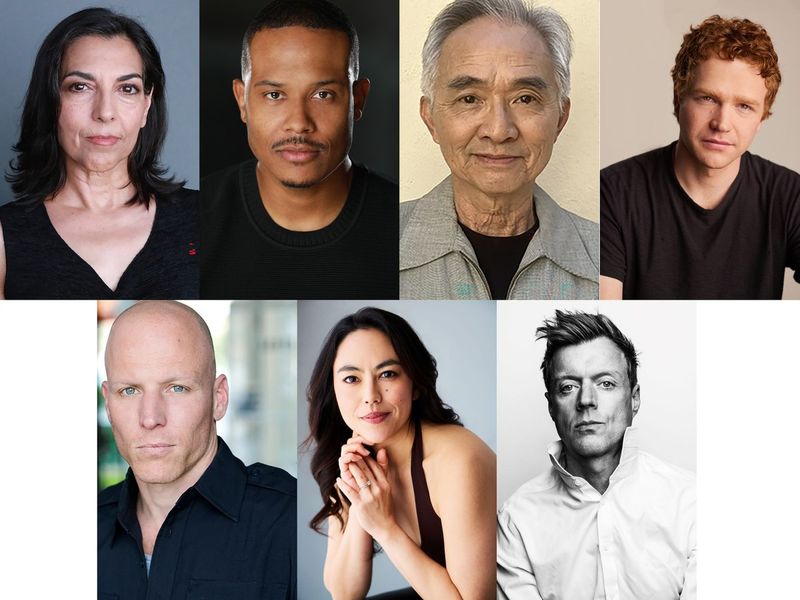
Top row:
Lauren Campedelli, DeJuan Christopher, Dennis Dun and Clay Hollander
Bottom row:
Jason McBeth, Cara Mitsuko, Jay Paulson
The Odyssey cast of Enemy of the People includes Jay Paulson as Dr. Stockmann; Jason McBeth as his brother, the town mayor; Cara Mitsuko as his wife, Kate; Dennis Dun as his father-in-law, Martin Kiel; DeJuan Christopher and Clay Hollander as the editor and reporter of local news site The People’s Voice; and Lauren Campedelli as the news site’s wealthy backer.
The creative team includes scenic and Costume Designer Frederica Nascimento, lighting designer W. Alejandro Melendez and sound designer Jonathan Flikkie. The stage manager is Katie Chabot. Beth Hogan produces for Odyssey Theatre Ensemble, and the production is supported, in part, by Isabel and Harvey Kibel.
Performances of Enemy of the People take place on Fridays and Saturdays at 8 p.m. and Sundays at 3 p.m. from August 22 through September 27, with one additional performance on Wednesday, Sept. 16 at 8 p.m. Prior to opening, there will be three previews on Wednesday, Aug. 19; Thursday, Aug. 20; and Friday, Aug. 21 each at 8 p.m.
Tickets to performances are $35, except opening weekend (August 22 and August 23) when tickets are $40 and include a post-performance reception - and previews, which are $20. Discounted tickets are available for seniors ($27) and students ($15). A $3 fee will be added to each ticket purchased with a credit card.
Scheduled post-performance talkbacks take place on
Friday, Aug. 28 with Oliver Jai’Sen Mayer, USC Professor of Playwriting;
Friday, Sept. 4 with David Davila, LMU Professor of Playwriting;
Sunday, Sept. 6 with Romain Ranciere, USC Professor of Economics;
Friday, Sept. 11 with Gary Yeritsyan, UCLA Professor of Sociology; and
Wednesday, Sept. 16 with Hajar Yazdiha, USC Professor of Sociology.
The Odyssey Theatre is located at 2055 S. Sepulveda Blvd., Los Angeles, CA 90025. For more information and to purchase tickets, call (310) 477-2055 or go to OdysseyTheatre.com.
Prefer BroadwayWorld in Google Search?
Add us as a preferred source so our stories show up more often in Top Stories and Google’s AI answers — for you.
Sign up for all the news on the Fall season, discounts & more...
|
CLUB27 Jaxx Theatre (10/01-10/30) |
|
Crone Creed El Portal Theatre (9/30-10/17) |
|
Good Night, Oscar North Coast Repertory (9/16-10/11) |
|
A Killer Night in Studio City Vitello's (9/06-10/31) |
|
Catch Me If You Can Colony Theatre (9/17-10/18) |
|
Dinner with Friends Santa Monica Playhouse (9/26-9/27) |
|
Gershwin and the Golden Age The Soraya (10/11-10/11) |
|
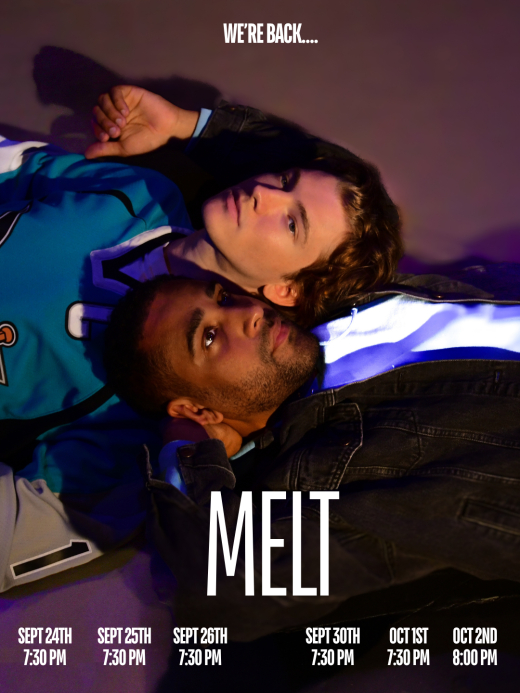
Melt : The Play The Marilyn Theatre at the Lee Strasberg Institute (9/24-10/02) |
|
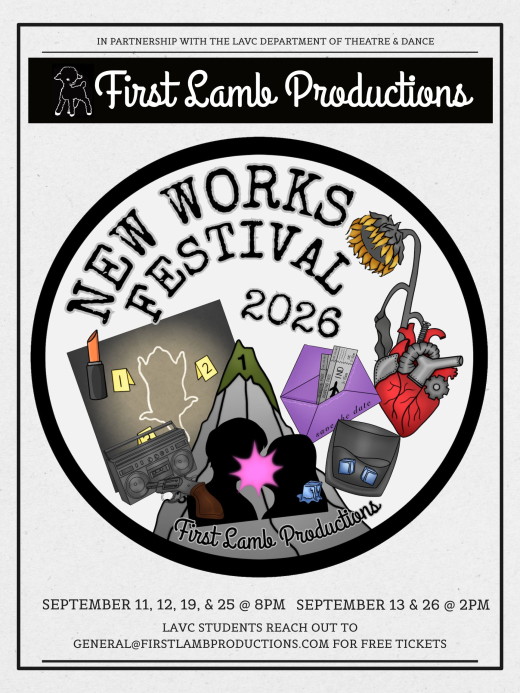
New Works Festival Shoebox Theatre (9/11-9/26) |
|
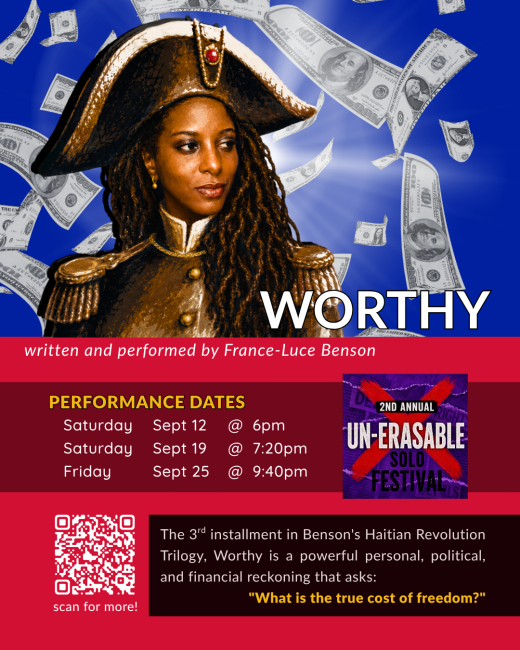
Worthy The Un-Erasable Solo Festival - Willie Agee Playhouse (9/12-9/25) |
