


Celia Keenan-Bolger Deep Dives Into ANTIGONE (THIS PLAY I READ IN HIGH SCHOOL) and More
ANTIGONE (This Play I Read In High School) is now playing at The Public Theater through April 12.
Do you have a burning Broadway question? Dying to know more about an obscure Broadway fact? Broadway historian and self-proclaimed theatre nerd Jennifer Ashley Tepper is here to help with Broadway Deep Dive. BroadwayWorld is accepting questions from theatre fans like you. If you're lucky, your question might be selected as the topic of her next column!
Submit your Broadway question here!
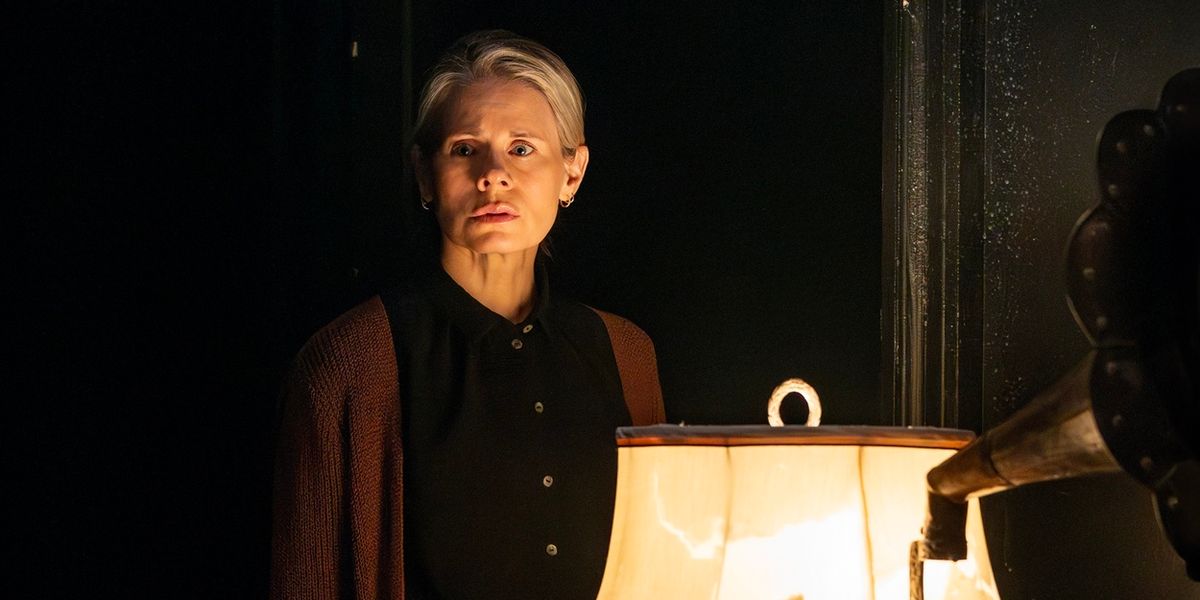
Tony Award winner and star of ANTIGONE (This Play I Read In High School) Celia Keenan-Bolger discusses with Jennifer Ashley Tepper working at The Public Theater, the rigor of off-Broadway previews, the legacy of Spelling Bee, and more.
When did you first become involved with ANTIGONE (This Play I Read In High School)?
Anna Ziegler, [the playwright], was chosen by the Lark to develop the play there. She had been working on it way before that but then the Lark selected it for development and this culminated in a one-day reading. When the play was sent to me, I wasn’t sure it was a good fit. it was not called ANTIGONE (This Play I Read In High School). I think it was called Antigones. And I thought: I don’t think if I really want to be in Antigone. I wasn’t sure it was a great fit.
Then I started reading the first few pages and [thought it was] very interesting. I kept going and thought: oh my god, this is so not like anything I have really encountered. So I did that reading and then afterward, felt like I really though this piece should have a life.
Anna and Tyne [Rafaeli] who was already attached as the director [told me] that they’d sent it out to the non-profits but didn’t know if anyone had even read it. I told them that I would like to try to help push this forward. We were able to share [the play] with some people who helped get it to The Public. That was in 2023, so it’s been a few years. We did little one to two day readings throughout the years as Anna kept rewriting and as more people came on. There were different notes [to incorporate].
When we first started talking about it, [we felt that] The Public would be the dream place to have the play produced. The fact that it ended up there is really amazing.
What’s your history with The Public? Do you remember the first show you saw there?
I’ve never worked at The Public before! It was my dream and I’ve wanted to forever. I’ve been offered a couple of Shakespeare in the Parks that I wasn’t able to do.
We studied The Public Theater at the University of Michigan because of A Chorus Line and [the theater] looms large for so many reasons, like so many other non-profits in the city. [The Public’s] values are so in alignment with the way I think theater can be important to the culture and to civilization as a whole.
I’ve seen so many shows here. When I first moved here, one of my best friends from college was in this Keith Haring musical called Radiant Baby and [I got to see that]. After having studied The Public] for all of this time, then I was living here and got to actually see shows here. That’s the first one I remember seeing but over the years I’ve seen so many plays and musicals here. I saw all of the versions of Fun Home here before it moved. I saw Hamilton. I saw all of these other plays that are just these tiny gems.
When we were in rehearsals, The Public hosted the People’s Filibuster and the whole staff of The Public, while putting up the three shows they had going on, was also facilitating this filibuster with hundreds of people. It was such an extraordinary gesture on behalf of the theater to be a host for [that] at a time when I think artists are all just [wondering] what we can do [about what’s going on in the world]. They created a space and something [actionable] to do.
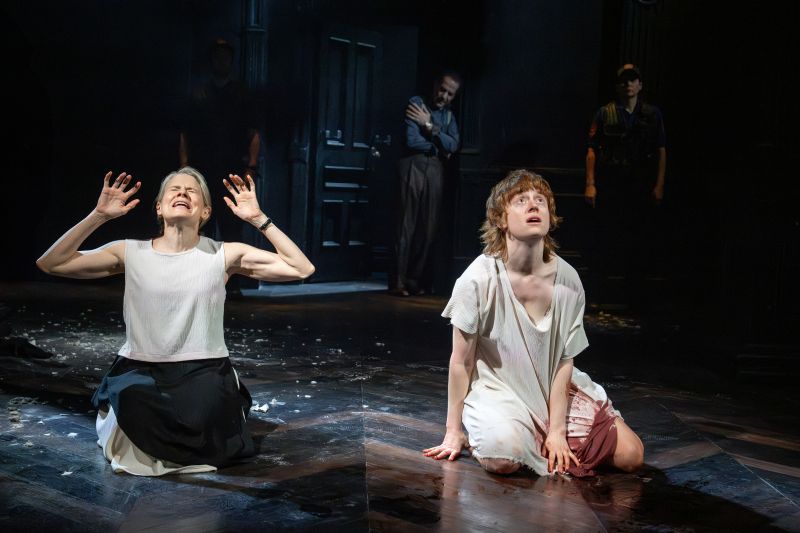
The production is stunning and I’ve thought so much about it since I saw it. I also really felt like it was one of those Public Theater shows where it added so much to the [theatergoing experience] to look up and around and really feel the history of the Astor Library and the Hebrew Immigrant Aid Society. The history surrounding the production really added to the import of it.
I could not agree more. They told us that the Anspacher specifically was [once] a holding space for immigrants coming from Ellis Island. I didn’t know that! I only thought of [the space] as the Astor Library.
I think [scenic designer] David Zinn did such an amazing job of bringing in those elements. It actually makes me think about Spelling Bee and how a space can really lend itself to a piece. Sometimes you’re a little bit at odds with a space and you have to figure out how to design and work [with that]. But in this case, it’s a wonderful merge of a play and a theater.
I’ve seen so many shows at the Anspacher, or the Barbaralee as it’s now called. I do think that for some of them, you feel it couldn’t be a more perfect space. And sometimes you think: I wish that column was different.
Also, for my job in the play, the thrust element [of the space plays such a role]. I can see everybody’s eyeballs but it still feels like there’s a spaciousness to it. Sometimes in off-Broadway houses, it feels like you’re all just in a little room together. And [the Barbaralee] has some scope to it that I think is really helpful for the piece.
Have there been any challenges to the direct address element of the play? With different audiences every night, is there anything you do to take the audience’s temperature? What has that part of the role been like for you?
What I think is so amazing and so hard about direct address is that you don’t have a scene partner. If there’s a day where I’m a little bit under [the weather] and I’m in a scene with another person, whatever balls they’re throwing at me, I get to be in conversation with their energy. [But] if an audience comes in and they’re a little bit low energy and I am [too], then the only person, the only motor that can get me to where the play needs to be is me.
I recognized early on that this would be a lonely job [in that way]. But also I actually really love getting to be with an audience like this. Especially right now, [there’s something to] trying to build experiences where we don’t feel the distance of the people on stage. We’re trying to make an experience that we’re all a part of. I love that part of ANTIGONE (This Play I Read In High School).
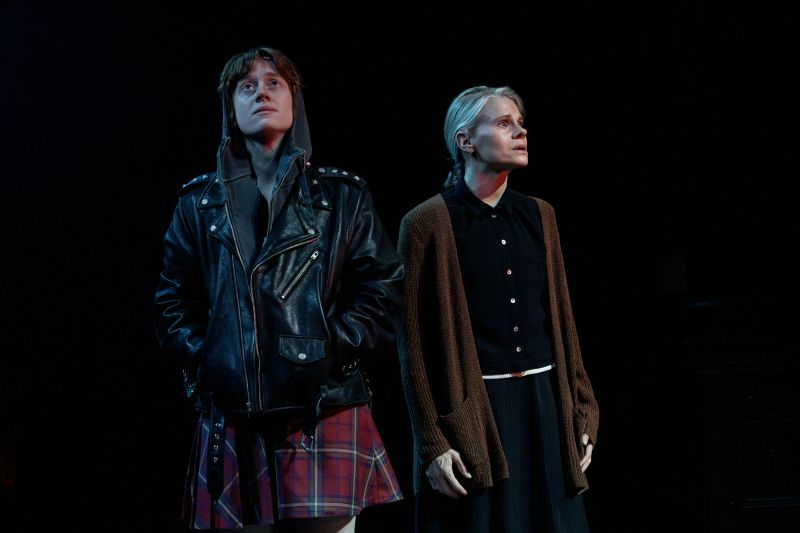
On one [performance], after opening, I did learn something. I thought: let me see what happens if I’m a bit more relaxed—and it was a mess. It was not good. [I realized that] I need this kind of relentless energy to capture the audience’s attention and keep them. Especially because there are parts in the piece where you’re [wondering]: what is this girl talking about? You’re heading somewhere but there’s a big part of the play where it’s not entirely clear why the audience is following two stories. I feel a lot of responsibility to make sure that I’m keeping everyone inside of the play and there isn’t a real dip when I start talking.
Usually, when you do direct address, the house lights are out, but in this play, they’re not always out. When we were being reviewed, I walked on stage and saw every reviewer. So many white pieces of paper and people just writing, writing. That was not an experience I had really had before. That was the hardest that [the direct address] was.
Then the gift of getting to watch people watch a play is very moving. When the house lights are off, you don’t get to see that as much. Watching that experience can [provide] its own little surge of energy for me.
I happened to see Tru starring Jesse Tyler Ferguson the same week that I saw you in ANTIGONE (This Play I Read In High School)—Spelling Bee shout-out—and it was interesting to me that there were some of the same challenges in what he was doing including responding to different energies of different audiences.
It goes back to what you are saying about taking the audience’s temperature. You’re trying to always understand the alchemy of the group that night. There’s a foundation I return to, but I do think that trying to gauge what [each] different audience needs is an interesting little science experiment in your head.
Did you read Antigone in high school? What was your relationship with the original play beforehand?
I did not read Antigone in high school. I didn’t read it until that reading [of this play] that I did in 2023. I don’t know if it’s because I studied musical theatre or went to Detroit public schools, but I always felt that I wasn’t smart enough for those classic plays. I felt like there was a kind of intellectual rigor that I associate with those Greek tragedies and with Shakespeare that I don’t have. I’m smart, but in different ways. I didn’t feel the pull. Then, since I did that first reading, I’ve done a lot of research about the function of those plays in [the year] 441 [BC]. Bryan Doerries, who is the [artistic director] of Theater of War [a company where] they do a lot of the tragedies, says that the only requirement to watch a Greek tragedy is to have experienced enormous pain in your life. The more pain, the more it will resonate. Oh my god, that was such a better framing [for me] than: ‘do you know this adaptation or that one?’
He also talks a lot about how the Greeks used these plays as a way to communalize their grief and their trauma. At a time when we are very hungry for places to commune and process the times we’re living in, it feels really right to be [doing this play]. It’s not a coincidence that in one season we’ve had our play, and Oedipus, and The Other Place at The Shed [which also utilized Antigone]. There’s a reason that we’re reaching back into history to try to help us understand these times we’re living through.
What you’re saying also really resonates as part of The Public Theater’s mission. They have the legacy of showing people who think that Shakespeare and classics have that intellectual rigor they can’t reach that those plays are for them, by presenting them in a new way, and your play has that as well.
Yes. And who are these plays for? That used to be a line my character had. What makes a classic a classic and who decides?
I think there are so many audience members who feel they were never invited into those experiences. So any time a theater is committed to trying to reimagine or make more accessible [a classic] without flattening the whole thing, I think [it’s] such a noble and important effort.
How do you strike a balance between bringing the trauma of our world to the story you’re telling on stage without feeling overwhelmed by it as an artist?
I actually think that [having] the work is really, really helpful. [It’s] having a place to process the world that feels somewhat active. So much of what is very hard right now is that there’s so much that is so bad and we’re all like: well, what can we do?
For so long, I’ve undervalued the importance of arts in a culture, in a society, and now, it’s so apparent to me. For years, decades, centuries, authoritarian governments have tried to shut down the arts and that’s not a coincidence. They understand that these stories can actually move the needle in changing hearts and minds [and] that scrolling or watching the news is going to have a very different impact.
The gift of doing something that is as heavy and sort of thick as this play is that it also feels like I have a place every night to go when the news is really bad, to try to put all of that through the processor. That’s the thing I’m thinking about. The other thing I’m thinking about is: how do we all leave the net of the play [at the end]? The audience gets to be captured in it so that they feel held for a moment. [Whether or not] what you’re processing has anything to do with Antigone, the act of gathering in person right now feels so essential. It’s radical any time we can be in space together, processing the world, whether that’s at the theater, or at church or school. I think we really want to keep investing not only our resources but also our psychologies into those kinds of places.
Can you tell us more about working with Anna Ziegler and Tyne Rafaeli? What has the collaboration been like for you all?
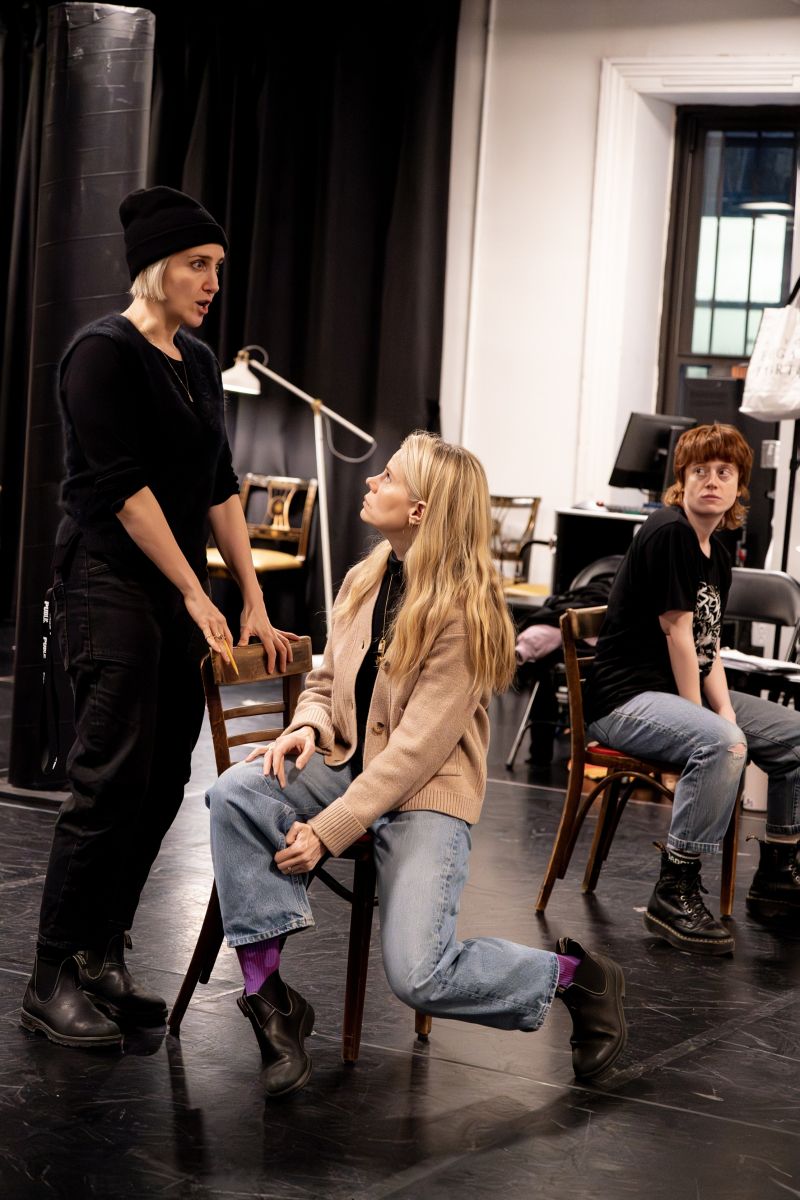 I had never worked with either of them before this piece, [although] I was familiar with both of their work. Tyne was Bart Sher’s associate for many years and although we never overlapped, he talked about her a lot. The piece of that that was very moving to me, and it’s about [the passage of] time, is that when I worked with Bart, he also talked incessantly about Garland Wright, who was his teacher at the Guthrie Theater. He would teach us things that Garland had taught him. And now, working with Tyne, who talks about Bart, I feel this lineage, moving through me through time.
I [once] said to Bart, “You are with me in every room I go into.” Many directors are. But in this particular case, even though Tyne and I had never worked together before, we had such a shorthand because of our mutual mentor who was nowhere in the actual physical room but had been so impactful on both of our lives. And through Bart, Garland and all of Bart’s other teachers [are also in the room] and that’s really meaningful to me.
Anna… Anna is one of the great American Playwrights that we don’t know as much about [as we should]. I am really invested in her voice being heard more in the American theatre. Her brain is really wild and this play’s ambition is something that really drew me to it. I love a living room play with a couch and a family. But I also think these times are asking for something that is new and something that’s maybe a little bit harder to wrap your arms around.
The preview process for this play was [wild]. It never had another production before this or even a reading that was more than a week long and it’s a really big play—[especially] given an off-Broadway rehearsal and previews schedule. During the first week of previews, Anna was like: “I need to re-order the entire first act. I realize that I have put [scenes] in the wrong order.” [For me], as the person who is leading us through the play, I then needed to [work] to remember what comes next and where we are in the play, with those changes.
Then [during] our second week of previews, which was [also] our last week of previews, Anna texted me and she [said], “I’ve been wondering if maybe your character’s speeches shouldn’t be in the third person.” Up to that point, they always had been. She was like, “I think they need to be in the first person and I actually think that they need to be different speeches.” I didn’t disagree. I thought [the rewrite] was a great idea. She wrote on Tuesday. On Wednesday, I went on and I learned four new monologues in the first person that were different monologues [than before]. I carried a book and read the other two for the second act. I came home on Wednesday night and learned the other two monologues. On Thursday night, I put them all in. On Friday night, I had a minor meltdown where I was [feeling] at capacity, and like I didn’t know how to do this. And then on Saturday, critics came.
On the one hand, people [understood] how insane it was and we all knew it was a big lift. But—and this goes back to Anna and her amount of rigor with the piece—I’ve also been a part of so many projects where at a certain point, the writer is just like: “this is the play. I don’t know what to tell you. Is it perfect? No, but this is what I have, this is it.” And of course, you can only do what you can do. But this was something different. And however at max I felt, I was also so grateful that we were all staying really in it.
That [extends] to the entire cast, [because] the big lift was really on everyone.
I just saw Vicki Clark and I don’t know what it is—maybe it’s aging and that I’m getting close to 50—but I [find myself] going back to the lineage of it all. I have been in rooms where I have watched artists [like Vicki] do something that caused me to think: I don’t understand how that just happened! And I thought I could maybe be that person [now] for all of these younger, extraordinary actors. I could create that imprint and [rise to the challenge]. It [made me] think about Christian Borle as well as Vicki Clark. Those are two artists that I watched take this massive thing and go: this is how we do it. I [realized]: that’s my position now. It’s [my turn] to be that person.
It’s an astounding feat, what you do on stage in this play—and I didn’t know any of that before! That’s wild.
I feel pretty high capacity. I’m happy doing the work. But [in this case], I got to a place where I realized I was capable of going beyond what I thought I was. I was grateful to know I could do something that was beyond my imagination.
I don’t think I’ve ever done an interview in my life where teachers haven’t come up in some capacity - whether it’s teachers at school or a director or collaborator who teaches you something, like you were talking about earlier. I just got back from spending last week at Florida Thespians, with 8,000 theatre high schoolers, and it was so moving to see how impacted they were by their teachers and then also see alumni coming back who are still impacted by their teachers. Are there any lessons you feel like you’ve taken with you from teachers in your life that you’d want to share? Anything you’ve carried into this production?
I so identify with all of that. I had a voice teacher in high school who was so tough. She was not particularly friendly and she had unreasonably high expectations. And then in college, there was not a lot of room for mess and creativity. There was this expectation of professionalism and preparedness that I think has served me so immensely in my life. And then I also had a voice teacher in college whose expectations were high but who was so different from my high school voice teacher. Her whole idea about a singing voice was that it is an expression of the soul and because there’s only one soul, you have this voice that is your own and no one else has it. How can you hone that sound as opposed to imitating someone else—which a lot of people do when they come to college? I think about all of that.
There’s this Agnes deMille - Martha Graham exchange [too], about how you have this one thing that nobody else has. So while I’m always looking to try to fill out a bigger version of myself as an artist, I’m also trying to remember this part of me that is only mine that might be useful in this moment. I try to embrace that and it has stayed with me for decades.
Is there anything that you’re watching or listening to right now that you’re finding inspiring? Any recent theatre you’ve seen or anything else that has filled your cup as a viewer or listener?
I just saw Mother Russia at the Signature which I absolutely loved. I [love] these new plays that are taking big swings and that are funny and meaningful. There was such artistry in that whole piece, from the writing to the production to the performances. I just loved this really beautiful book called The Wilderness by Angela Flournoy. When you’re immersed in a play, it’s really easy to feel like you can’t come up for air. I’m a pretty avid podcast listener and I try to know what’s [happening] in the world without over-saturation.
I go [to] a really amazing acupuncturist and she [asked], “What are you doing for fun?” And I [said], “What are you talking about?” That doesn’t even feel like it’s on the table [during the run of a play]. She said I had to carve out time to see [my] friends. It sounds cheesy, but the truth is that if I need to refill my cup all I need to do is like gather some people together—or even one person, and just get in there. Since we’ve opened, that’s been a lot more [possible].
Your siblings seem like such an important part of that community. Do you want to speak about how you’ve been impacted by each other’s work over the years as artists and also as humans?
My sister, for so long, had a theater company that was very [much] geared toward women’s and trans people’s stories. Her feelings about what theatre [can be] really opened the aperture for me about how theatre can exist and be useful. She is always moving through me in terms of how I think about what I want to do and projects I want to be a part of. [It’s] not that she dictates it, but her voice is in my head.
Both of my siblings are such an enormous part of my life. When you are a mother and you are an actor, the village has to be so intact. My sister, from the moment that [my son] William was born, was a person that could come into my home and take him and be like, “Go lie down.” It was harder than I imagined it would be for me to do that, and [my sister] continues to not only take care of William but also [gives me] wisdom and advice [that] I value so enormously. Having somebody I can count on [in that way] is really, really helpful.
My brother just wrote this book, Limelight, and he gave me an early copy to read. I cannot believe he wrote this book. It’s extraordinary. There’s something [so special] when you see your people on stage—but I know what it’s like to do that. I do not know what it’s like to write a huge novel! I was like, “Andrew, whatever I can do to help get this book out into the world, I [want to do].” Halfway through, I [had] a great idea: a book event with a conversation [as well as] Broadway actors singing songs that [have to do with] the book. In [Limelight], the protagonist goes to LaGuardia [High School of Performing Arts] and they’re doing Pippin and he’s in performance classes. So two weeks ago, we got to do this event at the New Victory.
Not only do I get to be in the same profession as my siblings, but I [get to] be so inspired by my siblings. Especially this recent [new] way that I’ve seen my brother just pushing himself into the unknown. I’m in awe of his ability to pick up something that he has never done before and try—and then do it so successfully! It’s like, semi-annoying but also extremely inspiring.
I can’t wait to read his book.
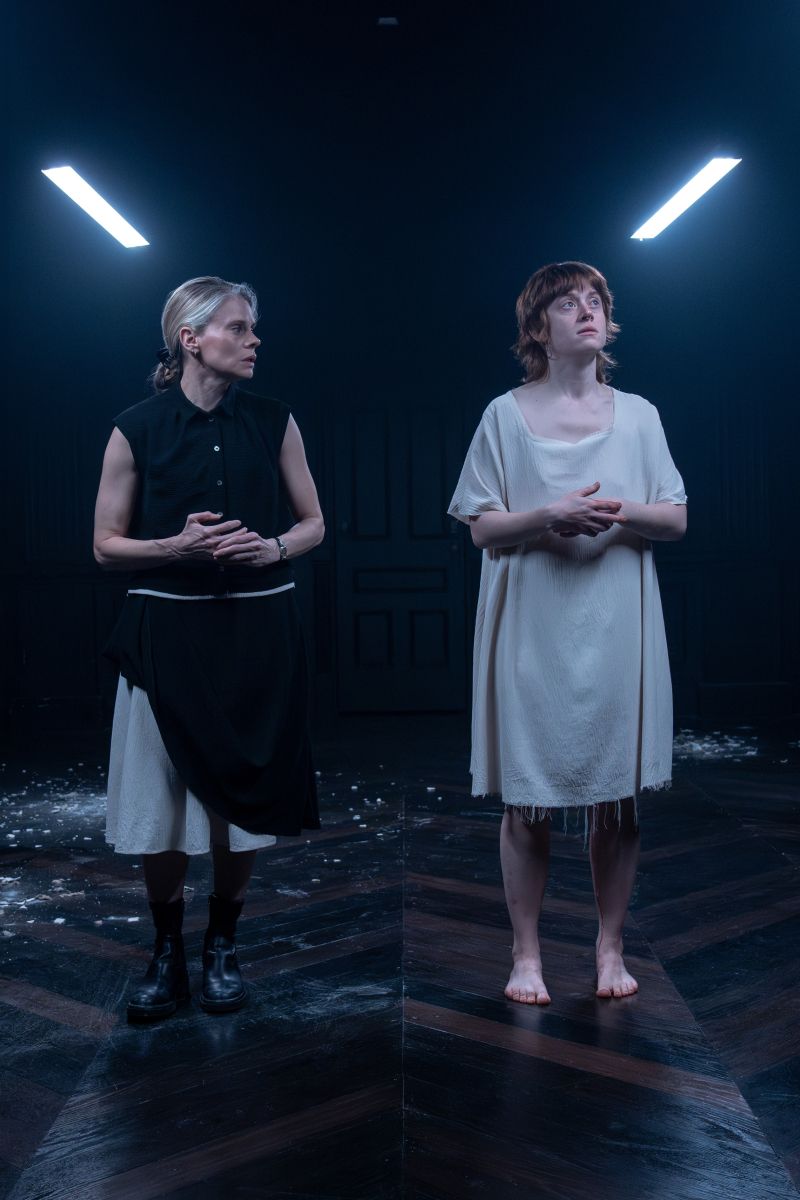
You and Susannah Perkins have such a powerful connection on stage. It feels physically palpable. Did you know each other before working together? And what kinds of conversations did you have in rehearsal about the ways that those roles intersect so uniquely and differently from most roles in plays?
When I saw Susannah in The Wolves I was like: who is that?! And when can I be in a play with them?! Over the years, we’ve done a lot of readings together and we are always like: well, this is nice, but someday we’re going to get to do a [full production].
When there were some casting conversations about the role of Antigone [in this show] I maybe went a little bit out of my lane. I [said], “It should be Susannah Perkins! It should absolutely be Susannah Perkins. That is my first choice. I think they are built for this role.” They did not need my vote of confidence but I think it was one of those situations where when they came in [to audition], everybody was like, “Oh! Oh.” I left a voice note and I was like, “We did it. We did it!”
As I’m talking about this lineage of older actors who I feel so impacted by, [it’s also true that] getting to watch Susannah Perkins on stage is such a gift. My character is locked in the entire time to what they are doing. The lessons and knowledge that I get watching them, the unselfconsciousness and the presence of what they bring to the role… I will never stop being nourished by it.
Susannah lost their mom about a year ago and we’ve had a few conversations [about that]. I think we talk around a lot of things for fear of naming something and then ruining it—but I feel there are a lot of different parts of ourselves and our own families of origin in play on this stage.
When I talk about the loneliness of not being able to have a scene partner, then to actually have that connection at the end feels like such massive catharsis and such a gift. I know I just have to get through because at the end, I have something waiting for me. And that something is Susannah.
What is it like to have roles you originated now being done by high schools and regional theaters all over the country? I imagine that will also happen with this play where more people will do it and be thinking of you when they do. What is it like to have that legacy of originating roles? And have you had experience of going to see new productions of shows you created?
Well, [we have to talk about] the Spelling Bee that is happening right now!
To be totally honest, I didn’t know if I needed to see the show again. I was part of that production for so long; I think it might be the longest run I’ve ever done. I did it for four months off-Broadway and then a year and a half on Broadway. I watched it so many times. And that original cast… I don’t know how you get better than that. I felt like [if I went], I was going to be longing for something else.
Then the entire original cast was invited to opening [of the current off-Broadway revival]. And I had an entire 180 degree experience [from what I thought I would]. I loved it SO much. [I had] such pride that I had been any part of the beginning of it. I was not expecting to feel that. That piece is so special and so indestructible in certain ways, but I feel like what this production was able to do is have the current of the original in it and still feel very of-the-moment and fresh.
Sometimes when you play a role and then you see someone else do it, you think: I need to steal some of those things [they’re doing]. When the [Spelling Bee] tour went out with Lauren Worsham [as Olive], that’s how I felt. You don’t want anyone to be better than you, but it’s so much worse if you go and you’re like: that’s not how you’re supposed to do it. That’s the opposite of what my experience was seeing this new off-Broadway [production]. That this thing we made gets to live on is very meaningful and very moving.
And the number of people who come up to me and tell me, “I was in Peter and the Starcatcher and it was the greatest experience of my life…” I think: that checks out. That feels exactly right. I felt that way too, being in that show.
It’s an amazing legacy. Last week at Florida Thespians, I saw teenagers singing “The I Love You Song” [from Spelling Bee]. They love it and they weren’t alive when you guys made it. It looms large in young people’s minds and that’s also [because of] the cast recording.
I think about the enormous impact of cast recordings because in my life, as someone who didn’t live in New York, or close to New York, and did not have a lot of money to make trips to New York, the cast recording was always that portal. It really is so special that I get to be part of that.
We have to touch on The Gilded Age. It’s the best show on television! What has it been like to craft a character on a show like that for multiple seasons? And what excites you about being part of a show that theater people talk about so much? It feels like The Gilded Age is almost both a TV show and a theater event.
One hundred percent. That show is one of the greatest gifts I’ve ever been given. I cannot emphasize enough how lucky I feel to be a part of it. What an absolute joy it is to go to work and be with all of the people who work on [The Gilded Age]. The level of artistry on that show is not always the case for television and from the people who make the props to who is acting in a scene, it is a very high level of artistry.
Also [it’s been] my own [education] in trying to wrap my arms around a different medium! Having ten thousand hours to get to return and return [again] and get to know the A-cam and B-cam and C-cam operators’ names and who does that job and what is their function… that has been so meaningful. And also, just being on a set with Carrie Coon, where I’m like: how do you do what you do?! I just watch her all of the time and try to learn because she is at—well, talk about a high level of artistry. That’s been it’s own sort of education and like grad school for television technique for me. I’m so grateful that it keeps going and that I get to go to a place of work that I just love so much.
ANTIGONE (This Play I Read In High School) is now playing at The Public through April 12.
Photo Credit: Joan Marcus

Sign up for all the news on the Fall season, discounts & more...

|
Powered by

|
.jpg?format=auto&width=300)





Comments
To post a comment, you must register and login.