Blog: RAGTIME's Immigrant Heritage Night Was 'Fuel to Keep Engaging in the Fight'
National Immigration Law Center President Kica Matos writes about her recent experience at Ragtime on Broadway.
Just last month, the Vivian Beaumont Theatre hosted a special event in recognition of National Immigrant Heritage Month. On June 23, Lincoln Center Theater honored a remarkable group of visionary leaders for a special evening at Ragtime to celebrate the extraordinary ways immigrants have shaped – and continue to shape – the cultural, intellectual, and civic fabric of this country.
For over four decades, Lincoln Center Theater has championed storytelling that reflects the complexity, ambition, and evolving identity of American life. Few works embody that mission more powerfully than Ragtime, a soaring representation of a nation straining toward its promise. Ragtime is the adaptation of E. L. Doctorow’s classic novel that follows three fictional families in pursuit of the American Dream at the dawn of the 20th Century: Black pianist Coalhouse Walker, Jr. and his beloved Sarah, Jewish immigrant Tateh and his little girl, and a wealthy white family led by matriarch Mother—a portrait of a country transformed by those who come to it, and by the contributions they make to its culture, conscience, and future. All grasping for the same dream, if only they can hold onto it.
Following the special day, President of the National Immigration Law Center Kica Matos shared her memories of the event with BroadwayWorld:
I almost didn't get to the reception on time. My husband was still making his way to me, having arrived on a train from Connecticut, running late, and I remember checking my phone every few minutes, half-listening for an update, half just trying to take in the fact that I was about to spend an evening at a Broadway theater that had chosen to celebrate and honor immigrants' contributions to this country.
I've spent 24 years working in immigration justice, mostly in rooms that don't look anything like the one I was about to enter — legal clinics, community centers, church basements, courtrooms. So, there was something almost disorienting about walking into a pre-theater cocktail reception with a dedicated focus on centering immigrants.
Part of that disorientation was the moment itself. I had been invited to watch a joyful, powerful show that puts immigrants and marginalized people at its center, at a time when immigrants in this country are being systematically demonized and deported in large numbers by an administration that is openly hostile to them. Sitting in that theater felt like stepping into a different America than the one I spend my days and nights fighting for — not a naive or escapist one, but one that insisted, for two and a half hours, on telling the truth about who has always built this country.
The reception itself set the tone for the rest of the evening —watching the other honorees and guests find each other, and being in conversation with some of them affirmed that this wasn't a room of polite small talk. People were there for a reason, and it showed.
Tucked into the program was a leaflet for attendees that made the evening's purpose explicit. It stated that the performance of Ragtime was in recognition of immigrants’ contributions to America, and that it would honor "a remarkable group of visionary leaders and the extraordinary ways immigrants have shaped — and continue to shape — the cultural, intellectual, and civic fabric of this country.” It invited audience members to stay after the show as Ragtime director and Lincoln Center Theater’s Kewsong Lee Artistic Director Lear deBessonet recognized us onstage alongside the Ragtime cast. Reading it before the lights went down, I felt the weight of what was about to happen settle in — this wasn't a courtesy mention. It was the stated purpose of the evening.
Then the show began.
I knew about the play going in, at least on paper — the story of immigrants, African Americans and privileged Americans, all living in a country straining to make good on what it says about itself. But knowing a story and watching such an incredible production among people who've lived some version of it are two very different things. There wasn't one moment that hit hardest; the whole show built and held that weight from the opening number straight through to the curtain call, one wave after another, until I stopped trying to brace against it and just let it move me. The woman seated next to my husband and me wept nearly the entire performance, and I understood exactly why. There were moments when I too, shed tears.
By the time the lights came up, I wasn't thinking about the show as a period piece — I was thinking about how little the questions at its center have changed: who belongs, who gets believed, who is welcomed and who is maligned, who gets to write themselves into the country's story instead of being written about, or forgotten altogether.
I was also thinking about my own organization, NILC, where we've been working assiduously in recent years to build a real narrative and culture-change prong into our work. We believe, as an article of faith at this point, that arts and culture can shift hearts and minds in ways that even the most perfect legal brief never will. Sitting in that theater, watching an audience collectively laugh and cry and gasp and go quiet at exactly the right moments over a story about immigrants and belonging, I felt that belief confirmed in real time.
After the curtain call, Lear deBessonet came on stage. She spoke passionately and with real power about why the theater had chosen this night to honor immigrants, drawing a direct line between the story onstage and the work of the twenty-nine of us being recognized. It wasn't a rote thank-you-for-coming speech. She named the throughline between Ragtime's characters straining toward belonging, making linkages to the present day.
She was the one who handed each of us our certificates, one by one, as we stood together in a theater that had just spent two and a half hours making the case for exactly who we are and why we matter. Then we posed for photos with the cast — still in costume, still, in some sense, half in character. People who had just spent the evening embodying the very story we spend our days trying to protect.
There is a particular kind of power – especially today -- in being in a room that was completely unapologetic about celebrating and supporting immigrants — precisely because of how dark and hostile this moment is for immigrants in this country. It would have been meaningful in any year. For me, being in a space that refused to hedge or soften what it was celebrating felt less like an amazing evening and more like I was being provided with fuel to keep engaging in the fight.
I don't think I fully processed it until later, looking at the photos from the evening. It is an oddly weighty thing to have a piece of paper and a photograph recognize work that we at NILC are advancing, during a time when we are repeatedly and urgently called on to respond to real human suffering, when the stakes are so high and the risks are not abstract.
What has stayed with me since that night is the reminder that a room like that — an American theater, on an American stage, telling an American story — chose immigrants as the reason to gather. Not as a subplot, not as a talking point, but as the whole point.
I'm deeply grateful to Lincoln Center Theater for the invitation, to the brilliant cast and creative team of Ragtime for a production that clearly understands exactly what story it's telling and why it still matters, and to everyone in that room on June 23rd who reminded me, that night, that this work is seen.
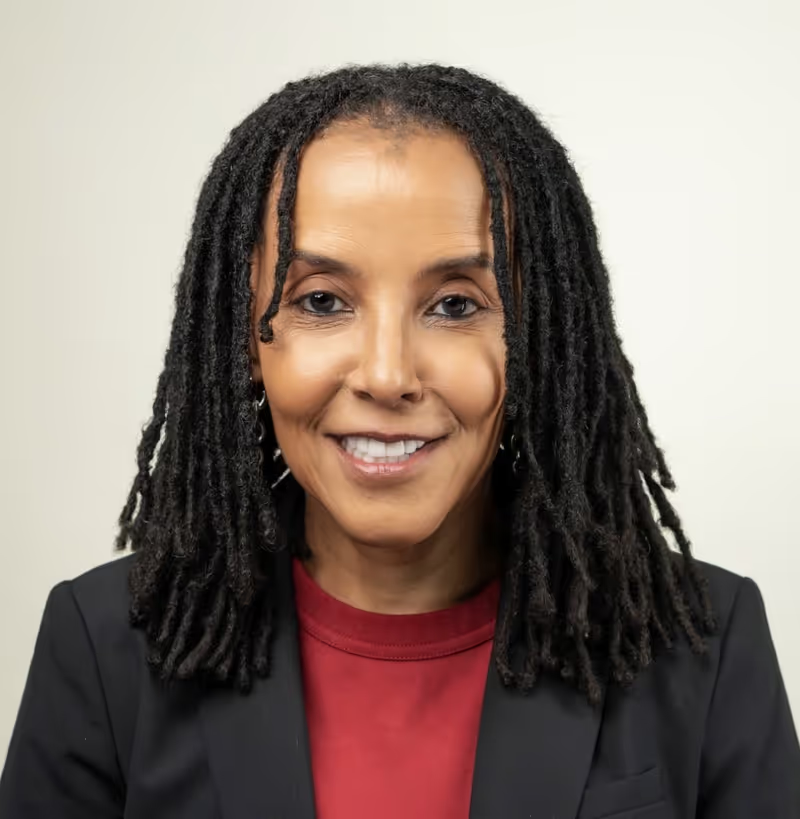
Kica Matos is the president of the National Immigration Law Center (NILC) and the Immigrant Justice Fund (IJF). She is also a Distinguished Practitioner at Yale University’s Brady Johnson Program in Grand Strategy. Kica joined NILC and IJF as executive vice president of programs and strategy in January 2023. Prior to this, Matos was vice president of initiatives at the Vera Institute of Justice. She also served as the director of immigrant rights and racial justice at the Center for Community Change. She has extensive experience as an advocate, community organizer, and lawyer.
Kica has also headed up the U.S. Reconciliation and Human Rights Program at Atlantic Philanthropies. Before joining Atlantic Philanthropies, she was deputy mayor in the city of New Haven, where she oversaw community programs and launched new initiatives including prisoner re-entry and youth and immigrant integration. Kica was previously the executive director of JUNTA, New Haven’s oldest Latino advocacy organization. She also worked as an assistant federal defender for death sentenced inmates and with the NAACP Legal Defense and Educational Fund and Amnesty International on death penalty and criminal justice issues.
She has a B.A. from Victoria University of Wellington, New Zealand, an M.A. from the New School and a J.D. from Cornell Law School. She was awarded honorary doctorate degrees from Albertus Magnus College in 2017 and the University of New Haven in 2019. She is a recipient of the John F. Kennedy New Frontier Award and in 2021, she was inducted into the CT Women’s Hall of Fame.
Photo Credit: Tricia Baron

Weekly top stories - unsubscribe anytime.
BroadwayWorld Merch
Shirts, mugs, phone cases & more


Powered by

|

.jpg?format=auto&width=300)