10 Great Movies About Theater, Actors, & Show Business
BroadwayWorld is pulling back the curtain on some of the best movies about theater.
As we move further into 2026, there has never been a better time to celebrate the long, deeply intertwined relationship between two of humanity's most beloved art forms: cinema and live theater. Few things capture the electricity of stage life quite like a well-crafted film that pulls back the curtain on the world of performance, and for Broadway fans specifically, the options are richer than ever. BroadwayWorld has put together a list of ten films spanning nearly five decades of filmmaking that offer a compelling taste of theatrical drama and comedy, most of which can be streamed from the comfort of your home.
What separates these films from the broader category of entertainment industry dramas is their specificity. Whether the story centers on an aging Broadway star fighting to hold her place under the spotlight, a scrappy group of community theater enthusiasts mounting an impossible production, or a playwright racing against time to finish a Broadway musical, these movies understand the theater from the inside out.
This is not by any means a fully exhaustive list. However, every title included is widely regarded as exceptional by both critics and general audiences, with several having earned significant recognition at the Academy Awards, BAFTA, and beyond. The genres range from outright comedies and mockumentaries to psychological dramas and international arthouse cinema, but they all share one common thread. Whether the central conflict unfolds backstage during a Broadway play or inside the walls of a theatrical production mounted under the most unlikely of circumstances, each film showcases the business of show in all its messy and magnificent reality. Take a look at the full list below, and happy watching.
Hollywood's Long Love Affair With the Stage
The relationship between Hollywood and Broadway stretches back to the earliest days of sound cinema. When the talkies arrived in the late 1920s, studios immediately recognized that the stage was a goldmine of ready-made material, and Broadway plays were rapidly adapted for the big screen.
As the decades progressed, stage actors themselves became some of the most sought-after talents in the film industry. Studios understood that performers trained in live theater brought a discipline, range, and presence to the big screen that was difficult to manufacture. An acting troupe built on theatrical tradition brought a depth of craft that elevated whatever project it touched, and directors were eager to harness that energy. Hollywood did not merely borrow from the stage. It romanticized it, portraying the world of theater in film after film as a place of passion, rivalry, sacrifice, and transcendence, a story worth telling over and over again at varying levels of drama and intensity.
The backstage drama emerged as one of Hollywood's most durable and beloved genres precisely because it offered something other film categories could not. The story of what happens behind the curtain, away from the audience and the applause, gave filmmakers permission to explore ambition, ego, vulnerability, and the cost of artistic obsession in their rawest forms. From the golden-age melodramas of the 1930s and 1940s through to the psychological complexity of films like All That Jazz, the genre evolved continuously, absorbing the anxieties and aspirations of each new generation of artists drawn to telling stories about storytellers.
All That Jazz, in particular, represents a watershed moment in cinema's approach to the theater world. Bob Fosse's 1979 semi-autobiographical masterpiece used the stage as both setting and metaphor, blurring the boundaries between performance and reality in ways that influenced virtually every serious backstage drama that followed. It remains one of the best movies ever made about the creative life in its entirety, the ecstasy and the wreckage of it, and its fingerprints can be found across many of the ten films on this list. Understanding where these movies come from and the long tradition they belong to makes watching them a significantly richer experience.
The Films Organized by Era: The Twentieth Century (Pre 2000)
Opening Night (1977) — John Cassavetes
From renowned director John Cassavetes comes one of the most psychologically rich and emotionally demanding theater films ever committed to celluloid. Opening Night centers on Myrtle Gordon, a famous actress in the middle of an out-of-town tryout for a new play. When a young fan is struck and killed by a car right outside the theater following a performance, Myrtle witnesses the tragedy firsthand and becomes increasingly haunted by the spirit of the young woman in the days that follow. What begins as grief quietly curdles into something far more destabilizing, as Myrtle is forced to confront her changing identity, her fear of aging, her loneliness, and the deeper question of what her life and work actually mean. The film explores the intense emotional toll on stage actors as they perform in front of an audience, highlighting the pressure they face regardless of whatever personal struggles are unfolding just beyond the dressing rooms.
Opening Night portrays the intense emotional toll on stage actors with unflinching honesty, as Myrtle Gordon struggles with her mental health after witnessing a traumatic event, highlighting the psychological challenges faced by performers who must deliver night after night, no matter the cost. The late, great Gena Rowlands turns in what many consider the performance of her career in the lead role, a portrayal of such raw and unguarded humanity that it feels loosely based on the real and universal fears that haunt every serious artist. Cassavetes, who was Rowlands' husband in real life, directs with the kind of intimate ferocity that only someone deeply familiar with his subject could achieve, and the result is a film that feels less like a production and more like a confession. The unexpected virtue of the movie is how it refuses an easy resolution, instead sitting with the discomfort of a woman who has not yet found her way through.
Opening Night has gained a deeply devoted following and is now widely regarded as one of Cassavetes' finest achievements. It eventually inspired a new movie, a 2024 stage musical of the same name written by Rufus Wainwright, cementing its legacy as a work that continues to generate creative dialogue decades after its release. Opening Night feels like a direct spiritual precursor, engaging many of the same themes around aging, visibility, and the entertainment industry's complicated relationship with women who dare to grow older. In the same way that Funny Girl explored the cost of stardom from the outside, Opening Night tears it apart from within, and the result is a film that only grows more urgent with time.
The Dresser (1983) — Peter Yates
Based on the Tony-nominated play by Ronald Harwood, The Dresser is a masterfully constructed two-hander that plunges the viewer into the exhausting and deeply codependent relationship between a crumbling theatrical star and the man who keeps him standing. The film follows Norman, the loyal and long-suffering dresser to an aging theater actor and director known only as Sir, whose health is deteriorating at an alarming rate even as he insists on taking the stage. Sir is the kind of towering, tyrannical figure who has built his entire life and identity around performance, and as his memory fades and his grip on reality loosens, it falls entirely to Norman to hold the production together. The setting is wartime Britain, and the theatre troupe they belong to is itself a kind of living metaphor, a company of artists pushing forward under impossible conditions because the show, as it always must, demands to go on.
Director Peter Yates brings a remarkable sense of claustrophobic intimacy to the material, keeping the camera close and the emotional temperature constantly near the boiling point. At the center of everything are two performances of extraordinary life and precision. Albert Finney plays Sir as a man of genuinely Shakespearean dimensions, a star whose grandeur and cruelty are inseparable from one another, and whose final performance of King Lear becomes a devastating meditation on what it means to give everything you have to an art form until there is nothing left. Opposite him, Tom Courtney reprises the role of Norman that he had previously inhabited in both the West End and on Broadway, and his work here is a masterclass in the stage beauty of a quieter kind, a life poured entirely into the service of another person's greatness. There is something of Gene Wilder's gift for playing fragility and fierce devotion simultaneously in Courtney's performance, a quality that makes Norman one of the most fully realized supporting figures in all of cinema.
The Dresser was nominated for five Academy Awards, including Best Picture, Best Director, and individual nominations for both Finney and Courtney, a rare double acting recognition that speaks to the film's extraordinary performances. Though it did not win on the night, its reputation has only deepened in the decades since, and it is now considered one of the finest British films of its era. In 2015, the story was revisited in a celebrated television remake starring Ian McKellen and Anthony Hopkins as Norman and Sir, respectively, two titans of stage and screen whose own life histories lent the material an additional layer of resonance. The Dresser remains essential viewing for anyone who wants to understand what it truly costs to be a star.
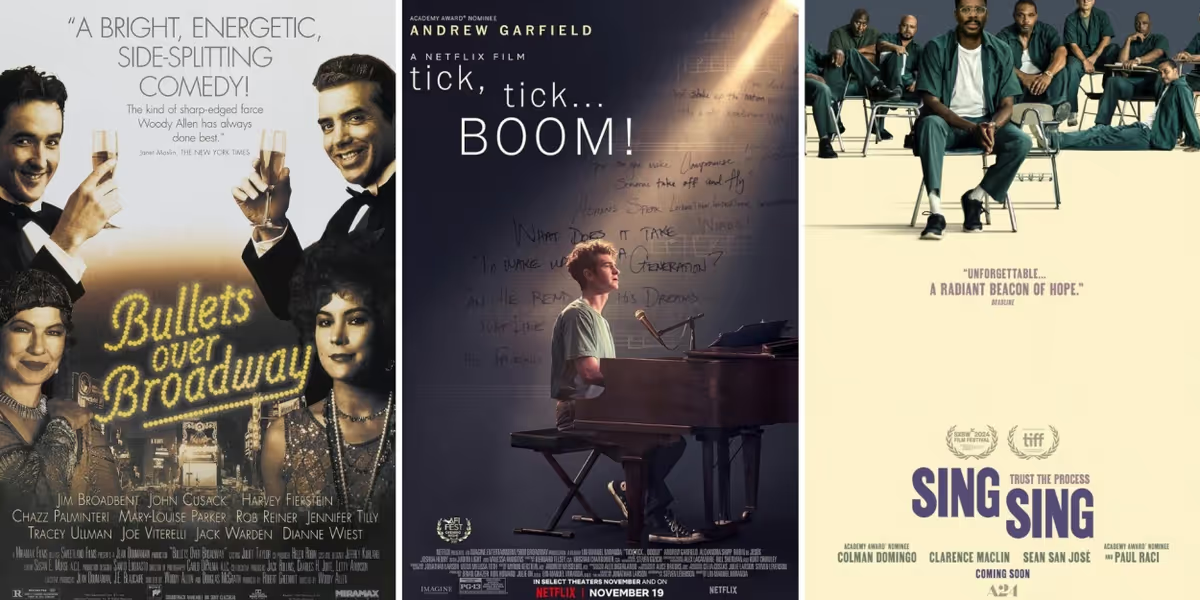
Bullets Over Broadway (1994) — Woody Allen
From controversial director Woody Allen comes Bullets Over Broadway, a wickedly funny and surprisingly sharp comedy that merges the worlds of New York organized crime and theatrical production in ways that feel both absurd and entirely believable. The film follows David Shayne, an idealistic and self-serious up-and-coming playwright played with wonderful comic timing by John Cusack, who lands the opportunity of a lifetime when a major investor agrees to finance his new Broadway play. The catch, as there always is one, is that the investor is a powerful gangster who insists that his talentless girlfriend be cast in a leading role. The film is set in 1920s New York, and Allen recreates the era with tremendous style and affection, giving the whole production a screwball energy that recalls the great comedies of Hollywood's golden age.
The ensemble Allen assembles around Cusack is one of the great comic casts of the 1990s. Jennifer Tilly is an absolute revelation as the gangster's girlfriend, delivering a performance of such perfectly calibrated comic obliviousness that it earned her a richly deserved Academy Award nomination. Jim Broadbent and Tracey Ullman round out the theatrical company with scene-stealing energy, while Harvey Fierstein brings genuine warmth and industry knowledge to his role as an acting manager, a casting choice that theater fans will particularly appreciate. The true revelation, however, is Chazz Palminteri as Cheech, a gangster bodyguard who turns out to possess a startling natural gift for dramatic writing. The role is a knowing nod to Palminteri's own real-life roots and his celebrated success with A Bronx Tale, and he brings to it an authenticity and comic gravity that gives the film much of its heart.
Dianne Wiest delivers what many consider the comedic performance of her career as Helen Sinclair, a fading theatrical star of enormous ego and even larger personality, and the Academy agreed, awarding her the Oscar for Best Supporting Actress. The film itself received seven Academy Award nominations in total, a remarkable achievement for a comedy, and stands as one of Allen's most purely enjoyable and craftfully constructed works. In 2014, a stage musical based on the film premiered on Broadway, completing a full circle journey from screen to stage that felt entirely appropriate for a movie so deeply in love with the theater world it satirizes. Much like the best work of the era, Bullets Over Broadway understands that the most effective way to honor an art form is sometimes to laugh at it without mercy, and the result is a film that remains as sharp and entertaining today as it was upon its release.
Waiting for Guffman (1996) — Christopher Guest
Fans of Best in Show are in for a genuine treat with this wildly funny and surprisingly tender mockumentary from Christopher Guest and Eugene Levy, two of the sharpest comic minds of their generation. Waiting for Guffman takes place in Blaine, Missouri, a small and deeply self-satisfied town preparing to celebrate the sesquicentennial of its founding with an original theatrical production. At the center of the chaos is Corky St. Clair, played by Guest with a commitment to character that borders on the heroic, an outlandish and passionately deluded community theater director who has relocated from New York and has brought with him an ambition entirely out of proportion to his surroundings. Corky throws himself into the production with the fervor of a man who genuinely believes he is mounting the most important theatrical event of the decade, and the film mines that gap between his vision and reality for comedy that is both relentless and oddly moving.
The ensemble Guest and Levy assemble around the production is one of the finest collections of comic talent ever gathered for a single film. Eugene Levy and Catherine O'Hara play a sweetly deluded married couple who regard their work at a travel agency as merely a pause between their true destinies as performers. Fred Willard and Parker Posey round out the company with performances of extraordinary comic specificity, while Lewis Arquette brings a quiet and dignified absurdity to his role as one of Blaine's elder statesmen of amateur performance. The film was largely improvised by its cast, a creative choice that gives every scene a loose, spontaneous energy no amount of scripting could have manufactured, and the result is a comedy that feels genuinely alive in a way most films simply do not.
What elevates Waiting for Guffman above simple parody is the unmistakable affection at its core. The film is sharp and often laugh-out-loud funny in its observation of small-town self-importance and theatrical delusion, but it never condescends to its characters or dismisses the very real joy they derive from their participation in community theater. The entire production hinges on the imminent arrival of Mort Guffman, a Broadway producer who has apparently expressed interest in attending the show, and the anticipation of his presence gives everyone involved a sense of purpose and possibility that is genuinely touching to watch. Waiting for Guffman honors that impulse even as it laughs at it, and that combination of warmth and wit is precisely what has kept the film beloved for nearly three decades.
The Twenty-First Century (2000–Present)
Synecdoche, New York (2008) — Charlie Kaufman
Perhaps the most unconventional film on this list, Synecdoche, New York marked the feature directorial debut of Charlie Kaufman, the writer behind some of the most adventurous and cerebrally demanding screenplays in modern American cinema. Having previously penned surrealist landmarks like Eternal Sunshine of the Spotless Mind and Being John Malkovich, Kaufman stepped behind the camera to tell the story of Caden Cotard, a theater director in upstate New York whose body is failing him even as his artistic ambitions continue to expand without limit. Synecdoche, New York (2008) explores the life of a theater director whose life merges with his monumental stage production, a life-size replica of New York City. Beautifully and heartbreakingly played by Philip Seymour Hoffman, Caden is a man of genuine creative seriousness who receives a MacArthur genius grant and uses it to pursue the most audacious theatrical project imaginable, a life-size replica of New York City constructed inside a warehouse, within which he attempts to stage a play that captures the full truth of human existence. The film explores a theater director whose life merges with his monumental stage production so completely that the boundaries between the two eventually dissolve altogether, making Synecdoche, New York one of the most radical meditations on art and mortality ever put on screen.
Where films like 42nd Street and The Band Wagon celebrated the theater world with energy and affection, and The Red Shoes examined the cutthroat nature of artistic devotion through the lens of dance, Synecdoche, New York goes further than perhaps any of its predecessors in asking what it actually costs a human being to pursue total artistic honesty. As Caden's production grows over the years and then decades, consuming his relationships, his health, and finally his sense of self, the film becomes something genuinely vertiginous, a work about the producers of meaning and the terrible loneliness of those who dedicate their lives to creating it. Kaufman surrounds Hoffman with a cast of extraordinary depth, including Michelle Williams, Samantha Morton, Catherine Keener, and Emily Watson, each of whom represents a different facet of the life Caden is simultaneously living and failing to fully inhabit. Dianne Wiest appears in a role of startling and mysterious power, functioning almost like an Eve figure within the film's increasingly strange internal logic, the last human presence in a world that has become entirely theatrical.
Synecdoche, New York was not a major commercial success upon its release, but its critical reputation has grown steadily and substantially in the years since, and it is now widely regarded as one of the genuinely essential American films of the twenty-first century. Hoffman delivered what many consider the definitive performance of his remarkable career, a portrayal of creative obsession and human frailty that carries the weight of everything he brought to every role he ever played. The film resists easy interpretation and rewards repeated viewing in a way that very few works of any era manage, revealing new layers of meaning and feeling each time it is encountered. For audiences willing to surrender to its demands, Synecdoche, New York is an experience unlike anything else in cinema, a film that uses the theater not merely as its subject but as its very structure, turning the act of watching into something uncomfortably close to being watched.
Drive My Car (2021) — Ryûsuke Hamaguchi
Drive My Car follows Yusuke Kafuku, a prominent stage actor and director whose life is quietly shattered when he unexpectedly loses his wife while in the middle of starring in a production of Uncle Vanya. Two years later, still carrying his grief largely unexamined, Yusuke accepts a residency in Hiroshima, where he is tasked with mounting a new and deeply ambitious production of the same Chekhov play, this time featuring a multilingual cast drawn from across East and Southeast Asia. The rehearsal process becomes its own kind of excavation, as Yusuke works with performers delivering their lines in Korean, Japanese, Tagalog, and Korean Sign Language, creating a theatrical environment in which the shared emotional truth of the text transcends every linguistic boundary. Theater not only entertains but also transforms audiences, and Drive My Car makes that argument more beautifully and more rigorously than perhaps any film of its generation, exploring the deep connections between art, life, and personal struggle with a patience and intelligence that is genuinely rare in contemporary cinema.
Director Ryûsuke Hamaguchi, adapting a short story by Haruki Murakami, builds the film with extraordinary deliberateness, allowing relationships and revelations to unfold over a runtime that demands the viewer's full attention and rewards them fully. As Yusuke gets to know the members of his cast and crew, including TV star Koji Takatsuki, who carries his own complicated connection to Yusuke's late wife, and the quietly devastated young woman assigned to drive him between his apartment and the rehearsal space each day, the film becomes a profound meditation on how human beings process loss through the act of performance. Misaki Watari, the driver with whom Yusuke forms the film's central and most unexpected bond, has experienced her own considerable grief, and the long hours the two spend together in the car create an extraordinary space of intimacy and honesty that neither could have found anywhere else. Much like Birdman examined the deep connections between art and personal struggle from a place of frenetic anxiety, Drive My Car approaches the same territory from stillness and accumulated feeling.
Drive My Car arrived in 2021 as one of those rare films that the international film community recognized immediately as genuinely important. It received four Academy Award nominations, including Best Picture, becoming only the third non-English language film in Oscar history to receive that honor, and ultimately won the award for Best International Feature Film. It also won the Best Screenplay award at the Cannes Film Festival, among numerous other international honors, and has since been celebrated by critics worldwide as one of the greatest films of the twenty-first century. At its heart, the film is about what it means to keep living and keep making art in the face of devastating personal loss, and Hamaguchi answers that question not with grand gestures or theatrical epiphanies but with the quiet and cumulative power of two people sitting in a car, talking honestly, moving forward.
Tick...Tick...BOOM! (2021) — Lin-Manuel Miranda
For musical theater fans and creatives alike, Tick...Tick...BOOM! is a film worthy of serious engagement by all artists, along with those who simply want to understand what the creative life truly demands of the people who choose it. Lin-Manuel Miranda, the Hamilton writer and Broadway titan, makes his feature directorial debut here with a project that clearly means everything to him personally, an adaptation of Jonathan Larson's autobiographical musical that Miranda himself championed for years before finally bringing it to the screen. The story follows Larson, played with explosive and deeply felt energy by Andrew Garfield, on the eve of his 30th birthday, a milestone that looms over him with the weight of every unfulfilled ambition he has been carrying since he first decided to dedicate his life to musical theater. A budding composer of extraordinary instinct and restless imagination, Larson is simultaneously trying to finish his ambitious new show Superbia and prepare a workshop presentation that he hopes will finally earn him recognition in the notoriously tight-knit and unforgiving Broadway community.
Miranda directs with tremendous propulsive energy, staging the musical numbers with the confidence of someone who has spent their entire adult life thinking about how songs tell stories, and the result is one of the most viscerally exciting musical films in recent memory. The supporting cast surrounding Garfield is excellent across the board, with Alexandra Shipp and Robin de Jesús bringing warmth and specificity to roles that could easily have functioned as mere satellites to the central performance. Vanessa Hudgens appears in a role that reminds audiences of her genuine musical theater roots, and Bradley Whitford delivers a quietly luminous performance as composer Stephen Sondheim, the great mentor figure of Larson's life, and the eve of a tradition of musical theater craftsmanship that Larson himself was on the verge of carrying forward into a new generation. The film is populated throughout with cameos from Broadway legends that will send knowing ripples of recognition through any serious theater audience.
What gives Tick...Tick...BOOM! Its most devastating emotional dimension is the knowledge of what happened next. Jonathan Larson died of an aortic aneurysm on the morning of January 25, 1996, just hours before the off-Broadway opening night of Rent, the show that would go on to win the Pulitzer Prize and the Tony Award for Best Musical and transform the American theatrical landscape entirely. He was 35 years old. In one extraordinarily poignant moment late in the film, Sondheim's actual voice can be heard, a detail that carries additional weight given the composer's passing in November 2021, just weeks after the film debuted on Netflix. No German spy of sentiment or manufactured emotion is at work here. The film earns every feeling it produces because the story it is telling is real, and the loss at its center is genuine. Tick...Tick...BOOM! is available to stream on Netflix and stands as both a love letter to the creative spirit and a reminder of how much the world lost when Jonathan Larson did not live to see what he had made.
Theater Camp (2023) — Nick Lieberman, Noah Galvin, Molly Gordon, and Ben Platt
For the theater kid at heart, and for anyone who has ever loved one, Theater Camp is an absolute delight, a mockumentary that captures the singular madness and magic of the performing-arts summer camp experience with an authenticity that can only come from people who have lived it. The film arrives from a creative team of four, director Nick Lieberman alongside Noah Galvin, Molly Gordon, and Tony winner Ben Platt, the latter three of whom also star in the film and bring to it a collective understanding of the theater world culture that gives every scene a ring of complete and joyful truth. The story centers on AdirondACKS, a beloved summer camp for young theater obsessives whose founder and director suddenly falls into an unexpected coma just as the season is about to begin. Into the breach step Platt and Gordon as two fiercely devoted and magnificently unqualified staff members who appoint themselves co-leaders of the camp and set about writing and directing an entirely original musical for their young charges, with predictably chaotic and unexpectedly moving results.
What makes Theater Camp work as well as it does is the genuine love that radiates from every frame of the production. Platt and Gordon have a comic chemistry that feels completely natural and unforced, and their characters' relationship, a best friendship of the kind that only the theater world seems capable of producing, grounds the film emotionally even as the plot around them escalates toward glorious absurdity. Noah Galvin is a revelation in a supporting role that requires him to navigate an extraordinarily specific brand of theatrical ego and insecurity simultaneously, and the young performers playing the campers bring an energy and commitment to their roles that consistently threatens to steal the entire film. The mockumentary format, used previously to such great effect in Waiting for Guffman, serves the material perfectly here, allowing the filmmakers to observe their characters with a fond and clear-eyed intimacy that a more conventional narrative structure could not have achieved.
Theater Camp was warmly praised by critics upon its release and earned particular recognition as one of the finest and most purely enjoyable independent films of 2023, a year rich in strong independent cinema. Beyond its considerable entertainment value, the film makes a genuinely sincere argument for the transformative power of theater in young people's lives, and for the particular kind of community that forms around shared artistic passion. There is real substance beneath the comedy, and the film earns its more heartfelt moments precisely because it never condescends to its characters or treats their devotion to the performing arts as anything less than entirely serious and entirely valid. Theater Camp is available to stream on Hulu and represents exactly the kind of warm, intelligent, and deeply funny independent filmmaking that deserves to find the widest possible audience.
The Great Lillian Hall (2024) — Ernest Dickerson
The Great Lillian Hall arrives as one of the most quietly devastating theater films in recent memory, a television drama of exceptional craft and emotional intelligence that uses the world of Broadway as the backdrop for a deeply human story about identity, memory, and the terrifying prospect of losing the very gift that has defined an entire life. The incomparable Jessica Lange stars as Lillian Hall, a Broadway legend of the highest order who is in the process of preparing for what promises to be another landmark performance when she begins to notice something is wrong. The confusion arrives quietly at first, small moments of forgetfulness and disorientation that Lillian attempts to dismiss or conceal, but as the symptoms grow more pronounced and a dire diagnosis becomes impossible to avoid, the film deepens into a portrait of a woman confronting the possible end of everything she has built and everything she is. Director Ernest Dickerson handles the material with great sensitivity and restraint, never allowing the story to tip into melodrama when honesty and stillness serve it so much better.
The supporting cast assembled around Lange is worthy of the material in every respect. Lily Rabe brings tremendous nuance to her role as Lillian's daughter, navigating the complex emotional terrain of a child watching a parent diminish while trying to protect her from the consequences of her parent's condition. Kathy Bates is deeply moving as Lillian's longtime assistant and closest friend, a woman whose devotion to Lillian is absolute and whose grief at what is happening is all the more powerful for being largely unspoken. Pierce Brosnan brings warmth and unexpected delicacy to his role as Lillian's neighbor, offering a connection to the outside world that feels genuinely sustaining amid the gathering darkness. Meanwhile, Jesse Williams is quietly excellent as David, the director of the Broadway production who must navigate the near-impossible position of caring deeply for Lillian as a person while also bearing responsibility for a theatrical production that cannot wait indefinitely for her to find her way back to herself.
At the center of everything, Lange delivers a performance of such grace, poise, and stark and unsparing humanity that it stands comfortably among the finest work of her extraordinary career. She brings to Lillian Hall the full weight of a lifetime spent understanding how human beings carry themselves under pressure, and the scenes in which Lillian's formidable theatrical presence flickers and wavers are almost unbearable to watch in the best possible sense. The film joins a distinguished lineage of works, including Opening Night and The Dresser, that take seriously the question of what happens to performers as they age and as the instrument they have spent their lives perfecting begins to fail them, and it addresses that question with a compassion and an honesty that feels genuinely rare in contemporary television drama. The Great Lillian Hall premiered on HBO in 2024 and is currently streaming on Max, where it deserves to be discovered and celebrated by the widest possible audience.
Sing Sing (2024) — Greg Kwedar
One of the most powerful and genuinely important theater films in recent memory, A24's Sing Sing arrives as a work that transcends the boundaries of what cinema about the performing arts is typically expected to achieve. Named after the notorious New York correctional facility in Ossining where it is set, the film tells the true story of a group of incarcerated men who come together to mount an original theatrical production in partnership with Rehabilitation Through the Arts, a real and remarkable program dedicated to bringing healing, dignity, and human connection to people who have been largely written off by the world outside their walls. Director Greg Kwedar approaches this material with extraordinary sensitivity and a deep respect for the men at the center of the story, crafting a film that is simultaneously a celebration of theater's transformative power and a quietly furious argument about who deserves access to art and what happens when they receive it. The result is a film that sits entirely in a category of its own, unlike anything else released in 2024 or in several years before it.
At the heart of Sing Sing is the friendship between two men, John "Divine G" Whitfield, played with tremendous depth and quiet authority by Colman Domingo, and Clarence "Divine Eye" Maclin, who plays a fictionalized version of himself with a naturalness and emotional honesty that no amount of conventional actor training could have produced. Domingo, one of the finest and most versatile performers working in American film and theater today, brings to Divine G a dignity and an interior life that is genuinely moving to witness, and his chemistry with Maclin gives the film its beating heart. Paul Raci delivers strong supporting work alongside a cast that includes numerous former participants of the Rehabilitation Through the Arts program, a casting choice that lends every scene authenticity and weight that are impossible to manufacture. These are men who know precisely what it means to find themselves through performance, and that knowledge is present in every frame they inhabit.
Since its debut, Sing Sing has become one of the most celebrated and discussed films of its era, with both Domingo and Maclin receiving widespread praise and significant award recognition for their performances. The film made history by becoming the first film ever to be simultaneously screened in correctional facilities alongside its theatrical release, a decision that felt entirely in keeping with the spirit of everything the film stands for and that generated extraordinary and deserved attention. As of early 2026, Sing Sing is available to stream and continues to reach new audiences, encountering the same combination of surprise and profound emotional impact that greeted its initial release. It is a film about theater, yes, but more fundamentally, it is a film about what it means to be human, and about the irreplaceable role that art plays in helping people remember that fact about themselves, even in the most unforgiving circumstances.
Final Thoughts
What these ten films collectively demonstrate is that theater has always been one of the richest subjects available to a filmmaker. Each work approaches it differently, through comedy and tragedy, realism and surrealist abstraction, and yet they all arrive at the same truth. The stage is not simply a place where performances happen. It is a place where human beings go to find out who they are and what it truly costs to pursue something with everything they have.
The range of stories here speaks to how democratic the performing arts are as a subject for cinema. Theater belongs equally to the Broadway legend battling her own memory in The Great Lillian Hall and to the incarcerated men discovering their humanity in Sing Sing, to Jonathan Larson racing against time, and to Myrtle Gordon choosing, night after night, to walk out onto the stage anyway. These are not niche stories. They are stories about what it means to be alive, told through the lens of people who have made that question their life's work.
BroadwayWorld encourages every reader, whether a lifelong Broadway devotee or someone simply seeking exceptional cinema, to work through this list with an open heart. If any one of these films moves you to go and experience live theater for yourself, then they will have done exactly what the best art always does.