


Review: DUO SIQUEIRA LIMA AND YOUNG TAEK JO – ADELAIDE GUITAR FESTIVAL 2025 at Elder Hall, University Of Adelaide
A wonderful concert of guitar virtuosity.
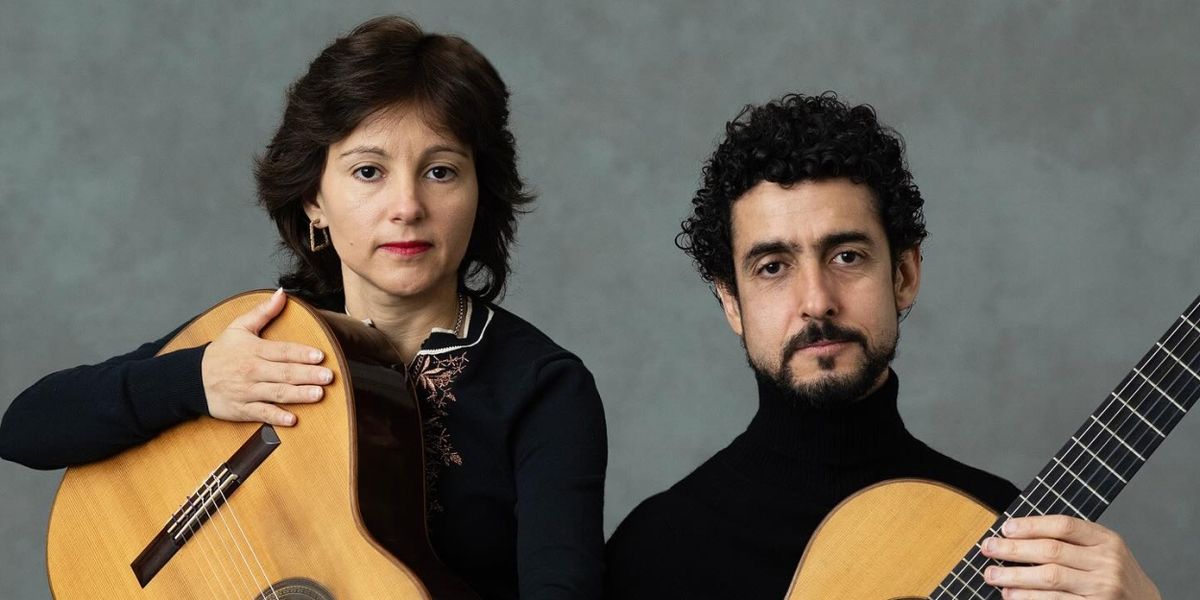
Reviewed by Barry Lenny, Saturday 13th September 2025.
The Adelaide International Guitar Festival once again brings to our city a diverse group of guitarists covering a wide range of styles and genres. This concert brought together Duo Siqueira Lima and Young Taek Jo. Cecilia Siqueira is from Uruguay and Fernando de Lima is from Brazil, while Young Taek Jo comes from Korea. The concert included both works written for the guitar, and arrangements for guitar of works originally written for other instruments. The Festival’s Artistic Director, Slava Grigoryan was on hand to introduce the artists.
South Korea’s classical guitarist, Young Taek Jo, opened the concert, and it was immediately easy to see why he was the winner of the 2024 Adelaide International Classical Guitar Competition. He began with the popular Sonata in E Major, K.380 by Domenico Scarlatti (1685–1757), originally written for harpsichord and arranged for solo guitar. Scarlatti wrote 555 sonatas. His impressive technique and his precision were matched by his sensitive interpretation.
His appearance in the Festival was part of his prize for winning the competition last year. He also received a cash prize and, who wouldn’t be envious, one of Jim Redgate’s magnificent guitars, which he played in this concert.
He turned to the music of Spain for the next work, with two contrasting movements, III, Pavana Triste, a pavane with a deep feeling of sadness, and IV, Final, a fiery movement, from Sonata parra Guitarra, by Spanish composer, Antonio José (Antonio José Martínez Palacios, 1902–1936), his only work for guitar. His performance of the pieces further demonstrated his depth of understanding of the rich culture behind the notes.
Next came A mi madre (To my mother) and Julia Florida by the Paraguayan composer, Agustín Barrios Mangoré (1885–1944), known simply as Barrios. A mi madre is a delicate work that has an open structure demonstrating the composer’s love and respect for his mother, while Julia Florida was written for Julia Martinez, a student of his, a lyrical piece filled with romantic emotion. Young Taek Jo invests both with warm emotions appropriate to each form of relationship.
To end his set, he looked to France, and a piece by guitarist and composer, Roland Dyens, Triaela for classical guitar, movement III, Crown Down, actually titled Clown Down (Gismonti au cirque). Translated as Gismonti at the circus, it was inspired by Brazilian composer and guitarist, Egberto Gismonti. It employs unconventional techniques and alternate tuning, providing a unique opportunity for him to show the extent of his remarkable capabilities. Extensive applause ended his part of the concert.
After the interval, Duo Siqueira Lima brought a change of style to the afternoon, offering a selection of classical and Latin music. Interestingly, they also opened with a piece by Scarlatti, his earlier Sonata in D Major, K.33, another arrangement, for two guitars. This set the pattern for this part of the concert, with her taking the upper, melody lines, and him providing the harmonies and counterpoints. Their long association was evident in the tightness of their musical collaboration.
They then performed the Spanish composer, Ernesto Halffter’s (1905-1989), Danza de la Gitana (The Gypsy's Dance) from his one-act ballet, Sonatina. Filled with strongly rhythmic ideas, fast runs, and punctuated with powerful chords, it showed the virtuosity of these two guitarists.
So many of my favourite composers were represented in this half of the concert. Next, to Brazil, for the Bachianas brasileiras No. 4, by Heitor Villa-Lobos, with the three of its four movements, I, Preludio (Introdução), III, Aria (Cantiga) and, IV, Dança (Miudinho). This suite, one of nine, draws on both the compositional style of Bach and the folk and dance music of Brazil, giving them scope to to engage with the contrapuntal ideas of the Baroque blended with that wonderful Latin influence, providing the audience with a insight into the way in which composers are aware of and influenced by past and contemporary sounds to create new ideas.
It was back to Europe, next, and Claude Debussy’s Arabesque No.1 in E Major, Andantino con moto, originally written for piano. It employs many of his techniques, which make his style unmistakable. Their interpretation was superb.
Brazilian accordionist and composer Hermeto Pascoal’s very lively song, Bebê, came next, without the vocals, their fingers flying unerringly along the fretboards. Nicknamed O Bruxo (the sorcerer), Pascoal worked with such influential people as the percussionist, Airto Moreira, trumpeter, Miles Davis, and singer, Flora Purim. The Latin Jazz feel is on display in this song.
Uruguayan Latin jazz composer Hugo Fattoruso’s Sin Nombre (Candombe) incorporates percussion, tapping various points on the guitar’s bodies to simulate Candombe style percussion, which is played on three different-sized drums, and comes from Montevideo's Barrio Sur district. This piece displayed more of the skills of these two marvellous musicians.
I am always more than happy to hear the music of the great Argentinean bandoneonist and composer, Astor Piazzolla, and two of the three movements of his Tango Suite followed, the Andante and Allegro. This work, in what is known as nuevo tango, fusing tango with jazz, and classical music, was specifically written for two guitars. From their impeccable performance, it seemed clear that the duo had a great fondness and reverence for this work.
IXO, or Um a Zero, by Brazilian composer, Alfredo da Rocha Viana Filho (1897 –1973), better known as Pixinguinha, is in the style that he developed, known as choro and celebrates soccer and its players, a very popular sport in Brazil. In 1919, the Brazilian team won the South American championship, one-nil. The duo conveyed all of the excitement that such an event would have meant.
The gentle Contrato de Separação, without lyrics, acting as a brief prelude to the lively Nilopolitano, both by Dominguinhos, brought the printed programme to its conclusion. Extended applause followed, every bit of it greatly deserved by these two sensational musicians.
To the delight of the audience, they ended their performance with an encore, with him snuggling up behind her and reaching around to play the choro style piece, Tico-Tico no fubá, by Brazilian composer, Zequinha de Abreu (1880-1935), on the same guitar, including quite a few humorous interactions as they played. A well-deserved standing ovation followed to close the afternoon concert.
Sadly, like so many Festival performances, it was the only opportunity to see and hear these three remarkable musicians, but, hopefully, they’ll all be back again sometime soon.
Photography, Nicholas Sinclair.
|
Log Boy State Theatre Company South Australia (10/01-10/10) |
|
Faulty Towers The Dining Experience - Darwin Oaks Elan Darwin (8/20-8/22) |
|
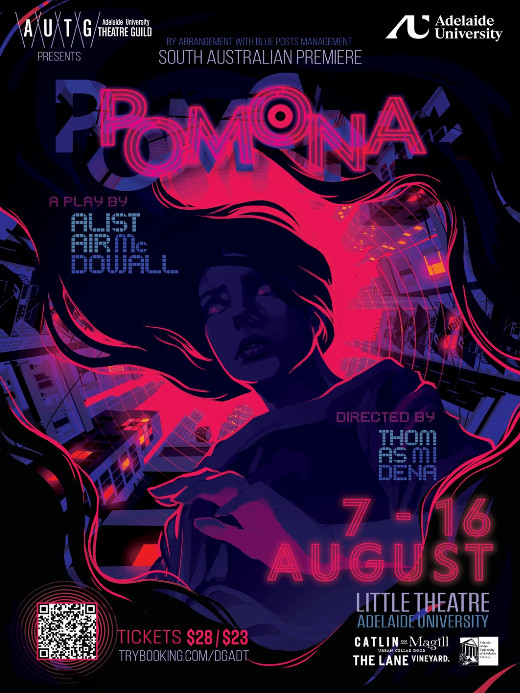
POMONA Adelaide University Theatre Guild (8/07-8/16) |
|
The Heartbreak Choir State Theatre Company South Australia (11/20-12/05) |
|
Commentary State Theatre Company South Australia (8/21-9/05) |
Reader Reviews
To post a comment, you must register and login.