


Review: A STRETCH OF THE IMAGINATION at The Studio, Holden Street Theatres
Meet an archetypal Aussie bloke
Reviewed by Ewart Shaw, Wednesday 25th June 2025
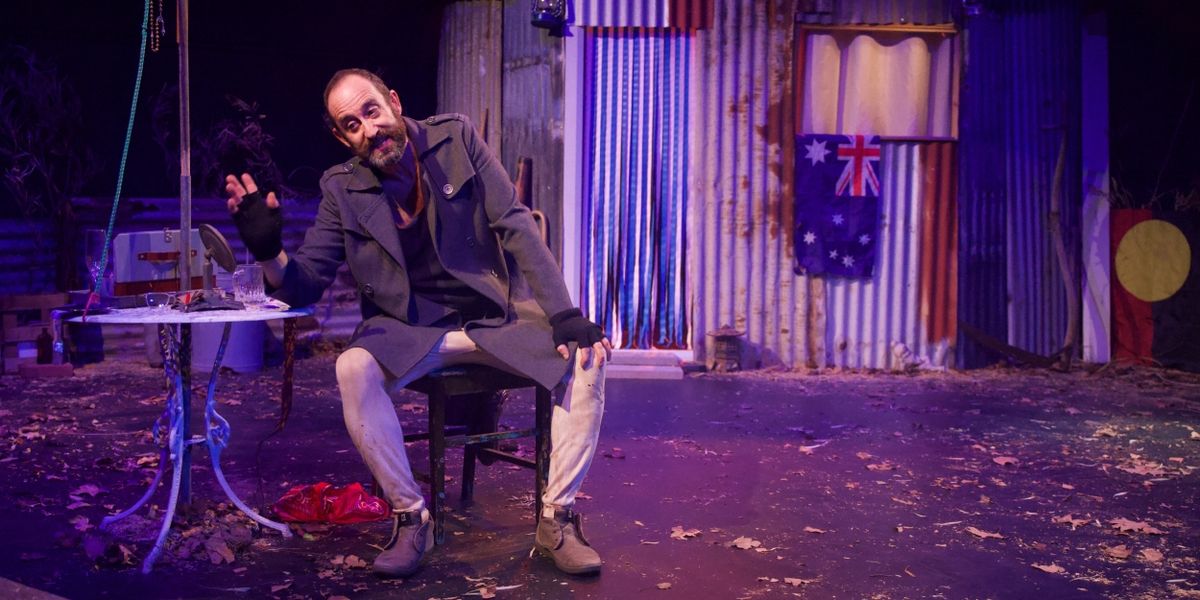
Monk O’Neill staggers out of his corrugated humpy into a desolate yard. His bones creak. He makes it over to a rubbish bin and has his first piss for the day. What an overture, what a statement. It is a stretch of the imagination to see this man as a hero. A Stretch of the Imagination, by Jack Hibberd, directed by Tony Knight, gives Marc Clement an epic moment on the stage, and questions all the classical ideas of heroism. O’Neill is an archetypal Aussie bloke, subverting everything one might have thought about the hero’s life.
Marc Clement is a known, and highly regarded, quantity in Adelaide’s theatre world. He’s a versatile actor with a gift for comedy. He brings to the role the necessary intelligence, charm, and physicality. There’s something else. Clement refers to Max Gillies and their conversations. Learn from the best. However, if you look at Gillies’s performance, and imagine the previous incarnations, Clement has one particular defining asset that shifts the balance of the story. Gillies is grubby, down at heel, and unwashed. Clement is in remarkable shape, and there’s an unveiling that makes it obvious. His head is shaved. Though he walks and moves with the mobility issues, rheumatism, etc., of an older man, he is physically potent. What might have made O’Neill’s threats a mere fantasy of a defeated soul, informs Clement’s comments with real power. He kills the dog, but who might be next? While the jokey behaviour, the pratfalls, and Clement’s facial expressions, elicit laughter, that may distract you, like Christmas decorations on a cactus, your conscience may not be the only thing pricked.
Knight and Clement are long-time collaborators and they here demonstrate just what that makes possible, and boundaries are pushed. The words are part of the web, and the moves, the silences, and the grotesque sound effects of bodily processes have created a mesmerising eighty minutes of theatre. Richard Parkhill’s lighting, moment by moment, shifts the temporal world into something surreal. That surreality extends to the costuming, especially the hats. The sound score of the alarm clock and the birds is beautifully managed, but the fart was spontaneous, I’m certain.
Jack Hibberd was in his early thirties when he wrote this play, and he gives Monk O’Neill a story to tell in an Australian vocabulary that was already dying out amongst urban middle-class theatre-going Australians. This production provides a handy glossary. The play text has roots in Joyce, Becket, and even, in one illuminating phrase, Gulliver’s Travels. The absurdist and expressionist tradition of European theatre has a lot to be grateful for. Clement and Knight have done a stupendous job. I’ll see it close to the end of the short run at Holden Street Theatres to see how it plays out.
Sign up for all the news on the Summer season, discounts & more...

|
Vanya and Sonia and Masha and Spike Little Theatre (10/09-10/18) |

|
The Heartbreak Choir State Theatre Company South Australia (11/20-12/05) |
|
The Shawshank Redemption Her Majesty's Theatre (4/01-4/11) VIDEOS |

|
Log Boy State Theatre Company South Australia (10/01-10/10) |

Reader Reviews
To post a comment, you must register and login.