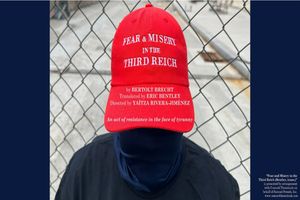
Fear and Misery in the Third Reich, one of Bertolt Brecht’s most essential and explicitly anti-Nazi works, is rarely produced in the United States. Structured as a series of 18 interconnected vignettes, the play depicts daily life in 1930s Germany as Hitler rises to power and ordinary citizens are gradually more...
consumed by poverty, surveillance, violence, fear, and mutual distrust. Rather than focusing on the spectacle of dictatorship, Brecht exposes how authoritarianism takes root in homes, workplaces, and private relationships.
At a moment when art was expected to soothe or distract, Brecht intentionally disrupted the theatrical form itself, rejecting passive empathy in favor of critical awareness. His work demands that audiences think, question, and take responsibility for their social position rather than simply feel. That kind of disruption, once aimed at resisting fascism in 1930s Germany, feels necessary again in an America where political theatre is being asked not just to reflect reality, but to challenge it.






.jpg)