


Interview: Snehal Desai of THE EMPLOYEE DHARMA HANDBOOK at TheatreWorks Silicon Valley
Desai directs the world premiere of Geetha Reddy's bold and funny exploration of cross-cultural dissonance running through August 2nd in Palo Alto
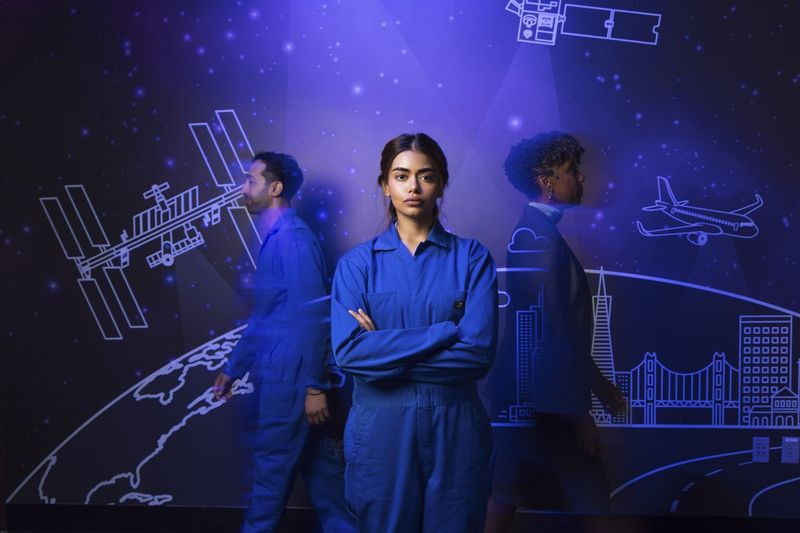
TheatreWorks Silicon Valley is kicking off its 56th season with the world premiere of Geetha Reddy’s bold and funny The Employee Dharma Handbook. The Bay Area playwright’s work was a favorite at last year’s TheatreWorks Silicon Valley’s New Works Festival and is a recipient of TheatreWorks’ Kurjan/Butler commission. The play takes place at a Silicon Valley aerospace company where an HR investigation into a potential staffing issue uncovers simmering tensions of ancient origins amongst the company’s Indian immigrant employees that threaten to derail the company’s upcoming rocket launch.
The production is being helmed by Snehal Desai in his TheatreWorks Silicon Valley debut. Desai has been a pillar of the Southern California theater scene for two decades, first as Artistic Director of the seminal Asian theater company East West Players and currently as Artistic Director of Center Theatre Group. For the latter, he recently directed ground-breaking productions of American Idiot and Here Lies Love at the Mark Taper Forum.
I caught up with Desai by phone last week while he was preparing for tech rehearsals. We talked about the challenges of directing such a multi-layered play, his immersion into the world of aerospace tech, and the fabulous cast he’s assembled. We also chatted about his experience working with deaf actors on American Idiot and what he sees as the road ahead for regional theater in the U.S. Desai is clearly someone who loves his job and has a hunger to keep creating work that engages with the community. The following conversation has been edited for length and clarity.
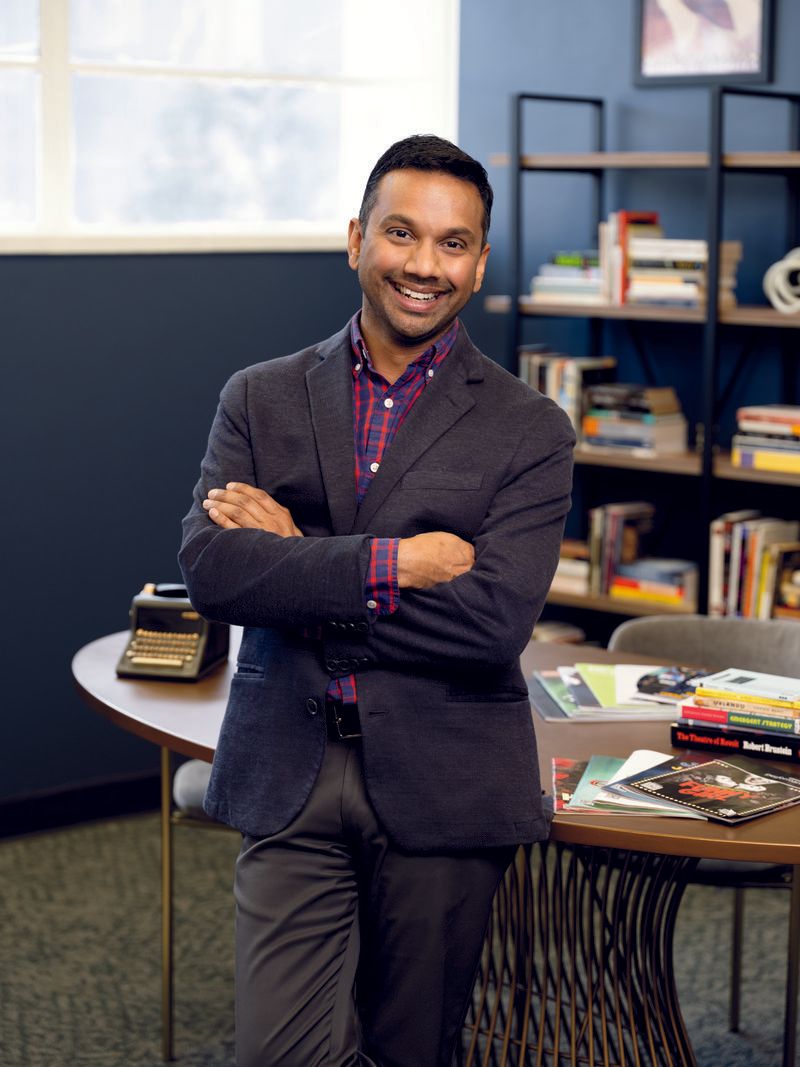
at TheatreWorks Silicon Valley (photo by Jeffrey Fiterman)
How did you become involved in the project?
Through a mutual playwright friend, Jonathan Spector. He introduced Geetha and I, and we really hit it off.
This is a world premiere so audiences will be coming to it cold. How would you describe what it’s about?
It’s about these two women – Val, an HR manager, and Leela, an employee. Leela is trying to navigate the professional workspace with other cultural issues that are coming into it. So it’s a little bit about what happens when Eastern traditions and culture collide with Western HR traditions and structures. And what happens in the workplace when you have issues of identity playing out.
So I would imagine there’s some humor in that as well as some complicated issues.
That’s exactly it. We’re basically viewing the story through Leela, who thinks there may be caste discrimination going on at the company, so she’s on a journey to discover what is happening, and that’s where I would say the HR system at this aerospace technology company is trying to come to grips with what that means.
Your cast includes several actors who are familiar from TV and movies. Had you worked with any of them before?
Yeah, it’s a really, really great cast. Kapil Talwalkar and I worked together before on Free Outgoing a number of years back, and some other projects. A couple of them we already knew each other and everyone else I knew of, but I had not worked with before. Megan Suri [Never Have I Ever], Kathryn Smith-McGlynn [Maze Runner: The Scorch Trials], Ranjita Chakravarty [Never Have I Ever], Kunal Dudheker [Ad Astra], all do a lot of TV and film. So they were all folks I kind of admired in various ways but had not worked with, except Kapil.
Your scenic designer Wilson Chin’s work is familiar to TheatreWorks audiences since he’s designed a number of productions for the company. How did you approach collaborating with him to create a physical environment for the show?
This show has given me a crash course in the world of aerospace tech. It’s very Silicon Valley, but it’s not in my wheelhouse. That’s what I love about being an artist - we kind of get to, for a certain period, be interlopers in other people’s worlds and universes. It was a little bit of like well, we can’t build a rocket onstage, right, so what are the things we can do and then what are the things we want to gesture towards?
It is set in this office space world, and it has a tone where it starts out as a thriller and then almost goes into more of a romcom territory, if you will. When you do things that have a humor element, you can’t go fully abstracted, you want to be a little bit more literal. So he and I started the conversation there, and then he came up with this brilliant idea… which I won’t spoil for you.
And the play moves - it’s 90 minutes, 25 scenes, no intermission. So it wants to have a certain speed and theatricality, even though we’re in this kind of hall of mirrors world where perspectives continue to shift scene by scene. So we just created a really fun place where we can do that in a dynamic way, and then there’s some alluding to the large pieces and elements that they’re working with as they talk about rocket missions and satellites and stuff.
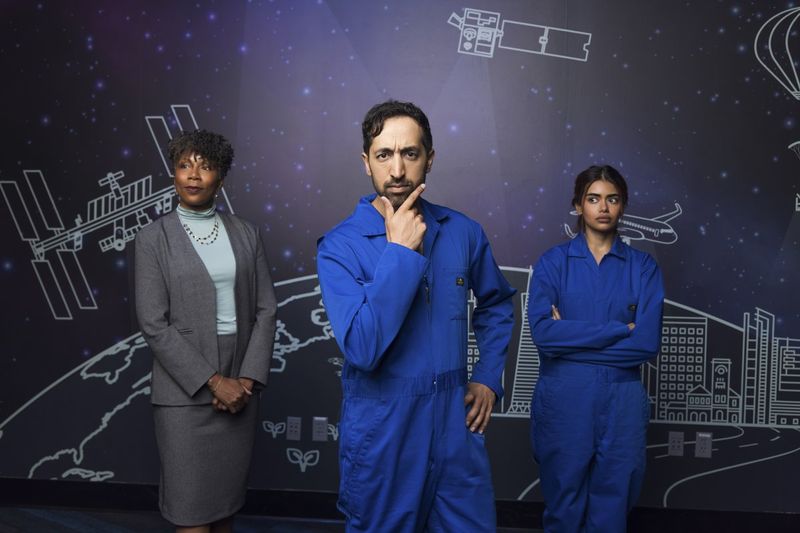
in TheatreWorks Silicon Valley's The Employee Dharma Handbook
(photo by Tracy Martin)
I really enjoyed your production of American Idiot at the Taper that you did in collaboration with Deaf West. As a hearing person, what did you learn from the experience of directing deaf actors?
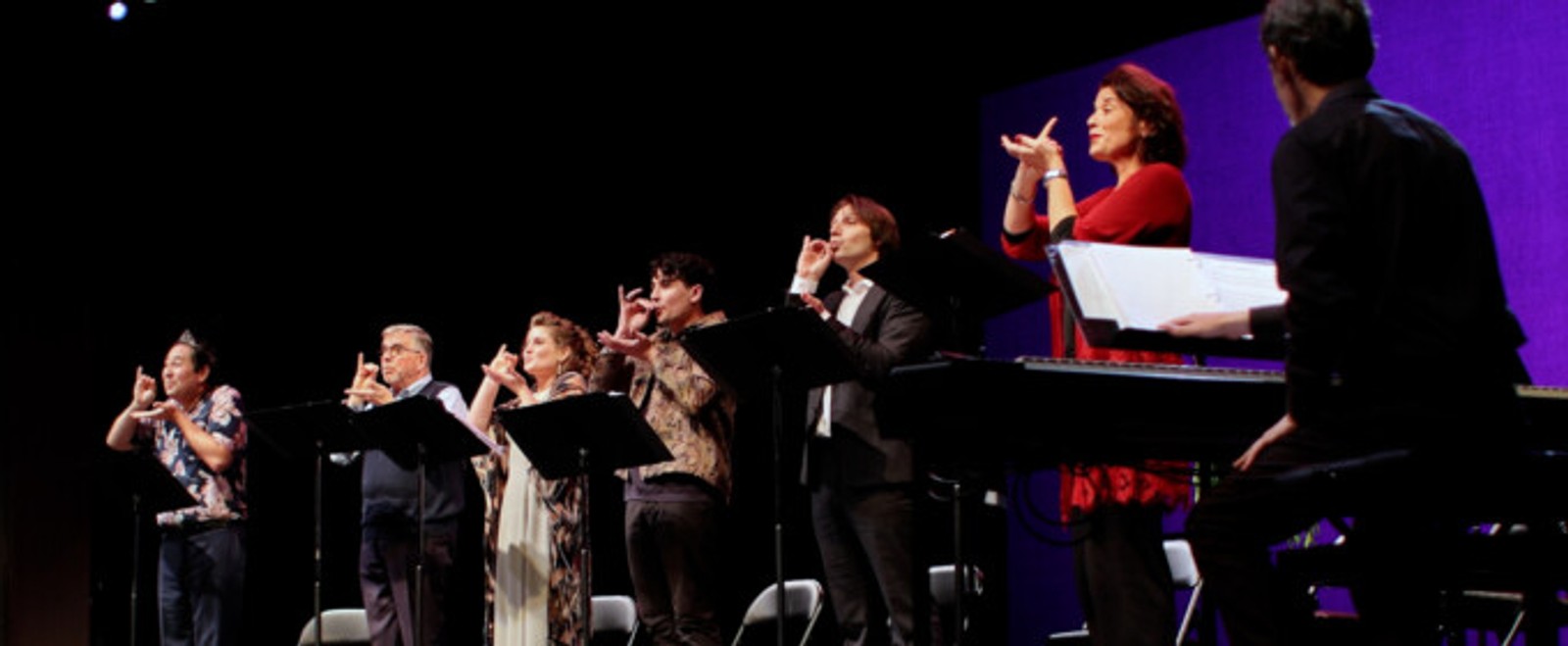
Thank you for coming to see that show. ASL is its own language, so it’s like how do we convey storytelling all through a physicalized vocabulary? If you are non-deaf, you both hear and see the storytelling, so can pick up nuance and subtext in different ways. But when you’re telling it all through a gestural vocabulary, it’s a question of how do you layer in subtext and meaning with that?
And then for me it was a lot about accessibility. I was doing a rock musical so for hearing folks it was about how it sounded, but then it also meant going home after rehearsal and watching it without sound, to make sure that the storytelling was crystal clear. Because if you are deaf you’re not hearing any of the other cues. So it meant putting myself in their shoes to craft an experience that I hoped was accessible for everyone.
I have to say that I found the storytelling much clearer than in the original Broadway production, where I had enjoyed the energy but honestly couldn’t understand most of the lyrics cause it’s rock music played at a super high decibel level with a lot of reverb. Deaf actors doubling the language really made the story more legible, even though I’m not fluent in ASL.
I felt the same as you. I enjoyed it [the Broadway production], but it moves so fast and is so broad in its strokes of storytelling. It really made us dive in and make sure that every song was kind of a chapter or a scene that had an arc in terms of the storytelling. And it’s Green Day lyrics, it’s not even musical theater lyrics. So oftentimes it’s repetitive lyrics over and over again, and I had to be like “Well, what does it mean?” With the ASL, the actors were like “Do you want me to just sign the same line over and over 8 times?” And I was like “No, there’s a progression, a meaning.” And they’re like “Well, what are the different layers of meaning? Cause if I just sign it the same way it’s not gonna convey that to a deaf audience, the urgency or the change that you want.”
And then the other interesting thing was I had this amazing choreographer Jennifer Weber on the project. For her and I both, when every gesture means something to a deaf audience member, how do you make the choreography clear? How do you make choreography that every movement has to be endowed with meaning or can be construed as a word? So it was really interesting to go through that process.
You served as Artistic Director of East West Players for quite a long time and you’ve been Artistic Director of Center Theater Group for three years now. In both of those positions you basically inherited a regional theater model that had been invented by visionaries like Mako and Gordon Davidson back in the 1960s. That was the model I grew up with and thought would last forever, but it broke down once COVID hit. What do you see as a more sustainable path going forward?
It’s a great question, and I don’t know… I think folks are wanting like an answer, right? Like “This is what it is.” I think sustainability right now means evolution and nimbleness, and a responsiveness. The fixed model does not hold up the way it used to, for a variety of reasons, and I don’t know if it ever will in the same way. I think it's gonna be important to figure out what our next evolution is. It’s an opportunity to change. I don’t mean this in a flip way, but it’s almost like nothing can be sacrosanct in the way that it used to be, because everything’s changed. The way we go to theater, the traditions, the habits, the competition, the cost of doing business and the operations, all of that's changed.
And then there’s all these external factors. I mean, over the last year in LA we had the wildfires and then we had curfews in downtown LA. The streets had to be empty before curtain time. So we had all these things you would never imagine, and we just had to be resilient and flexible to find a path forward. That to me is key, and then it’s also looking at where are we, what do folks actually want, what is serving our communities - and meeting them where they are.
I don’t hear you complaining about the challenges you face, but it seems to me that you’ve got a very hard job these days. What about it brings you joy? What keeps you coming back for more?
There are two things that bring me joy. One is - I also am an artist, so being in the rehearsal room, being able to work with other artists, support them in their career trajectories, create a place that can be their artistic home, gives me a lot of fulfillment. We just had Kristina Wong, an artist I’ve worked with a lot over the years, from my time with East West. We did a mini-presentation of a project called “From Number to Name” where she and I wanted to be able to break open the taboo of incarceration in the API community, and what that recovery is like. Kristina’s a trail-blazing artist and one of the privileges of being an artistic director is to be able to support artists when they’re developing work like that. That gives me a lot of pleasure and joy. The same with discovering a voice like Geetha, who I think is so funny and so sharp. To be able to engage with her as an artist and support her is great.
And then the other thing is doing work that is resonant in the moment and that creates spaces for communities who haven’t necessarily been visible or felt that their stories haven’t been told. The American Idiot you brought up is a perfect example, working with Deaf West. And this past year at CTG we did Here Lies Love, and it was news to so many folks in LA that LA is home to the largest Filipino community outside of the Philippines. I had a lot of folks who were like, “Well, are they here? Will they show up?” And not only did they show up, they showed up by the tens of thousands and brought friends, [who were amazed that a] story about Imelda Marcos could also feel so timely and relevant.
So those are the things that are really, really giving me joy or keeping the flame alive. That what we are doing is meeting the moment and resonant and having impact. I’m a big fan of Brecht and this idea that the experience of going to the theater should feel like a sporting event. Like how are we changing the rules of engagement? We’ve kind of trained our audiences to sometimes be quiet and sit in the dark, and some shows want that, but then there’s other shows where I want you to feel engaged and express yourselves and also feel seen as an audience member. That’s the theater that really gets my pulse going.
(Header photo by Tracy Martin. L to R: Kathryn Smith-McGlynn, Megan Suri & Kunal Dudheker)
---
The Employee Dharma Handbook performs July 8 – August 2, 2026 at Lucie Stern Theatre, 1305 Middlefield Road, Palo Alto. For more information, visit TheatreWorks.org or call 877-662-8978.
Prefer BroadwayWorld in Google Search?
Add us as a preferred source so our stories show up more often in Top Stories and Google’s AI answers — for you.
Sign up for all the news on the Fall season, discounts & more...
|
Bye Bye Birdie Warren Theater (9/18-10/04) |
|
Gutenberg! The Musical! Hillbarn Theatre (10/08-11/01) |
|
Hamilton (Angelica Company) San Jose Center for the Performing Arts (7/07-7/18) |

|
Based on a Totally True Story City Lights Theater Company (1/21-2/14) |
|
Steel Magnolias Town Hall Theatre (9/10-10/03) |
|
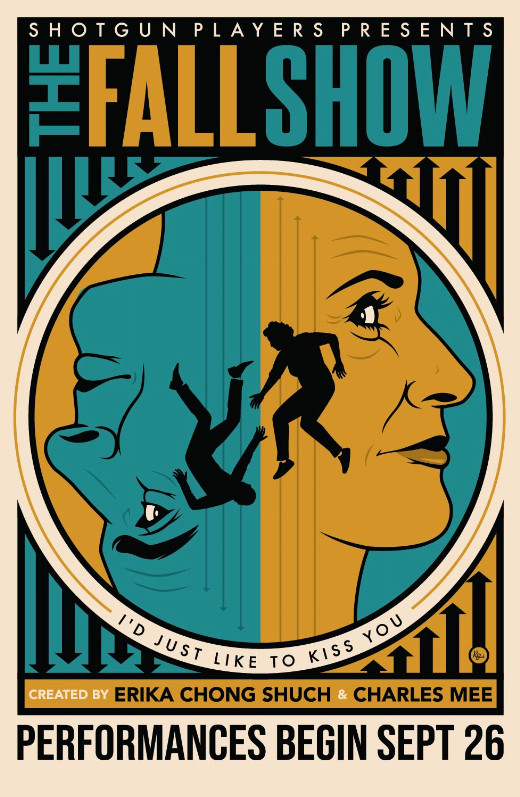
The Fall Show Shotgun Players Ashby Stage (9/26-10/25) |

|
The Secret in the Wings Theatre Lunatico (10/10-11/01) |
|
Legally Blonde The Musical Berkeley Playhouse (9/11-10/11) |
|
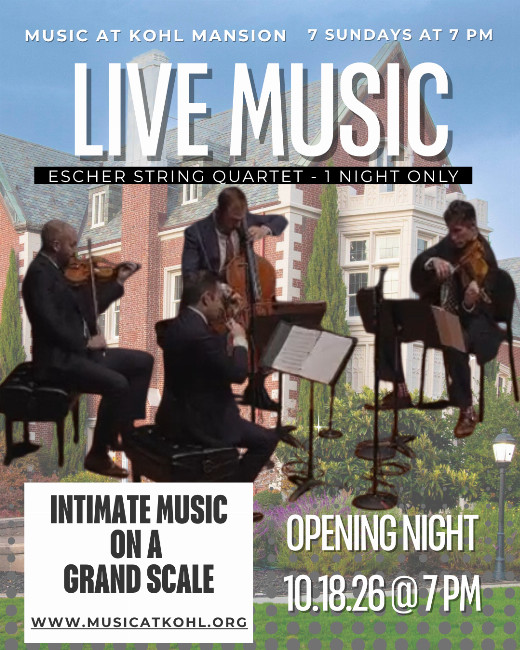
Escher String Quartet Kohl Mansion (10/18-10/18) |
|
Musical Cafe: Songs from New Musicals Feinstein's at Hotel Nikko (9/27-9/27) |
