


Review: A COURAGEOUS PRODUCTION OF DIARY OF ANNE FRANK at Desert TheatreWorks
This emotional production recounts the Nazi terror and Holocaust during World War II
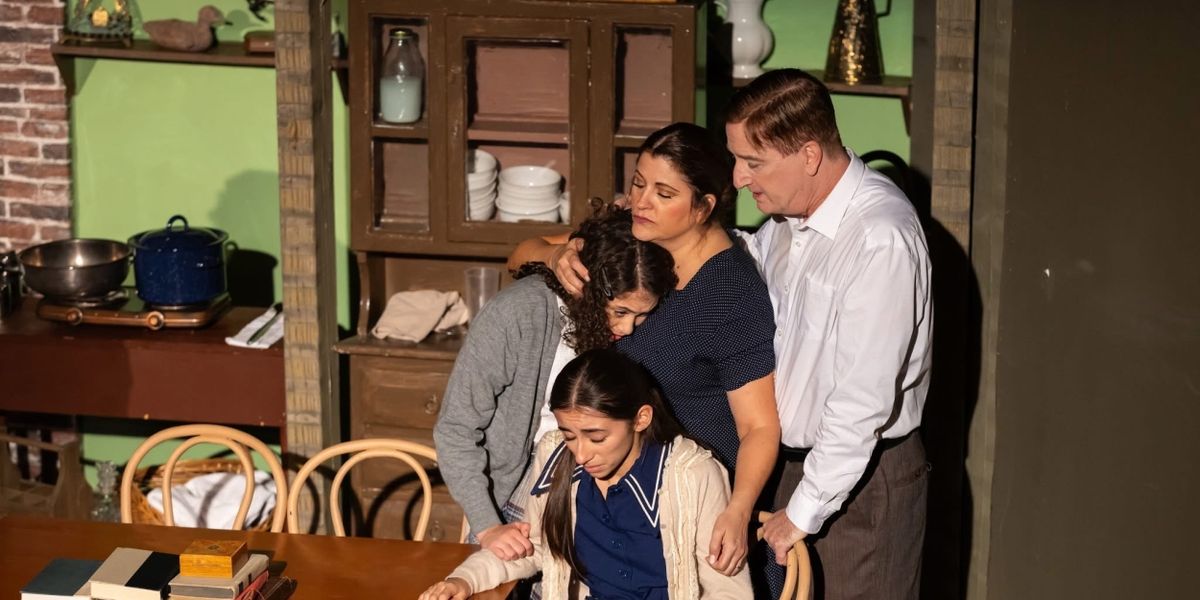
Despite copious evidence attesting to the horrors of the Nazi Holocaust, there has been an unprecedented rise in Holocaust Denial. In this new one-act adaptation of DIARY OF ANNE FRANK, Desert TheatreWorks courageous production comes at a time of rising antisemitic violence, with focus shifting away from reality--the torture and murder of millions of innocents--to the evil, dehumanizing rhetoric of emergent apologists for crimes committed by Adolf Hitler and his Gestapo henchmen.
Many people turned a blind eye to the horrors perpetrated against their neighbors. It took great courage not only for Anne Frank and her family to go into hiding for more than two years but for those who risked their lives to hide them.
On the morning of Monday, July 6, 1942, Otto Frank (Jim Rogers), Edith Frank (Jana Giboney), and family moved into a three-story space above Opetka offices on Amsterdam's Prinsengracht. For the next two years, some of Otto Frank's most trusted employees--Miep (Renee Bourgeau) and Mr. Kraler (Hal O'Connell)--served as their helpers for survival. Anne (Tess Martinez) was only thirteen at the time. Her sister Margot (Aden Burgen) was sixteen. They were joined by Mr. and Mrs. Van Daan (Shel Safir and Christine Gold) and their sixteen-year-old son Peter (Ben Schwinner), and finally by Mr. Dussel (Herb Schultz).
We know how the story ends: an unidentified snitch betrays them. The Gestapo evacuates the hiding place. They are all sent to death camps. Otto Frank is the only survivor. Miep was not arrested, and she preserved many of Anne's writings. After escaping from a camp, Mr. Kraler eventually emigrated to Canada.
The amazing Tess Martinez delivered another poignant performance (following her award-winning role as Scout in To Kill A Mockingbird last season). Whenever she uttered Anne Frank's famous quotes, Tess inhabited the character authentically. Marking the psychological torment of the Van Daans, Shel Safir breaks down and steals a piece of bread. His wife (Christine Gold) skillfully uses the loss of her fur coat to symbolize the loss of her previous life and all she had held dear. Herb Schultz's performance paints an accurate picture of the the self-centered, somewhat petty Mr. Dussel. Otto and Edith Frank struggle to maintain control of the living situation as it begins to deteriorate with the passage of time. Peter and Anne? Well, they are curious teenagers after all. Margot? Always her sister's advocate.
The one thing that surprised me--but apparently that was in the script, not a directorial adjustment--was the use of the Sephardic pronunciation of Hebrew, which did not come into popular use until the establishment of the State of Israel in 1948. The Franks, the Van Daans, and Mr. Dussel were Ashkenazic Jews who would not have used Sephardic Hebrew in the mid-1940s. I mention this as a note to future producers of this script: please check the printed transliteration of Hebrew words for anachronisms.
To continue the work that founders Lance and Ron Phillips envisioned, DTW is announcing the opening of their new professional division, PRISM THEATER, in Palm Springs. The new venue will focus on a variety of timely, relevant material Plans have been approved, and the vision is slated to become reality this year.
What is more fitting than to end this review with a quote by Anne Frank herself? "I see the world being slowly transformed into a wilderness. I hear the approaching thunder...I feel the sufferings of millions. And yet, when Iook up in the sky, I somehow feel that everything will change for the better, that this cruelty too shall end, and that peace and tranquility will return once more."
For information about future productions, including GLADYS IN WONDERLAND running April 29 and 30, KIDSWORKS, and ARTSWORKS, dtworks.org.
|
Mama''s Boy Starring Gregg Glaviano Plaza Theatre (9/26-9/26) |

|
Gunhild Carling at Oscar's Palm Springs Oscar's Palm Springs (9/03-9/03) |

|
Little Shop of Horrors 40th Anniversary Tour with Ellen Greene (the Original Audrey) The Plaza Theatre (1/27-1/27) |

|
John Cameron Mitchell: Hedwig 25th Anniversary Movie Tour Palm Springs Cultural Center (11/07-11/07) |

|
Jonathan Van Ness: Hot & Healed Comedy Tour 2026 Grove of Anaheim (10/09-10/09) |
|
Mourning Sunset Irvine United Congregational Church (8/06-8/15) VIDEOS |

|
All Things Equal: The Life & Trials of Ruth Bader Ginsburg Plaza Theatre (3/30-3/30) |

|
FRIDAY NIGHT LIVE! FNL Improv with PRNIT! PseudoRandomNoise Improv Theater (7/10-6/11) |

|
The Rocky Horror Picture Show Spooktacular Tour with Nell Campbell The Plaza Theatre (10/11-10/11) |

|
The Rocky Horror Picture Show Spooktacular Tour with Nell Campbell Fox Theatre (10/09-10/09) |
Reader Reviews
To post a comment, you must register and login.