Get all the top news & discounts for Off-Off-Broadway & beyond. No password required.
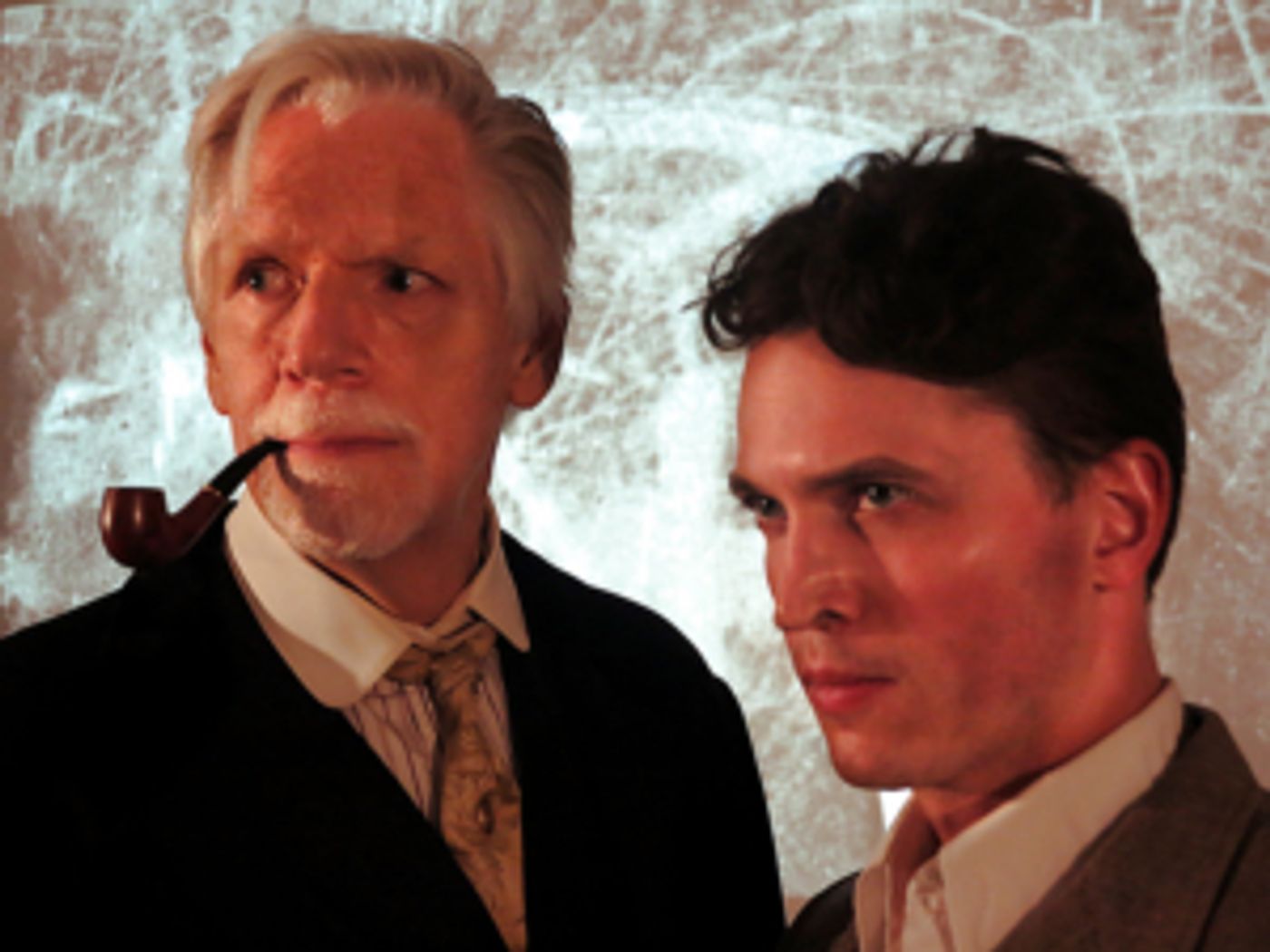
"Ludwig and Bertie" by Douglas Lackey examines the relationship of two leading twentieth century philosophers, Ludwig Wittgenstein and Bertrand Russell. Theater for the New City (TNC) will present the play's world premiere run September 26 to October 13, directed by Alexander Harrington. The piece is a successor to TNC's hit production last season of "Arendt-Heidegger: A Love Story," which was also written by Lackey and directed by Harrington. That play dramatized the troubling, lifelong affair between Zionist Hannah Arendt and Nazi sympathizing philosopher Martin Heidegger.
Is it possible that an act of child abuse perpetrated by an Austrian schoolteacher in 1926 could have created the post-truth world of Donald Trump? The answer is "yes" if the teacher was Ludwig Wittgenstein, a man otherwise recognized as one of the great philosophers of the twentieth century. That is the premise of this wildly plausible new play, which charts the forty-year love/hate relationship between the philosopher Bertrand Russell ("Bertie" to his friends) and his most famous student, Wittgenstein.
"Ludwig and Bertie" traces the entwined lives and philosophies of these two avatars of modernism from their first meeting at Cambridge in 1911, when Russell was nearly 40 and Wittgenstein was 21, to Wittgenstein's death in 1951. A play on such characters might seem to be a play of philosophical ideas, but this one is rooted in a pointedly personal drama that plays out at many levels. Russell is heterosexual, hedonistic and agnostic; Wittgenstein is puritanical, gay and Jewish. Russell is an imprisoned pacifist; Wittgenstein a decorated combat soldier. Wittgenstein is intensely religious; Russell mocks religion from first to last. Academically, they start out together as proponents of a modernism rooted in logic, mathematics and science. Wittgenstein creates a modernist book, and then designs a modernist house, each with as many sharp angles as a painting by Mondrian. But it all goes wrong in 1926, when Wittgenstein wakes up to a post-modern, post-truth world. Russell tries desperately to hold on to modernism, but Wittgenstein supplants him at Oxford, Cambridge and around the world.
We ride along as their ideas evolve, including Wittgenstein's notion that the meaning of a proposition varies with its use. Meanings, you see, are only rules--and when you get down to it, there are no rules for rules. With this logic Wittgenstein drives Russell nearly mad.
Ludwig regards Bertie as his "mental father," but their relationship has elements of rivalry. At one point, Russel declares, "Damn it, I will never catch up with him." Their clashes take many comic turns, as when Russell is unable to prove to Wittgenstein that there is no rhinoceros in the room.
It's unsettling to think that Wittgenstein's theorems may be related to the notion of "alternative facts" that vexes us these days. But it's also possible that Russell had the last word. At the end of the play, he explains the conflict between politics and science, declaring "When politicians pass a law, the purpose is to keep the holders of power happy. When a scientist conducts an experiment, the purpose is not to make anyone happy, but to discover the truth. There is no other source of truth; the alternative to science... is fiction."
Playwright Douglas Lackey has two lives, as a playwright and a philosophy professor. He is a Professor of Philosophy at Baruch College, CUNY, where he has taught since 1972. But he has a 16 year relationship with Theater for the New City, which has presented all his plays to-date. His first play presented there, "Kaddish in East Jerusalem" (2003), dealt with issues of the Second Intifada. His "Daylight Precision" (2014) was a historical drama examining "just war" theories through an unsung hero of World War II, Gen. Haywood Hansell. Last season, his "Arendt-Heidegger: A Love Story" earned critical praise and drew sellout audiences. It dramatized the unlikely romance between Martin Heidegger and Hannah Arendt. In the 1920's, they had a passionate affair. In the 1930's, Heidegger became an ardent Nazi while Arendt became an ardent Zionist. After the war, they continued to correspond and meet in one of the more puzzling relationships of twentieth century intellectual history.
Lackey writes, "I am grateful to Crystal Field and Theater for the New City for encouraging me to present the story of Wittgenstein and Russell and their astonishing relationship. TNC is willing to take on my "comedies of ideas" and these are quite different from the contemporary obsession with those of jumbled identities and failed relationships. Kudos to a theater that will buck the mainstream."
Director Alexander Harrington staged the premieres of Douglas Lackey's "Arendt-Heidegger: A Love Story" last season and "Daylight Precision" in 2014. He has directed in New York theaters at Metropolitan Playhouse, La MaMa, The Culture Project, Queens Theatre, and The Actors Studio and at many regional theaters. He founded The Eleventh Hour Theatre Company and was 2012 artistic director of the student ensemble at HB Studio. He has directed his own adaptations of Dostoevsky's "The Brothers Karamazov," Chekhov's short story "The Kiss" and a chapter from Sherwood Anderson's "Winesburg, Ohio" titled "The Philosopher." He translated and directed Aeschylus' "Agamemnon" and wrote "The Great Society," a play about Lyndon Johnson. Harrington takes a special interest in classics and has directed numerous productions of Shakespeare and Greek tragedies. He has also developed and directed numerous contemporary plays and is widely published as a scholar and critic. (alecharrington.wixsite.com/alexanderharrington)
The actors are Connor Bond as Ludwig Wittgenstein, Stan Buturla as Bertrand Russell, Pat Dwyer as Cambridge philosopher G.E. Moore, Alyssa Simon as Lady Ottoline Morrell (Russell's paramour) and Marguerite Stonborough, Daniel Yaiullo as David Pinsent (Wittgenstein's undergrad lover), Michael Bradley as Minister/Ensemble and Hayden Bercy as Young Wittgenstein. Scenic Design/Projections are by Jon DeGaetano. Lighting design is by Alexander Bartenieff. Costume design is by Anthony Paul-Cavaretta. Dialect Coach is Keri Safran. Company Manager is Courtney Fenwick. Stage Manager is Ericka Lee Conklin.
Tickets are $15 and available through the show's website, www.ludwigbertie.com, and TNC's website, www.theaterforthenewcity.net. The TNC box office is 212-254-1109.