


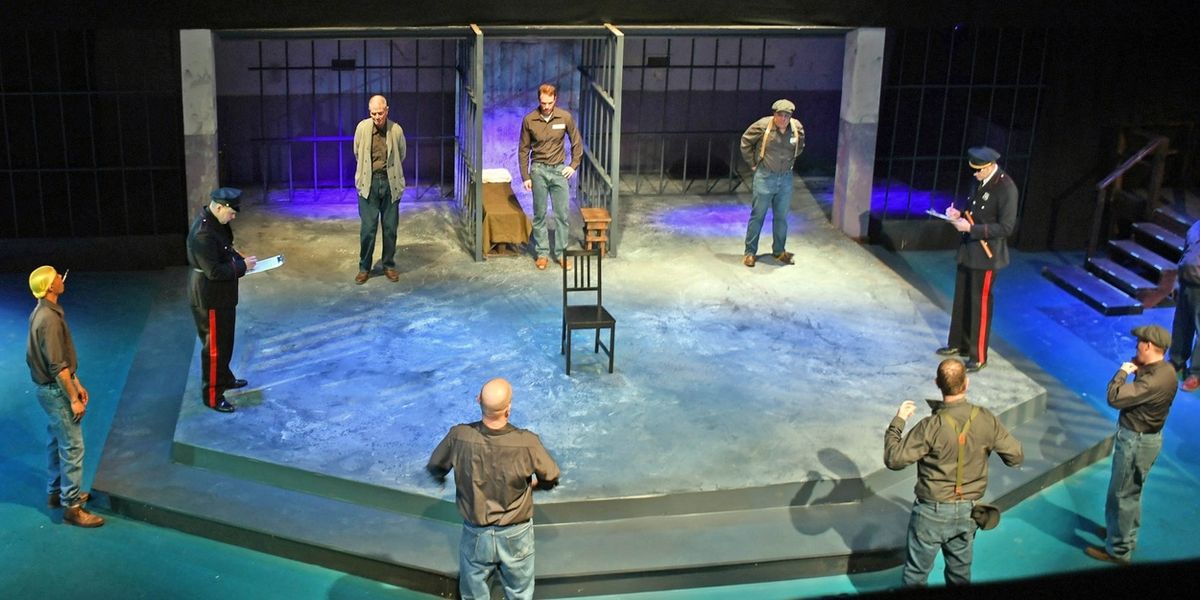
A full auditorium of just over a hundred patrons filed into the newly renovated Warwick Theater for a re-imagination of Stephen King’s “The Shawshank Redemption.” Audience members are first struck with the professionalism of the setting by Associate Director Tim Ahlenius and Paige Ahlenius.
Overhead, a new pipe grid and digital lights make area lighting by Karen Paisley possible in ways not easily achieved before the renovation.
The audience sees a three-quarter thrust stage in the center of the space with a wooden staircase ascending on the stage-left side while a warden’s desk and chair sit on stage-right. Above and upstage is a guard’s gallery space that watches the floor of Shawshank prison. Upstage and stretching across the playing area, we see bars, imagined entry points and a suggested single cell for the focus of the play, one Andy Dufresne.
This theatrical adaptation is written by Irish playwrights Owen O’Neill and Dave Johns, an unlikely yet inspired pairing. Both men came to prominence as stand-up comedians before turning their attention to drama. Owen O’Neil is present for this Saturday evening performance. Both men have developed an ear for rhythm and character.
O’Neil and Johns have taken the spectacle that was the 1994 filmed version of Stephen King’s novella and transformed it for the live stage in unexpected ways. King is aware of this adaption and has licensed his intellectual property.
I had not visited the Warwick Theatre since before a fire devastated much of the building on February 7, 2024. As near as we can tell, flammable rags spontaneously combusted to cause the fire. Costumes stored near the rear of the building added fuel. Women’s costumes covered in plastic cleaner’s bags melted into the fabrics.
If a fire wasn’t bad enough, a series of post fire burglaries robbed much of the salvageable equipment from Metropolitan Ensemble Theater, owners of the facility.
This new iteration of the Warwick Theater literally rose from the ashes and is much superior to the version that was consumed eighteen months ago. Originally, built in 1912, the Warwick Theater in midtown Kansas City housed vaudeville and silent films before becoming one of the first theaters to feature the new talking pictures in the late 1920s. Originally, a single screen movie theater entertained up to 1200 movie goers.
I am told audience facilities in this new Warwick Theater restrooms are much superior to the facilities that they replaced. The feel of the place overall is a significant upgrade to what was.
This is the second MET staging of “The Shawshank Redemption.” The first successful production hosted the North American premiere of the play in 2019. Director Bob Paisley tours “Fringe Festivals” worldwide and especially in the UK. Paisley became acquainted with O’Neill and Johns during his travels and with their play.
“The Shawshank Redemption (the play)” first premiered in Dublin in 2009, a detail that gives the work a distinctly Irish theatrical lineage despite its American setting. That first production, staged at the Gaiety Theatre, carried with it the burden of enormous expectation: audiences already knew the story intimately, and comparisons to the celebrated 1994 film were inevitable. Yet the stage version quickly set up its own identity, leaning into narration, ensemble performance, and suggestion rather than cinematic realism.
In this newly imagined retelling, Red (Jerron O’Neil) is the storyteller. He becomes the narrator of the tale throughout. It is from his perspective that Andy Dufresne’s (Jacob Funke) story is told.
Andy (Funke) is a banker falsely convicted of murdering his philandering wife and her golf pro lover. Andy is sentenced to a life term at the notorious Shawshank Prison imagined by King in the forests of Maine. Although Shawshank is an imagined place, late nineteenth century similar places exist across the country. I have personally visited some of them.
As Red tells us his story, the audience becomes immersed in this world. Actors enter and exit through unexpected places. Andy is an educated man which sets him apart from many of the Shawshank Inmates. And he decides to keep his head down and stay out of trouble.
Red is the person to know if one desires contraband smuggled into the prison. Cigarettes, candy, cigars, card decks, and other miscellaneous items all flow through Red.
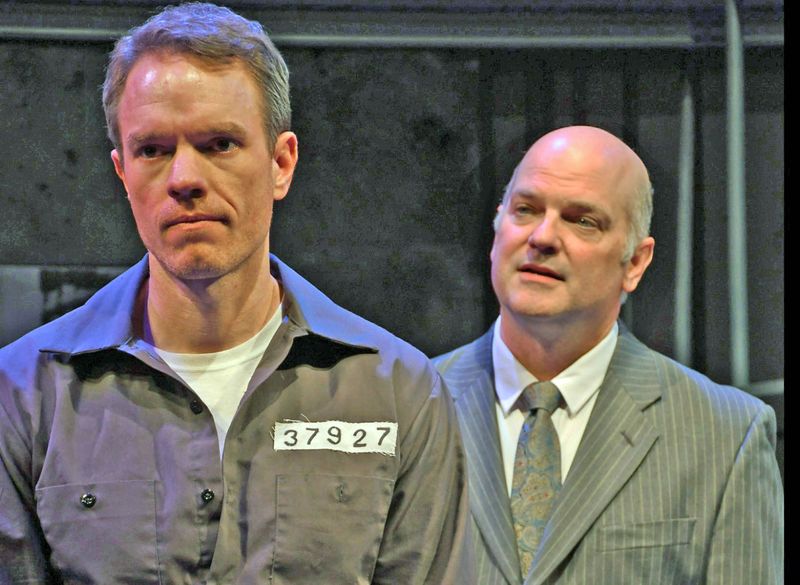
in The Shawshank Redemption
Andy approaches Red for a small rock hammer. Andy is a rockhound and lapidarist. His hobby is identifying rocks from the prison yard and shaping them into common objects, Red resists at first, but sees something unusual in Andy. The two bond and become friends.
As in many prisons, the administration, cruel guards, and a prisoner gang rule. Here, the gang called “the Sisters” is led by a prisoner named Bogs (Chad Burris). Andy is raped by “the Sisters.” He is beaten mercilessly, but the beatdown is more about dominance that about sex.
The Shawshank prisoners are detailed work projects around the facility. One summer day, they are mopping tar on the prison roof. Andy overhears headguard Hadley (Derek Traulwein) and others as they discuss a tax problem having to do with an inheritance. Andy offers to help. After establishing his bono fides, Andy saves Hadley multiple thousands of tax dollars. Cleverly, Andy takes his payment for services rendered in cold beers distributed to his fellow inmates.
It isn’t long before all the guards approach Andy for tax and financial help. The reign of “the sisters” is pretty much over. Warden Stammas (Tyler Dustin) discovers Andy’s talents and asks him to keep the books of his less than savory outside businesses.
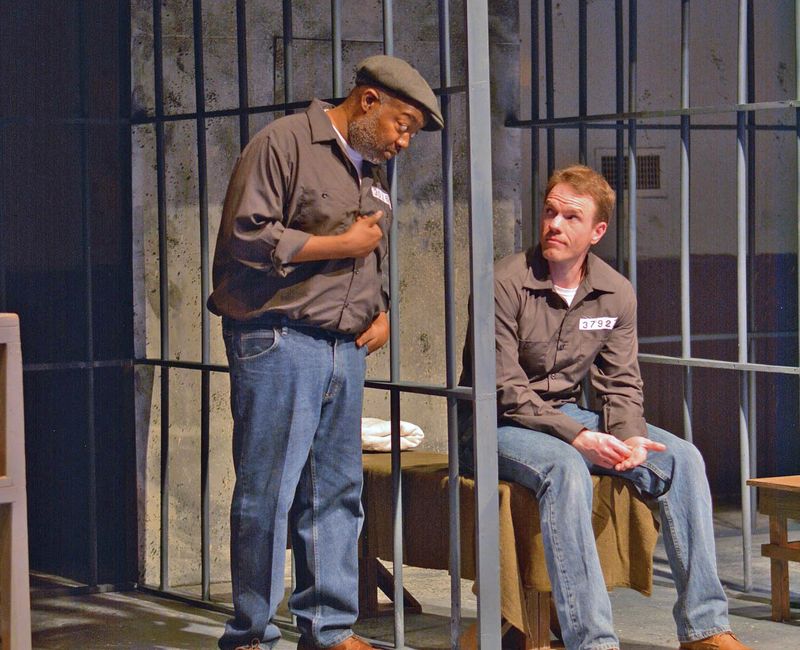
The Shawshank Redemption
Shawshank has become more livable. Red finds a way to get Andy his rock hammer. Andy responds with a miniature of a favorite train for Red.
Andy can now be found in a new prison library run by long-term inmate and librarian Brooksie (Kevin Fewell). Andy through dogged persistence has managed to expand the library and a new law library. Brooksie and Andy also bond as friends. Brooksie is offered a parole after some forty years. He is afraid of the outside world. He is eventually institutionalized and passes away in his sleep of an overdose.
Act II begins with the introduction of Tommy (Ace Loveless). Ace is a car thief now doing his second term inside. Tommy would like to reform, pass his GED and find another path in life to better live with his girl. Andy agrees to help. Tommy soon excels.
It turns out that a cellmate from Tommy’s earlier prison has bragged about previous crimes and a double murder. Andy realizes that this man must be the real murderer of his wife and the golf pro.
Andy approaches Warden Stammas with his opportunity to prove his innocence. But the Warden won’t hear it. Andy has done too good a job managing the Warden’s illicit businesses. Warden Stammas doesn’t want to give up Andy’s services.
Warden Stammas gives Tommy the opportunity to be paroled if he will forget what he has learned in the Rhode Island Penitentiary and forget his debt to Andy. Tommy has passed his GED. Tommy refuses to screw his friend and is mysteriously found hanging in the overhead prison guard’s gallery.
Seeing no future at Shawshank, Andy decides his best plan is to escape. He escapes the prison through the sewer system after exiting his cell through a hole in the wall behind a poster of Rita Heyworth.

in a scene from The Shawshank Redemption
But before he escapes, Andy confides in Red that he has significant resources on the outside, he tells Red how to gain access to the stash, and then where Andy can be found on the Pacific Coast of Mexico.
Red is eventually paroled. At first, he tries to live in a world he doesn’t recognize. Red eventually recovers Andy’s stash and joins him on the balmy coast of Mexico.
At the heart of the play is the unlikely friendship between Andy Dufresne (Funke)and Ellis “Red” Redding (O’Neil).
Andy, portrayed with a restrained intensity, is less the mythic figure familiar to film audiences and more a man clinging to fragments of dignity.
Red, meanwhile, serves as both narrator and conscience, his inflections lending a lyrical quality to the storytelling that feels surprisingly natural. His reflections on time, hope, and institutional life carry a rhythm that borders on poetic without tipping into sentimentality.
The adaptation wisely resists the urge to replicate the film beat-for-beat. Instead, it focuses on the interior lives of the characters. Moments that once relied on visual spectacle—escape, violence, revelation—are reimagined through dialogue, suggestion, and performance.
This choice places a heavy burden on the cast, but they rise to it with conviction. Supporting roles are rendered with enough individuality to avoid caricature, grounding the story in a recognizably human reality.
What emerges most powerfully is the play’s meditation on hope. In a theatrical space stripped of cinematic distraction, hope becomes not an abstract theme but a fragile, contested force—something spoken, doubted, defended. When Andy insists that hope is “a good thing,” it lands not as a slogan but as a quiet act of rebellion.
Warden Stammas (Tyler Dustin), Brooksie (Kevin Fewell), and the Tommy character (Ace Lovelaess) distinguish themselves particularly well. Andy (Jacob Funke) and Red (Jerron O'Neil) hold their own in difficult and demanding lead roles. If there are weaknesses, they are in some unevenness in the supporting inmates and supporting guards.
If the production falters at times, it is in pacing. The deliberate tempo that allows for reflection occasionally drifts into inertia, particularly in the second act. Yet even here, the stillness serves a purpose, mirroring the slow, grinding passage of institutional time.
Ultimately, this Irish Shawshank Redemption is less about escape from prison than about endurance within it. It asks its audience not merely to see suffering, but to sit with it—and to consider what it means to believe in something beyond the walls.
“The Shawshank Redemption is a somber, thoughtful piece of theatre that lingers long after the final curtain, like a memory you can’t quite shake.
Stark lighting and minimal scenery create a world defined less by physical walls than by psychological ones. The result is an atmosphere thick with tension, where every footstep echoes and every silence speaks volumes.
Since its debut in Dublin, the play has travelled widely. It has enjoyed multiple UK tours, with productions appearing in venues such as London’s Wyndham’s Theatre and regional houses like The Alexandra Theatre in Birmingham, where critics noted its immersive staging and strong performances.
Seen in this context, this production becomes part of a longer theatrical tradition—one that embraces adaptation not as imitation, but as reinterpretation. It lives, instead, in the voices of actors, the pauses between lines, and the collective silence of an audience leaning forward in the dark.
And perhaps that is the final, quiet triumph of this play: that a tale about confinement continues to find new ways to breathe.
What is striking about this American approach is its flexibility. Without the weight of a single “definitive” production, Director Bob Paisley leans on the philosophical narration of Red, treating the play almost as a memory piece.
In considering this production, one cannot overlook the guiding hand of director Bob Paisley, situates the play firmly within a tradition of actor-led, text-driven theatre. Paisley, long associated with Irish stage work that privileges clarity of storytelling over visual excess, brings a disciplined restraint to The Shawshank Redemption—a choice that aligns closely with the intentions of its playwrights, Owen O’Neill and Dave Johns.
If I had my choice. I might even further emphasize the role of Red. As the storyteller, I miss him during significant portions in the midpoints of each act. I can imagine him appearing in a pool of light as more connective tissue that holds this reinterpretation more closely together.
Taken together, these strands—the Irish origins, the British touring circuit, and the quietly persistent American regional life—paint a picture of a play that resists being pinned to a single tradition. Instead, The Shawshank Redemption in the theatre exists much like Andy Dufresne’s own legacy: passed from place to place, reshaped by those who carry it, and sustained less by spectacle than by belief.
In recent years, the play has continued to circulate through touring productions, including a major revival that has embarked on successive national tours in the UK and Ireland. Its return to Dublin in April 2026, at the Bord Gáis Energy Theatre, feels less like a revival and more like a homecoming—bringing the story back to the city where it first stepped onto the stage.
The Kansas City staging of The Shawshank Redemption at the The Warwick Theatre carries with it a quiet but notable distinction: this venue has served as a kind of American foothold for the play, particularly through the work of Metropolitan Ensemble Theatre, the company responsible for bringing the adaptation to local audiences both in earlier years and again in its current 2026 run.
The present production, running from late April into early May 2026, continues that lineage, situating the story within the intimate, historically resonant Warwick space on Main Street.
Tickets for “The Shawshank Redemption” are available on the MET website or by telephone at 816.569.3226. Production dates are April 24 through May 3, 2026.
Photos by Bob Paisley
Sign up for all the news on the Fall season, discounts & more...


|
'The Who's Tommy' Midwest Trust Center at Johnson County Community College (10/14-10/14) |

|
What iF Puppets presents 'How to Snag a Sea Monster' Midwest Trust Center at Johnson County Community College (10/07-10/10) |

|
'Burn the Floor presents Maks & Peta Live!' Midwest Trust Center at Johnson County Community College (4/03-4/03) |

|
Come From Away Olathe Civic Theatre Assn (OCTA) (6/04-6/20) |

|
Angels in America — Part 1: Millennium Approaches Metropolitan Ensemble Theatre at the Warwick (10/23-11/01) |

|
Don’t Talk To The Actors Olathe Civic Theatre Assn (OCTA) (4/09-4/25) |

|
'Hold On To Your Butts' Midwest Trust Center at Johnson County Community College (3/12-3/13) |

|
Actors From The London Stage 'King Lear' Midwest Trust Center at Johnson County Community College (3/25-3/26) |
|
The Last 5 Years Phoenix Arts KC (10/16-10/24) |

|
Yamato Midwest Trust Center at Johnson County Community College (3/27-3/27) |

Reader Reviews
To post a comment, you must register and login.