


Review: THE TIMEWALK EXHIBITION, ImmerseLDN
An immersive journey through 12,000 years
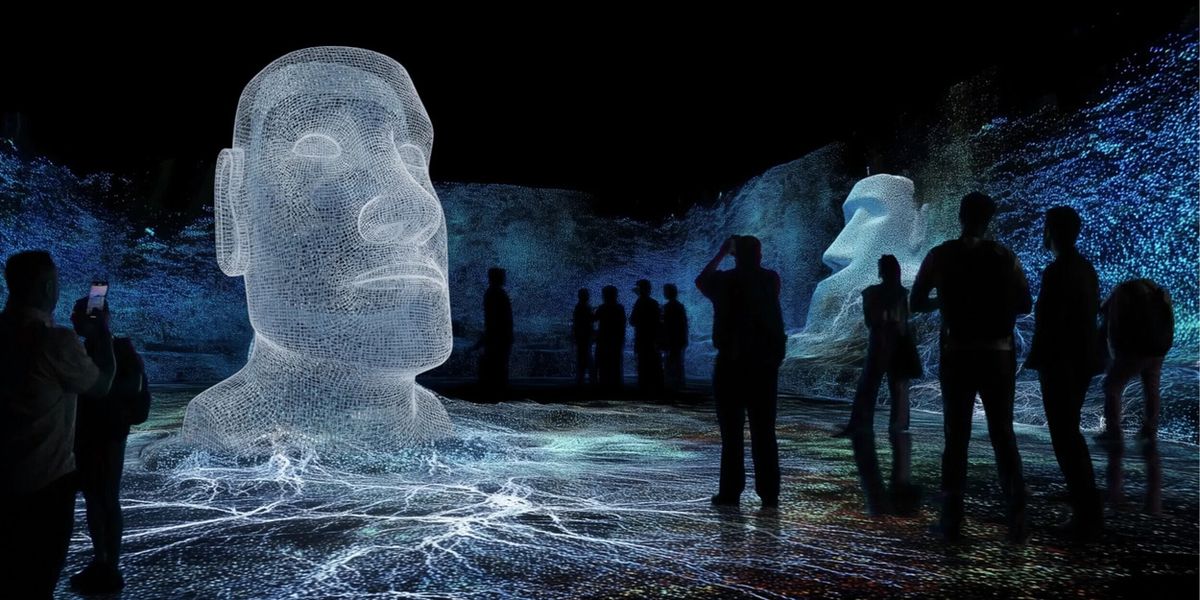
 DEM Museum’s attempt to traverse a dozen millennia in an hour is lacking in neither chutzpah nor dazzling technology. London's ImmerseLD has already taken us through individual catastrophes (Pompeii coming down, the Titanic going under) and dead royalty (Cleopatra, Tutankhamun) but The Timewalk Exhibition spins us across eons of prehistory and the civilizations that filled it, with David Schofield and Olivia Williams on narration. Ambition is not where this one falls short.
Twelve thousand years is a mind boggling span of time. When the first pillar went up at Göbekli Tepe (a hilltop of carved limestone pillars raised around 9500 BCE in what is now modern Türkiye), Britain was still tethered to the continent and you could have strolled from Scotland to the Netherlands without wetting your boots.
To put it all into perspective, let’s compress the whole span into a single day, midnight to midnight. Writing doesn't surfaces in Mesopotamia until not long before two in the afternoon. The Great Pyramid of Giza tops out around four. The Normans invade England at twenty past eight in the evening; Columbus finds his way into the Americas just before ten. And the first powered flight leaves the ground with twenty-five minutes left on the clock. That smartphone you live your life off? That was created with 40 seconds of the day to spare.
The immersion starts in the foyer, where actors dressed as figures from each age usher us in. On paper, this is the sort of touch that smells of cheesy theme park attraction but here, nudging us toward periods school history books rarely bother with, its a charming entrance into DEM’s worldbuilding.
Kitting-out happens at a welcome desk: choose from one of twenty-five languages plus a children's version, don the featherweight headphones and clasp the Walkman-size audio guide in one hand, and you’re off. The first room is Göbekli Tepe, though you’d probably need Indiana Jones's instincts to know it. We shuffle in the crepuscular atmosphere between pillars, each embedded with an artefact and carved with symbols. To trigger the pillar’s scripted episode, you crouch and hold the guide to a marked spot (a small act of genuflection the ancient gods, perhaps). There is never time to reach them all, and scant clue as to which pillar belongs to which era.
Then we get to most substantial part of Timewalk as we wander through Halls One to Four, a civilization apiece: Babylon, Egypt, the Maya, Rapa Nui. They come with their own solemn voiceover and projections that pour down the walls, across the ceiling and over the floor. Padded cubes let you perch while the imagery flows all around you. Babylon includes a replica of the Ishtar Gate (the real one resides in a Berlin museum), while other Halls contain their own physical artworks.
And that is broadly the recipe: swap the centrepiece sculpture, leave everything else where it was. Room after room, the template holds and — while the projections and narration update to cover each new era — the wonder thins somewhat with each repetition.
Before the inevitable exit through the gift shop, a playful finale comes with two more diversions. At a sandpit with brushes, we can join in with the actors gently removing grains away from buried trinkets (in much the same way as the lost cities themselves were carefully uncovered, one bristle-stroke at a time). It is an eerily calm and introspective exercise that gives a chance to reflect on just how much history is yet to be literally unearthed around the world; according to DEM, only a small fraction of Göbekli Tepe has been excavated thus far.
And then there is a bank of virtual life-size animated figures from each period that mirror your movements as you stand before them. Ever wanted to watch a Pharaoh walk like an Egyptian or see a fierce Mayan warrior boogie as though their afterlife depended on it? Go for it.
Compared to similar shows seen here, Timewalk doesn't have the same creative breadth and is understandably light on original physical objects to connect you to the history laid out in the Halls; the Cleopatra event alone put twenty-two genuine Egyptian artefacts in the room. Timewalk instead bets the bank on a better-than-average audio guide, four halls of magic visuals and a couple of cool ways to tie things up. For anyone with an allergic reaction to the idea of donning a VR headset yet wants something livelier and more immersive than the usual Sunday afternoon trudge past display cases, this exhibition is a winner.
The Timewalk Exhibition continues at ImmerseLDN.
Photo credit: DEM Museums

.jpg?format=auto&width=365)





Reader Reviews
To post a comment, you must register and login.