



 Three women, all missing men in one way or another (the play was written by a man, the once celebrated Rodney Ackland, adapted from another man’s book, the once celebrated Hugh Walpole) live in single rooms. The lodgings are physically a notch above such poverty-stricken boarding houses as once lined Notting Hill’s streets, but the psychological deprivation is acute.
It’s the Hungry Thirties and, though they are not starving, the money is running out and there’s a loneliness and quiet desperation, mediated through lower middle class anxiety, that’s gnawing at their souls. The play, set at that most distressing of times for those with nowhere to go - Christmas - is a psychological thriller that unfortunately lacks the psychology and the thrills it needs.
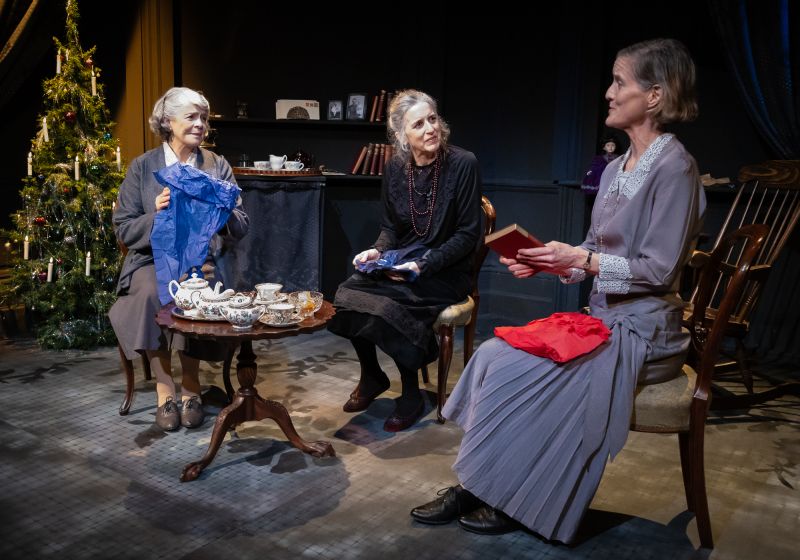
The actresses do what they can with the pedestrian, dated material. Julia Watson catches the despair of a widow, Mrs Amorest, whose son is abroad scheming to make his fortune and not answering her letters. You can almost see the ache of that absence as she masks the pain by attempting, unsuccessfully, but decently, to mother her housemates, both of whom, like her son, are indulged continually with an unearned benefit of the doubt. Amorest is, of course, a compound of the French words for love and stay and one can’t help thinking that she is stuck, blocked in life by a love that stays with her but is unreturned.
Catherine Cusack has less to bite on, her terrified Miss Beringer hanging on to the past in the form of a gigantic lump of amber given by a lost friend and pining for a dog into which you can’t help thinking she poured all the emotions that would have been better dedicated to a son or daughter. The character doesn’t really add up as she has upped sticks from her previous accommodation and travelled a considerable distance to take a room in a house full of strangers in a town unlikely to provide employment. She’s not a fool, just a woman on the verge of a nervous breakdown, so why is she where she is?
The sand in the shoes is provided by Abigail Thaw’s psychotic Agatha Payne, who dedicates herself to two linked objectives: bullying Miss Beringer relentlessly and acquiring the shiny lump of amber to satiate her magpie desire for shiny things. With a look of Cruella de Vil about her, it’s an almost impossible part to play. Do it straight (as in this production) and A Payne is indeed a pain, for us as much as for her fellow residents. Do it with a camp arched eyebrow and there’s a danger of straying into Lady Bracknell territory, albeit with real malevolence in words and deeds.
For some reason, there is little attempt to create three spaces on stage, and it takes some time to realise that the action isn’t taking place in a shared parlour, but in the women’s individual rooms. Quite why these women would not have locks on their doors or, at the very least, announce their arrivals, is hard to credit. Even the cruel Mrs Payne sticks to social conventions to some extent - the better foundation from which to launch her transgressive attacks.
Is the play irredeemable? I think not. Director, Brigid Larmour, had the good idea to move the action forward to 1935, the year the play was first staged, but surely it should have been adapted and set in the present day. That would bring to the surface issues like lthe oneliness and isolation in old age, the impact of nuclear families splitting, the root causes of Mrs Payne’s lack of empathy, which, to my untrained eye, looked like undiagnosed autism.
It’s frustrating to see so many hot button issues of today rendered all but invisible by a slow pace, caricatures where characters should be and an adherence to a text that was surely time-expired 30 odd years ago when last on a London stage. As such, it represents a rare misstep for a house that has so often found long neglected gems and polished them for our pleasure.
The Old Ladies at the Finborough Theatre until 19 April
Photo images: Carla Joy Evans
Sign up for all the news on the Fall season, discounts & more...
.jpg?format=auto&width=300)






Reader Reviews
To post a comment, you must register and login.