


Season 2, Episode 5: Behind every summer is a community that keeps Fire Island alive. This episode explores the history of the beloved Pines Pantry through the eyes of its iconic Pantry Girls, alongside the volunteer firefighters of The Pines and Cherry Grove who protect the island from fires, hurricanes, beach erosion, and an uncertain future.
Review: THE DANCE AND THE RAILROAD at Latino Theatre Company At LATC
Latino Theatre Company and Artists at Play illuminate early DH Hwang work.
By: Evan Henerson
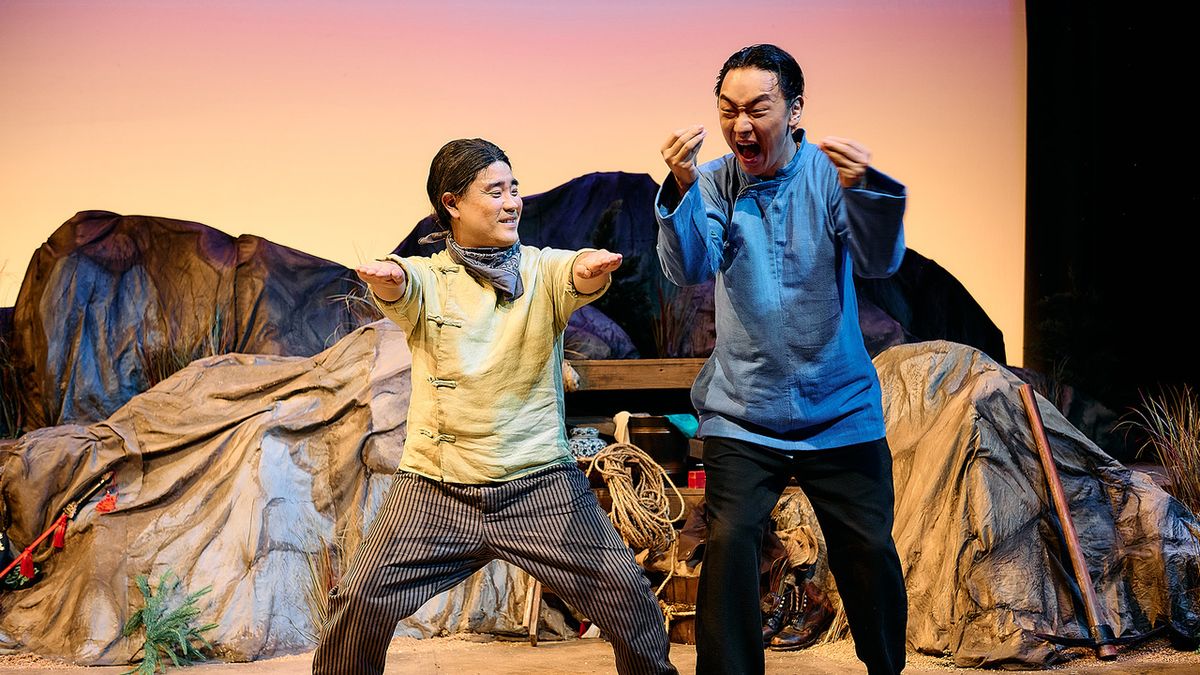
Two young Chinese men, immigrants in a foreign land, while taking a principled pause from the back-breaking labor that brought them to this country, take a moment apart from their fellow workers to indulge in their shared love of Chinese opera. One instructs, the other learns, and both dream. Their act – their dance – represents a gesture of defiance and self-definition even if nobody is around to witness it. Even if the sounds of the Gold Mountain (AKA a wilderness in California) drown them out. Even too, if they must ultimately trudge back down the mountain and resume their toil.
The play THE DANCE AND THE RAILROAD reminds us how insightful and imaginative the young David Henry Hwang was at the dawn of his playwrighting career back in 1981 when he wrote this two-character one-act commissioned by the New Federal Theatre under a grant from the U.S. Department of Education. The play was written for two actors who would go on to make their marks - John Lone (who also directed and choreographed the work’s premiere) and Tzi Ma. The two characters have their names.
The revival of DANCE at the Los Angeles Theatre Center – a co-production by Artists at Play and the Latino Theatre Company – is an artful rendering of an infrequently-staged Hwang work. In director Katherine Chou’s production, LATC audiences get a glimpse both at the beauty of an artistic discipline and some still-timely insight into the brutality of the treatment of immigrants and worker exploitation. It’s all there in 80 brisk minutes of stage time.
The play is set in June of 1867 when thousands of Chinese laborers building the transcontinental railway walked off the job, demanding higher wages, safer working conditions and fewer hours. Our protagonists are two of those workers - Lone (played by Tony Jin) and Ma (Scott Keiji Takeda). In two ways a non-conformist, 20-year-old Lone has isolated himself in a section of the mountain to practice the steps he has learned since he was a child. Interrupting his interlude is Ma, age 18, who arrives with a cautionary message from the striking men’s camp. “You got this kind of attitude,” Ma tells Lone. “You never sing songs, you never tell stories. You gotta watch yourself.” Lone is dismissive of this “child” bearing threats from the throng of his fellow workers whose opinions he doesn’t value.
But Ma isn’t so easily sent away, and over the course of the next few days, as Ma asks to learn the steps, Lone recognizes a potential kindred spirit, albeit one who can perhaps be both messed with and disabused of his Alger-esque dreams of wealth in a new land.
The physical contrast between the two characters emphasizes their differences. Jin’s Lone is lithe and graceful; while the smaller, stockier Takeda has difficulty contorting himself into the locus pose that Lone demands as a kind of act of initiation. But sheer persistence is something that the upstart grasshopper Ma possesses in abundance. “I wanna perform,” Ma says.
That’s not all he wants. Barely four weeks off the boat from China, Ma dreams of striking it rich on the Gold Mountain and returning to China in luxury. Concurrently, he believes the strike will be successful, that the “white devils” who are their employers will capitulate to their wage demands. Older (if only by a couple of years) but considerably more savvy, Lone knows better than to believe hooey about snow that never melts. If he’s going to instruct Ma, Lone asks for sweat, for discipline and to disavow the other Chinamen who he insists are “dead men.”
This odd couple kinship morphs gradually into friendship as Lone starts to genuinely care about the welfare – physical and mental - of his charge. Jin, who is all imperiousness and quiet disdain in his early scenes, infuses Lone with more warmth as the play moves forward and the two men bond. Takeda, projecting older than 18, renders Ma as decidedly a dreamer and a bit of a goof. Both actors smoothly handle the elegance of Annie Yee’s choreography.
The action plays out against the rocks and shrubbery of Leah Ramillano’s scenic design. Some hyperactive lighting changes at the performance I attended notwithstanding, Szu-Yun Wang’s lighting and Jesse Mandapat’s sound design help complete the effect.
Hwang’s play concludes with its two characters being delivered a hard dose of reality as far as the way of the world. Trains must run, after all, and tracks must be built. But dancers must also dance.
THE DANCE AND THE RAILROAD continues through Nov.1 at 514 S. Spring St., Los Angeles.
Photo of Scott Keiji Takeda and Tony Jin by Michael Palma
Broadway news in your inbox
Weekly top stories - unsubscribe anytime.
Weekly top stories - unsubscribe anytime.
Popular episode


|
CLUB27 Jaxx Theatre (10/01-10/30) |
|
The Cottage North Coast Repertory (10/28-11/22) |

|
Woof Odyssey Theatre (10/03-11/08) |
|
A Killer Night in Studio City Vitello's (9/06-10/31) |

|
Assassins The Actors Company — The Other Space (11/06-11/29) |

|
Audra McDonald The Soraya (4/03-4/03) |

|
Christmas Carol Goes Wrong Center Theatre Group (12/12-1/10) |

|
PlayGround Twisted Holiday Festival PlayGround LA (12/04-12/20) |

|
The Feel Good Story America Needs Right Now Theatre West (10/02-11/08) |

|
TST's 13th 10-Minute Play Festival Towne Street Theatre (10/03-11/01) |
Reader Reviews
To post a comment, you must register and login.