


Review Roundup: The National Theatre's ELECTRA/PERSONA, Starring Cate Blanchett
The production runs until 10 October
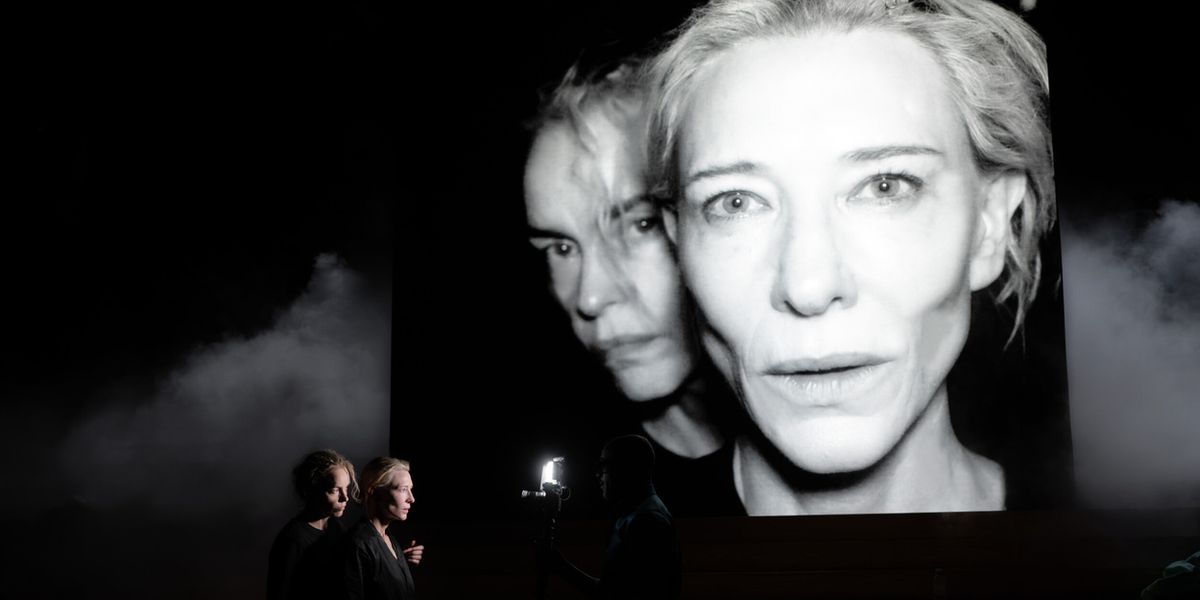
Directed and adapted by Benedict Andrews, this new play is based on both Sophocles' story of Electra from Greek mythology and Ingmar Bergman's celebrated 1966 film Persona – exemplifying The National Theatre's commitment to re-examining classic stories in new forms. Creating a charged dialogue that spans over 2000 years between the ancient and the modern, this ambitious new production will interrogate the inner life of an actress and query how grief can make us strangers to ourselves. What did the critics think?
Electra/Persona plays at The National Theatre until 10 October
Photo credits: Monika Rittershaus
 Clementine Scott, BroadwayWorld: Both Andrews’s Electra and his Persona could more than stand on their own as imaginative takes on seminal texts that reward those with knowledge of the source material. But the production’s real strength is in the elegant parallels it draws, to form a new whole that enriches and enhances the work of both Sophocles and Bergman.
 Sarah Crompton, WhatsOnStage: Hoss and Blanchett, so convincing in their previous performance opposite one another as a couple in the film Tár, relish every moment. As Electra, Hoss’s purposeful walk, her downturned mouth, and rising fury perfectly suggests a woman in the grip of mania, exuding “the holy stench of grief.” Her ability as Elisabet to reflect thought and feeling while staying utterly still is riveting; her strength and vulnerabilities are both delicately charted. As Clytemnestra, Blanchett is imperious and frightening, as Alma, needy, ingratiating and slightly terrifying. Ella Lily Hyland and Patrick Robinson make up the onstage quartet, in unrewarding but necessary roles.
Arifa Akbar, The Guardian: It’s a clever twist (too clever?) that seems earnest in its intentions to eke out mother-daughter friction from each drama, as well as exploring ideas on performance, how actors assume roles and who they become when they are off-stage – rather than a production conceived as theatrical sport. Yet, this intense, interval-free show is quite literally a game of two halves, Andrews’ overhaul of the ancient much more successful than his strangely sterile play on Bergman’s classic.
Clive Davis, The Times: Blanchett remains such an icily charismatic presence that you’re reluctant to look away even when the pace sags, as it does in the final hour. Her co-star Nina Hoss — who played Blanchett’s wife in the classical music film psychodrama Tár — makes an indelible impression too. Still, as the overlong Bergman segment wafts towards its conclusion, it’s the crispness of the images of the two women projected on to a compact screen that holds your attention rather than the script itself.
Andrzej Lukowski, TimeOut: But from the POV of an audience member who will only ever see it one way around, let’s call it what it is: a flex over how good Blanchett and Hoss are. And they’re really, really good: even if Benedict Andrews’ production maybe doesn’t entirely ‘work’, the sense that it is just bloody amazing having two such incredible actors doing an enormous amount of acting – and that we’re actually only even seeing half of it – pretty much carries the night.
Anya Ryan, London Theatre: Next to each other, the plays say very little. So, it is best to enjoy the aesthetics of Magda Willi’s pine, pyramid-sloped set and the pleasure of watching two actors right at the top of their game. On camera, their screen training shines: feeling comes through in even an eye twitch from Hoss as Elisabet, while tears silently roll down her cheeks. As Alma, Blanchett lets go of all professionalism and starts to spill out her secrets. Together, they mimic each other’s movements, rubbing their faces in unison and sitting in exactly the same formation. When their faces morph into one another on screen, you feel their duality starkly.
Claire Allfree, The Telegraph: Echoes between both works reverberate – Alma and Elisabet cradle each other, as do Clytemnestra and Electra; the odd line is repeated. Both Electra and Elisabet have withdrawn from themselves because the horror of the world is too much – the unstoppable cycle of violence for Electra, the senselessness of war for Elisabet (Andrews replaces Vietnam with the Middle East). One is estranged from her mother, the other from her daughter. Both struggle to find a way of being that feels both reasonable and true.
Daz Gale, All That Dazzles: Cate Blanchett and Nina Hoss lead the four strong cast with the two main roles (Electra/Elisabeth and Clytemnestra/Alma) but which role does each actress play? Well, that very much depends on the night. Each performance starts with the two actresses in the audience announcing that it will be decided on a coin toss. Either Blanchett or Hoss chooses heads or tails, and the victor gets to choose which role they perform that night. If that sounds a bit gimmicky, it is very much deliberate and the reasoning for this becomes far more apparent as the play progresses.
Demetrios Matheou, The Hollywood Reporter: Audiences seeing Electra/Persona once might wish to return another night, when the roles are exchanged. Blanchett and Hoss may be up there with the great stage collaborations of Gielgud and Richardson, McKellen and Stewart. More please.
Alice Saville, Independent: There’s also a kind of cerebral chilliness to this production – a kind of distancing that doesn’t really speak to its emotive themes of motherhood, and the failure to live up to the impossible demands of parental love. Or perhaps its impact is just delayed. To feel it, maybe you need to return again, and see the coin land on the flipside.
Stuart King, London Box Office: Ultimately then, a stylish piece which is well-acted, cleverly crafted and slickly presented. But don’t take children or easily bored individuals (like the glamorous airhead who sat fidgeting in the seat in front of me). They’ll only annoy those patrons determined to apply their own focus and attention.
Madeleine Morrow, London Unattached: Electra/Persona is a psychologically engaging production, reaching back to Ancient Greece via Bergman and into the present day. It is performed by a consummate cast on a set as bleak as the emotions uncovered.
Houman Barekat, The New York Times: Yet for all the skill on show, the essayistic churning of theme (performance, ambivalence, the dualities of the self) in “Electra/Persona” becomes somewhat labored toward the end of the 130- minute, intermission-free run time. And the “Persona” segment, though stylishly rendered, feels inescapably like a homage — more reanimation than reinvention. The applause at the curtain call was enthusiastic but not rapturous — suggesting, perhaps, a greater appreciation for the performers than for the piece.
Joanna Magill, Radio Times: Ultimately, Blanchett and Hoss delivered a performance for the ages – but the same couldn't be said for the script. A full performance of Benedict Andrews's Electra or Persona would feel like a more striking production, giving each script more room to breathe.
Michael Holland, South London: Design carries real weight throughout — the staging inventive, the soundscape visceral. But the production as a whole is easier to admire than to feel: intellectually alive, only fitfully moving, and, for all its ambition, never quite captivating.
Nick Curtis, The Standard: None of which takes away from the quality of the acting from Blanchett and Hoss. Or their bold, shared willingness to give themselves over to radical directors. Hoss has worked many times with Thomas Ostermeier, who directed Blanchett in a stupendous Seagull at the Barbican in 2025. Both have worked before with Andrews, who is one of three auteurs from Blanchett’s native Australia shaking up international theatre. His previous shows in London have been revelatory. This one is a misstep.
Andrzej Lukowski, TimeOut London: The main problem is that the Electra section ends up feeling somewhat thrown away because it’s so much shorter than the Persona section, and with a lighter tone (closer to Andrews’ usual voice on productions like his recent Hoss-starring Cherry Orchard). And that’s a shame because it’s very good and – despite the millennia-old plot – feels like an original stage work. Persona is really much closer to an act of transposition, of putting Bergman’s story on the stage faithfully. But it’s intense, serious, psychologically demanding source material that drains the night away from the shorter play. Electra is good, Persona is good, Electra/Persona isn’t necessarily one for the ages.
James Humphrey, The Upcoming: However, it’s still an intellectual wrestle as to why Electra and Persona have been brought together. Andrews seems to be probing at the emotional untangling in the female confrontation at each story’s heart. This reveals how rawness breaks to the surface after being buried by societal pressure, tragic loss, or dissatisfaction and how the two lead women struggle to cope with it. It is less a hammering than a haunting of the audience with this theme from one half to the other, but it’s frustratingly slippery to grasp – if indeed this is what the production is driving at. The overall experience of Electra/Persona is elusive, although the moments are delivered masterfully. It might just be worth seeing for the two lead actors at the height of their on-stage and – as this production surprisingly proves – on-screen powers.
 West End Wilma, West End Wilma: Electra, as a standalone piece, is excellent. Persona loses itself and constantly tries to cling to things that aren’t there. By the end (of what felt like forever), I couldn’t have cared less about these characters and that really isn’t an ideal outcome for a theatre show, which should leave you thinking and questioning but not scratching your head in boredom.
Average Rating: 70.5%
- To read more reviews, click here!
- Discuss the show on the BroadwayWorld Forum

Sign up for all the news on the Fall season, discounts & more...
|
Powered by

|
.jpg?format=auto&width=300)
.png?format=auto&width=365)





Reader Reviews
To post a comment, you must register and login.