EDINBURGH 2026: Interview: KT Tunstall on THE SINGER
The Singer is at the Traverse Theatre throughout August and on tour until 26 September
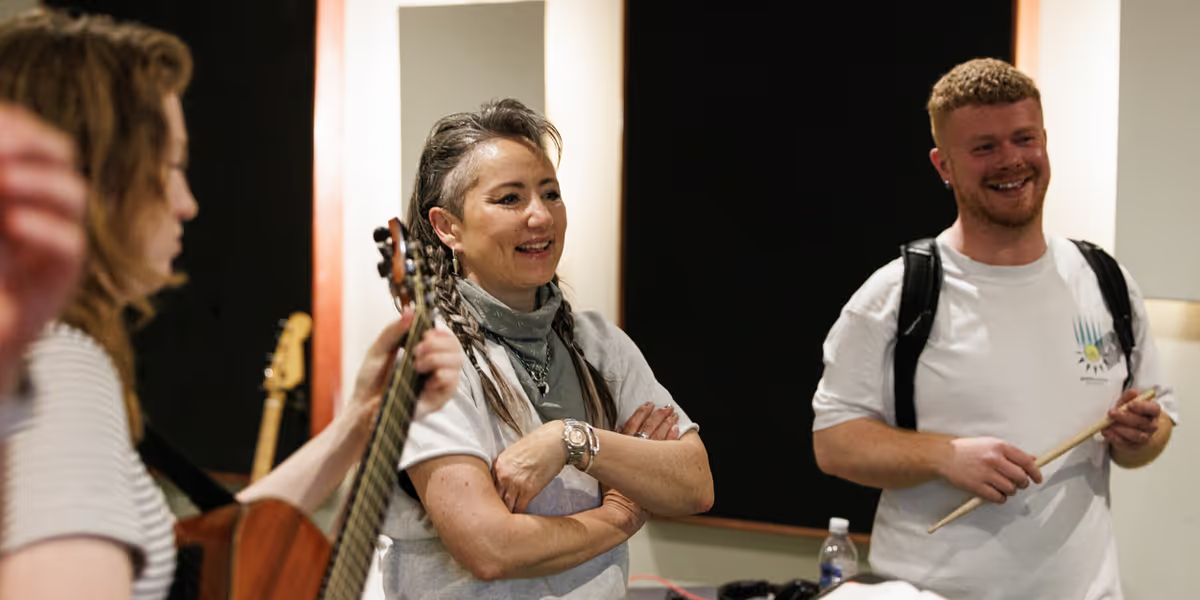
Grammy nominated singer-songwriter KT Tunstall has penned the music for new play The Singer which opens at the Edinburgh Festival Fringe this August ahead of a Scottish tour. BroadwayWorld Scotland editor Natalie O'Donoghue caught up with KT to chat about her involvement in the show and why this story is so important to her.
How did this collaboration come about for The Singer?
I think Cora (Bissett) had clocked that I was doing musicals, probably via Clueless. She and Jamie Rea, who plays Joe had collaborated to come up with the short film of The Singer and it's a beautiful short film. I guess her conversations with Dundee Rep's Andrew Panton threw up this idea of doing it as a stage show. We're not calling it a musical because it really isn't a musical. It's gig theatre, I love that term as well. It's really good, but, the songs are not necessarily propelling the narrative quite as intensely as a musical would.
So for me, as a writer, it's been an absolute joy, because I don't need to be quite as mathematical about the writing. Clueless was very challenging in that way, but Glenn Slater is such an amazing lyricist, but it's like insane amounts of narration. So Cora had heard that I was doing musicals and and I was totally unaware of her music industry background when we met. Then, 6 months into working together, she's like, “aye, I opened for Radiohead”. You f**king what?? And then I kind of learned all about it. I didn't do my Google stalking, but in a way, it was lovely that we just met each other where we're at in our lives. I didn’t know any of that and I didn’t need to know that to know she was an amazing person to work with but it completely made sense for why she's so good at writing about this subject.
The first thing that struck me about Cora is her energy. I think we're living in a time where a lot of creative people are somewhat struggling to be positive and finding it very difficult to kind of still exist in joy. And it's just my MO. That's kind of where I exist when it comes to the work I'm doing. And I think it was just that immediate recognition of someone who does the same. And Cora, despite having many thoughts about the world outside, she just exists in joy every minute. Those are the people that I'm really interested in working with. Even if it's a very difficult piece of work, it's the path to joy. For me, that's what art is. It's the path to your heart opening.
Even if it's difficult subjects, and I mean, I am not a crier and every time I've watched it, I've seen this show three times, so two run-throughs and then the first preview. And it makes me cry, which is really unusual for me. And I’m extremely uncomfortable with it. [laughs] But I think the moments that get me are when Petre [Dobre], who plays Pops, both of his BSL monologues: when he's doing the monologue as the choir member, and then when he's doing the monologue as Pops. I think the second one where he describes what BSL feels like and how its not linear and you almost go into this portal of this incredible different universe, a 3D universe of how you describe things. Then the second bit that makes me cry again is a moment of silence when Andy has learned sign language to speak to Joe. It’s a real testament to the play that as a hearing person who doesn’t speak BSL, the most emotional moments in the show are in silence. You’re guided towards those moments through the music and the actions and captions and BSL. I’m just absolutely amazed at Cora, She’s a genius.
But I said to her, surely this is one of the hardest things you've ever done because she doesn't have a tonne of deaf community experience before meeting Jamie. And also being a musician herself. It's not an obvious thing to be drawn to do, to feel like you are able to do this well. That’s what would have made me nervous is even growing up with a deaf sibling, I was like, how do you really serve the deaf community? I guess that's where that collaboration with Jamie was just golden. But she replied, she was like, oh my god, not even nearly amongst the hardest things that she's done. She's done shows that were way more difficult than this. She says, this has been like being in flow from the get go. And I just thought that was amazing. Because it really on paper, like when I was trying to write the song for the deaf choir, I could not understand what she meant. I was like, what do you mean, deaf choir? Like, how does this work? How are you doing deaf choir with a theatre full of probably majority hearing people? And she's like, Katie, don't worry about it. It's gonna work.
Then the really interesting thing is you get these moments of like fluke in theatre. And then you're overjoyed that you've hit this thing that you didn't even mean to hit. And one of them was in the deaf choir scene because “Find My Feet” I actually wrote as this sort of Disney song that Layla, the daughter, loves. That was written first as the song for her to ask Andy to play for her. And then we were like, and then we'll have a reprise of this one and he knows how to play it and that's their song together. But then, Cora had this amazing idea of using that song as the first song in the deaf choir. And I had not been thinking about writing a chorus that has a very slow melody. So the words in that core Find My Feet are really elongated. Not what I would usually write at all. And they just are so perfect for being able to teach a hearing audience to sign.
We actually noticed that in the reprise of the song we saw some people in the crowd doing the BSL while he was singing that. And I think that was probably also very emotional for Jamie and Petre on stage. I mean, and for Hannah and Dylan as well, to finally be in a full theatre of people actually doing the BSL. They'd been doing this in a vacuum up until that first night. What I find extraordinary about the show is just a complete lack of barrier. Between hearing to deaf and deaf to hearing. Uh, and I don't feel like there's probably ever been a show where both hearing and death, audience members are learning something, they're learning about communication. They're learning about language. I mean, in this case, probably the hearing are learning more than the deaf crowd. But there’s just this seamless kind of understanding of what's happening.
Having kind of this very strong Scottish vernacular as well. I was thinking about that quite a lot. About how, Shakespeare is still so prevalent, but a lot of audiences will not really understand every word of Shakespeare. If this show maybe goes elsewhere in the site, outside of Scotland. Maybe some people don't understand the Scottish words. I'm like, what a cool mirror that is of the deaf community. Having that experience of not understanding, not catching every word, and not being able to read every word.
Would you say that the songwriting's closer to your own style than the music for Saving Grace and Clueless?
Yeah, I think from all the shows that I've done, I've doing another one in America at the moment called God Sex and Musical Theatre, and that one is also more of a gig experience where it's kind of like an immersive, rock musical experience. But this one, I think also because it has Scottish bones. I think that that lends itself particularly to my early writing of, you know, I think "Living On Thin Air" being the opening song, you know, that's totally something I would have written for myself. Just having that character to write for that was literally me, busking in Glasgow and feeling frustrated. I mean, when I was busking in Glasgow, I was very young, so I hadn't been through all that at that point, but it was very easy to empathise with that character and relate to that character.
I think from a musical point of view, Cora and I talked a lot about having style to what they do because one of the challenges actually with the show too was when I read it and I said this to Cora. I was like, you know, people are actually pretty used to seeing BSL online. Because you'll have signers at festivals, you'll have signers at gigs, you know, sometimes have signers, you know, on television. So that in itself is not like massively unusual anymore. And I said to her, the Barrowland crowd have seen every iconic show that's ever been played in Scotland. It's the place to go and see an amazing band on the cusp of something bigger. Or big bands that want to come back to the Barrowlands because it's amazing.
I said we've actually got to put on a show that would really, genuinely blow people away. And I don't know if just two people playing music with a deaf guy signing is gonna do it. I don't think that's really gonna be an internet sensation. Is that believable if that's an internet sensation? And she then told me about Jamie having this pack that buzzes him to the beat. I was like, do you think he would be able to trigger the beats? And that was like this massive pivotal moment where Jamie won't, or the character of Joe, actually becomes a beats guy and he's writing the beats and he's writing some basslines, and with his lyrics, what I loved about it is that his, his music is arguably way cooler than Andy's. So it kind of propels that character, I think, to being the more inspiring artist. You know, where Andy's character is very dead set on fame and success. And Joe's character doesn't give a f**k about that. He doesn't give a f**k about money. He just wants to make art. And I think that aspect of what he's doing now and just watching him in that first workshop when I went, when I was with them all for the first time, there was three camera crews. There was like twenty people in the room. And he'd never he'd never done this before. And he's just dancing and hitting these pads on time. And loving it. I was just like, this guy is fearless. He's killed it. It's so impressive.
To describe the style I came up with Hozier versus Massive Attack. So we decided to call it Massive Hozier because Hozier Attack didn't sound quite as palatable.
What does this cast bring to the show?
I don’t know how we do this show without these people. They are fully extraordinary. All four of them. I mean, Cora had told me about Hannah Jarrett-Scott and I trusted her. Then the first time I saw them playing, it was on a Zoom and I was in America and I was like, “holy sh*t- this girl is outrageous”. She's now one of my favourite actresses. She's so funny, genuinely hilarious- a classic clown. Like commedia dell'arte level brilliant. The best clown can make you cry as well as make you laugh; it’s so emotional. And she's just the best of the best. And then I heard her sing- what an unbelievable voice. I'm like, “f**k, this girl's a better singer than me”. And thank God. And she's such a great player too. She's like an artistic octopus.
Dylan Wood was a later addition to the cast and he just couldn't be more perfect. He's such a great performer and the thing that blows me away with Dylan is that he seems real. Even though the captions are on the screens, the way that Dylan delivers dialogue is like he's genuinely searching for what he's going to say which is just so impressive. There's no kind of, over egging the pudding at all. And then Petre is just like watching a dancer. He's just such a beautiful performer.
And Jamie goes without saying. I just don't know how we do it without them. Jamie's been through programmes of Solar Bears, various programmes for 10 years. The hope is that Solar Bear will produce more people of this calibre. Deaf people who can really bring this unbelievable richness and talent to the pool of actors and musicians in Scotland and around the world.
I don't think people realise how powerful the show is until they see it. It really feels like this massive giant leap forward in breaking down the barriers of perception and expectation of a show that features people with deafness.
How do you connect personally to the story?
I really like the scene, the first deaf choir scene, when Jamie asks who is profoundly deaf and my brother would put his hand up if he was in the audience. And then he says who’s hard of hearing and I can put my hand up. I am part of this now; this is my reality and I'm very aware of my deafness every single day. But more than my own deafness since 2018 is my growing up with a profoundly deaf sibling. He was my best buddy growing up and so I've had a lifetime of watching him be ignored and watching him be ostracised and watching him not be included and him saying, “what did you say?” And someone going, “oh no, it doesn't matter”. And so I would always be lip-reading with him and telling him what was going on and being very aware of if he was being ignored, and looking out for him. And also just seeing how challenging it was for him to move through the world.
I think growing up, I would have been absolutely flabbergasted if someone had told me that you could make a play with music featuring a deaf cast that everybody could go and see. I'd be like, “how? how is that possible?” And then the answer would be-go talk to Cora Bissett.
As someone who has lived in Edinburgh, what's your experience of the Fringe?
Well, this is the other really magical part of this show is that my first ever paid gig was Karen Koren hired me to play the Fringe in 1998. And I had to play the Bear Pit in the students' union from one till three in the morning every single night for a month, and I nearly died.
It was just absolute carnage. My drummer had a habit by the end of it. My bassist has like nearly gone completely mad. We had the Cuban Brothers who were playing before us next door, up on stage, almost every night rapping to our hippie jams. There was a Kiwi 4-piece male comedian troupe and one being Rhys Darby before he was well known and they were always in the crowd. It was so brilliant. It was just an amazing time, but I'll tell you what, at the end of that, I was like, I am not, I am not doing this in a band. I am going solo. F**k these people, I'm the only one doing the work. But it was an incredible opportunity from Karen Koren from the festival.
I think what was just so great about it was that you feel part of it. It's this massive family of people kind of fighting adversity to make their art. And you know for sure, no one is there to make money. Everybody's doing it for pure passion and love of making things, and that is such a palpable energy.
How would you sell The Singer to somebody?
You will laugh out loud. You will cry. You will learn things. You will come out with different ideas about what human beings are capable of.
The Singer runs at the Traverse Theatre until 30 August and then is on tour.
Sign up for all the news on the Fall season, discounts & more...
.jpg?format=auto&width=300)