


EDINBURGH 2026: BACKSTAGE Q&A
Backstage ran at the 2026 Camden Fringe and Edinburgh Festival Fringe
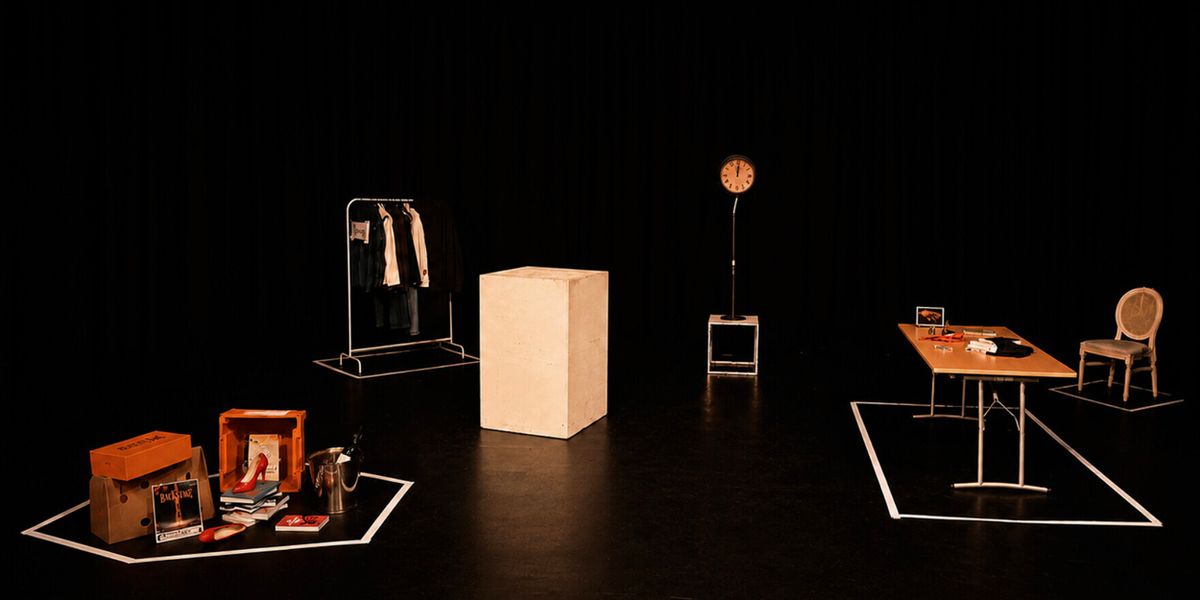
BroadwayWorld catches up with Yilin Yan, director of the Chinese production of Backstage and founder of Blue Eyes Theatre, to talk about bringing the production to the Camden Fringe and Edinburgh Festival Fringe this summer.
Tell us a bit about your experience of bringing Backstage to the Camden Fringe and Edinburgh Festival Fringe?
Bringing Backstage from China to the Camden Fringe and then to the Edinburgh Festival Fringe was an important stage in the production’s development.
For the Chinese production, Haoming Li and I worked closely on developing the piece from text to stage. As director, I focused on character relationships, performance rhythm, spatial movement and how the audience entered the world of the piece, while Haoming was also involved in the wider creative direction, production process and coordination between departments.
The original script by Junhan Cheng gave us the foundation, but the production continued to change through rehearsal. We worked with the writer, performers and creative team to refine the structure, audience interaction and use of space.
When we began preparing the UK version, that collaborative process continued. Anlan Shi adapted and translated the work into English, considering not only the language itself but also rhythm, cultural context and how the characters would communicate with British audiences.
Haoming then continued the development of the UK production as Producer and Creative Director, thinking carefully about how the work could function within the British Fringe environment and across different venues. Visual Designer Jiaorong Yu also developed the visual language of the UK version in response to those spaces.
The cast — Change Jia, Bai Ruiying, Beatrice Paolucci and Wendie Hou — brought their own energy to the roles, which naturally changed the rhythm and tension of the production.
Camden gave us our first real opportunity to see how British audiences would respond to the work. Edinburgh then demanded even greater precision because of the pace and practical structure of the Festival Fringe.
What interested me most was that the production remained recognisably Backstage in both cities, while adapting naturally to each environment.
How was it adapted for British audiences?
For us, adaptation meant much more than translating the script into English.
The original production came from a Chinese cultural context, so we had to reconsider how humour, tension, authority and audience participation might be understood differently in the UK.
Anlan Shi’s English adaptation helped us reshape the language and rhythm, while Haoming and the UK creative team continued to adjust the structure, interaction and staging.
The performers also became part of that adaptation. In immersive theatre, the audience is physically close to the actors, so even small differences in performance can change how a scene is experienced. Change Jia’s portrayal of Lena, for example, needed to remain emotionally accessible while the world around her became increasingly unstable.
We did not want to remove every cultural difference from the production. Some unfamiliarity was important. The aim was to make the dramatic logic clear to British audiences without losing the perspective from which the work was originally created.
What do you think made audiences connect with it?
I think it begins with curiosity.
The premise is very simple: someone is invited backstage and is given access to a world that would normally remain hidden. At first, that feels exciting rather than threatening.
Then the atmosphere gradually changes.
The cast — Change Jia, Bai Ruiying, Beatrice Paolucci and Wendie Hou — were important in controlling that shift. They had to create a world that initially felt welcoming, playful or intriguing, before slowly making the audience question what was happening around them.
The production explores trust, control and the way people respond to rules. If someone appears confident enough, or everyone around you seems to accept an instruction, how long do you continue before questioning it?
I think those ideas travel easily between cultures because they come from very recognisable human behaviour.
Humour also plays an important role. There are absurd and playful moments in Backstage, and they make the darker changes in the production more effective.
How did the different venues influence the visual and immersive approach?
Space is one of the main storytelling tools in Backstage, so each venue inevitably changed the production.
Visual Designer Jiaorong Yu played an important role in shaping that process. Working alongside Set and Props Designer Wendi Wu and Costume Designer Shaojia Li, she developed a visual language in which the space, objects and performers could work together to support the changing atmosphere of the piece.
A table, for example, might begin as part of a performance, then become a backstage working surface, and later function almost as a boundary between performers and audience.
That flexibility became particularly useful when moving between Fringe venues.
At Camden, the intimacy of the space meant that very small movements, changes in position or the placement of an object could have a strong effect.
Edinburgh presented different practical conditions, so Haoming, Jiaorong and the wider team had to rethink audience entry, sightlines, pacing and how quickly the environment could establish itself.
I do not think immersive theatre always needs a large or technically complicated environment. Sometimes changing the distance between performer and audience, restricting movement through a space, or changing the meaning of a familiar object can be much more powerful.
What is next for the production?
Haoming and I see Backstage as a long-term project rather than a production that ends after one festival season.
Our current plan is to continue taking the work into new international contexts. Next year, we hope to explore opportunities to bring Backstage to the Festival d’Avignon in France and the Hollywood Fringe in the United States. In China, we are also hoping to take the production to the Wuzhen Theatre Festival and the Aranya Theater Festival.
At the same time, the production is continuing to build a more permanent life in China. We have already signed a one-year agreement with a theatre there, which gives us the opportunity to keep developing the work over a longer period rather than treating each performance as a one-off event.
Haoming and I would also like to develop a similar model in the UK. One of our longer-term ambitions is to find a London theatre where Backstage could have an extended run or become part of an ongoing partnership. After Camden and Edinburgh, we feel there is much more potential to explore how the production can grow with British audiences over time.
For us, touring internationally and building longer-term theatre partnerships are closely connected. We do not simply want to take the same production from festival to festival. We want Backstage to develop through repeated performances, different audiences and sustained relationships with venues.
Ultimately, we hope it can become a project that has a continuing life both in China and internationally, with each version influencing the next.
Sponsored content
Prefer BroadwayWorld in Google Search?
Add us as a preferred source so our stories show up more often in Top Stories and Google’s AI answers — for you.
Sign up for all the news on the Fall season, discounts & more...

.png?format=auto&width=365)




