


Did You Know That These Writers Had Two Broadway Shows Running on the Same Street?
Lin-Manuel Miranda will soon have two shows on 46th Street- Hamilton and Warriors.
Do you have a burning Broadway question? Dying to know more about an obscure Broadway fact? Broadway historian and self-proclaimed theatre nerd Jennifer Ashley Tepper is here to help with Broadway Deep Dive. BroadwayWorld is accepting questions from theatre fans like you. If you're lucky, your question might be selected as the topic of her next column!
Submit your Broadway question here!
The proximity of our 41 Broadway houses adds greatly to the spirit of community in the theatre industry. Folks working at the Neil Simon have a 5-minutes-to-places tradition with folks working across 52nd Street at the August Wilson. A 45th Street stage door alley is shared by those working at the Majestic, Jacobs, and Golden. Cast members sometimes travel through a hidden tunnel from the Broadhurst to the Schoenfeld to visit each other backstage.
But there’s a special kind of community created when a major player on Broadway has more than one production on the same street. When a writer, director, or lead producer can boast more than one show on the same block, there is a cross-pollination involved that results in collective events, new traditions, unique sales initiatives, and a theatrical block party energy.
This season, 46th Street will join these special ranks when the new musical Warriors moves into the Lunt-Fontanne Theatre. Warriors, with book, music, and lyrics by Lin-Manuel Miranda and Eisa Davis, moves in across the street from Hamilton in its long-time home at the Richard Rodgers. Hamilton, with book, music, and lyrics by Miranda, already has a history of inspiring block party vibes on 46th Street with Ham4Ham, their in-person lottery turned pop-up concert event. Will there be a crossover lottery event for both shows? Perhaps Warriors will be the Lunt-Fontanne show to finally reopen the theater’s long-dormant retractable rooftop and wave to their neighbors?
In 2011 and 2012, the breezeway shared by the Gershwin and Circle in the Square Theatres, between 50th and 51st Streets, was unofficially deemed ‘Schwartz Alley’. The long-running Wicked, which has been the Gershwin’s tenant since 2003, was joined by a bouncy revival of Godspell at Circle in the Square. With this, composer-lyricist Stephen Schwartz became the reigning king of the area. Would-be ticket buyers who did not win the in-person lottery for Wicked tickets often went to check out the earlier Schwartz musical instead. Since some of a show’s best advertising is the theater exterior itself, it’s a great asset to have would-be buyers just next door!
With all of his blockbuster successes, Andrew Lloyd Webber would have to have an instance or more of playing multiple theaters on the same block. Indeed, for nine months in 1982 and 1983, crowds at Evita at the Broadway could just about wave to crowds at Cats at the Winter Garden. While both theaters lie on Broadway, they are a couple blocks apart. Cats was still running strong on Broadway between 50th and 51st Streets when Starlight Express moved into the Gershwin at 51st Street from 1987 to 1989. The presence of the large office building above the Gershwin prevented any anthropomorphized trains from making dressing room signs aimed at any anthropomorphic cats—but it didn’t prevent a sense of Lloyd Webber-scored camaraderie from echoing down the block. During The Phantom of the Opera’s long duration at the Majestic Theatre on 44th Street, the same block hosted Lloyd Webber’s Aspects of Love, just next door at the Broadhurst, a large scale revival of Joseph and the Amazing Technicolor Dreamcoat at the Minskoff, the original production of Sunset Boulevard which moved into the Minskoff directly afterward, and the short-lived By Jeeves at the Helen Hayes. While none of these productions overlapped with each other, they all overlapped with The Phantom of the Opera on 44th Street.
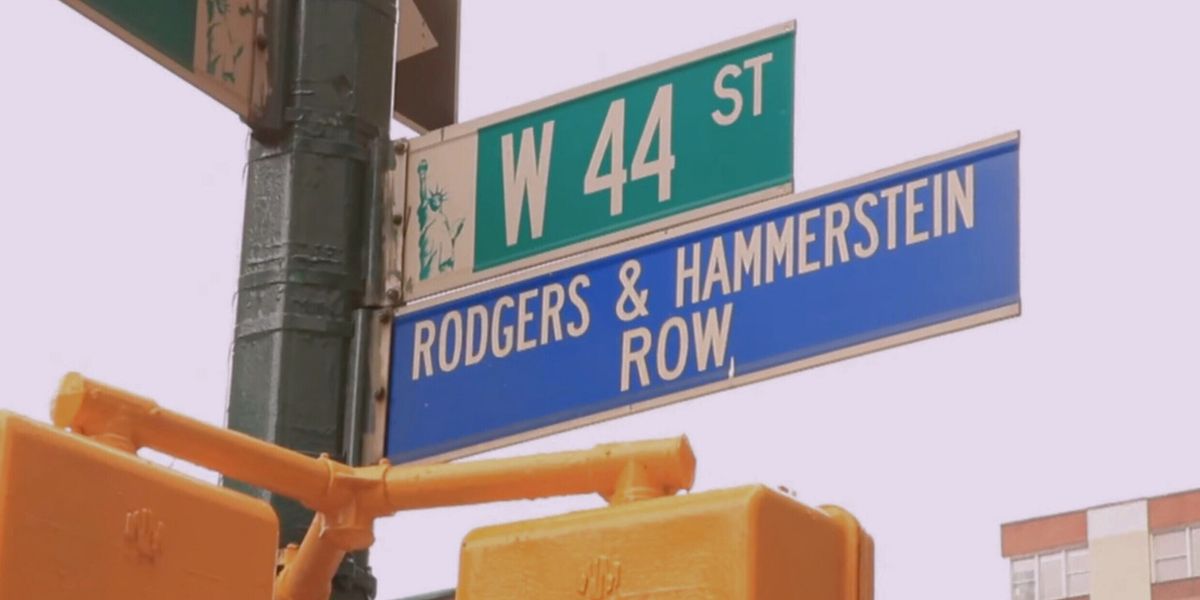
Richard Rodgers and Oscar Hammerstein notably enjoyed a time as reigning writers of 44th Street. The groundbreaking duo opened their first show together, Oklahoma! at the St. James in 1943. Their next production, Carousel, opened directly across the street at the Majestic, while Oklahoma! was still playing. Carousel ran from 1945 to 1947, and when it closed, the pair replaced it at the Majestic with their newest musical, Allegro. Oklahoma! ended its record-breaking run in 1948, while Allegro was playing across the street. For several years, only R&H shows had occupied the St. James and Majestic. After Allegro closed, the Majestic got a Carousel revival followed by the premiere runs of South Pacific and Me and Juliet, between 1949 and 1954. And Rodgers and Hammerstein re-claimed the St. James for The King and I from 1951 to 1954. In fact, West 44th Street was officially renamed Rodgers & Hammerstein Row due to the great volume of shows that the partners installed on the block during their golden era. (Pipe Dream also premiered at the Shubert.) Rodgers and Hammerstein’s only new musical together during their lifetimes that did not premiere on 44th Street was The Sound of Music, which opened at the Lunt-Fontanne.
A large majority of these instances of writers dominating a block with multiple shows have occurred on 44th Street. But there have been a are few on other streets—and even some occasions where a creative has boasted more than one show on the same block at theaters that no longer exist. The Playhouse was a Broadway theater on 48th Street, just across from what is today the James Earl Jones Theatre. Built in 1911, the mid-sized Playhouse was a popular theater until it was demolished for an office building in 1969. For many years, the Playhouse and the theater then called the Cort were sister theaters, just like the Simon and Wilson are today. You might recognize the Playhouse from its scenes in the original The Producers film or Valley of the Dolls film, or as the home of the original production of The Miracle Worker. In 1935, the Playhouse had a major hit with Three Men on a Horse, directed and co-written by the prolific George Abbott. When Abbott opened another major hit, Boy Meets Girl, later that year as director, he did it just across the block at what was then the Cort Theatre.
Director-choreographer Michael Bennett opened his follow-up to the landmark A Chorus Line, Ballroom down the block deliberately in the hopes of goosing business. While Bennett was not a writer on either show, he did conceive A Chorus Line and was the muscle behind both productions. While A Chorus Line played the Shubert for 15 years, Ballroom lasted fewer than 15 weeks at the Majestic.
There is one famous incidence where two productions of the same show actually played directly across the street from each other! In 1923, the operetta Blossom Time became so popular that it resulted in two different productions of the show, facing each other on 44th Street (Read more about it here). One played the Shubert and the other played the now-demolished 44th Street Theatre. Blossom Time, which ran from 1921 to 1923 and then was revived four times in the 1920s, had book and lyrics by Dorothy Donnelly and music by Sigmund Romberg adapted from the melodies of Franz Schubert and Heinrich Berte.
Few playwrights have had multiple plays running on Broadway simultaneously as many times during their lifetime as Neil Simon did. But due to a number of circumstances, Simon rarely found his productions occupying the same street. For a time, Simon owned and operated the Eugene O’Neill Theatre, meaning plenty of his own plays parked there—but he never once had a production at the Ambassador, across 49th Street. (Despite the proximity of the Eugene O’Neill and Ambassador Theatres on 49th Street, the two houses have no significant history of writers inhabiting both theaters at once. This won’t change any time soon since long-runners The Book of Mormon and Chicago are currently in those venues.) In 1986, a revival of Sweet Charity, with book by Simon, played the Minskoff while Broadway Bound premiered at the Broadhurst, both on 44th Street, but this was a rare instance.
Sign up for all the news on the Fall season, discounts & more...
.jpg?format=auto&width=300)






Comments
To post a comment, you must register and login.