


Reviewed by Ewart Shaw, Thursday 3rd April 2025.
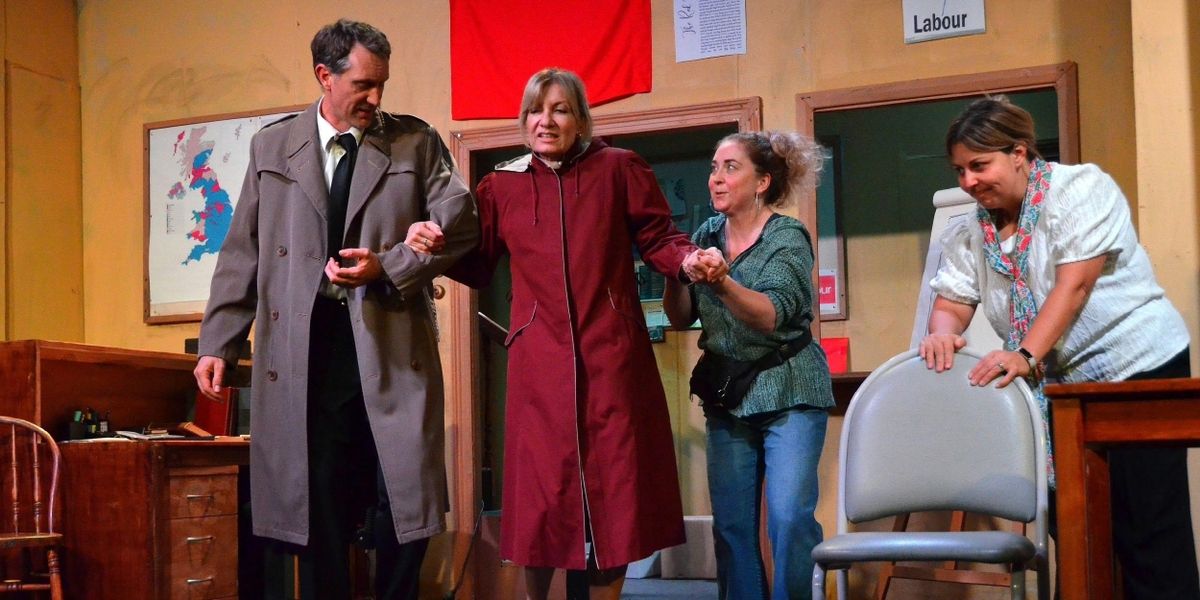
Labour of Love is a play with its political heart on its sleeve. It is also a labour of love for St Jude’s Players. It’s long, it’s wordy, and confusing in structure, but director, Kym Clayton, is blessed with a strong and confident cast.
The scenes follow the main characters’ political and personal fortunes in a series of scenes across the twenty years of their interactions. The challenge for actors and audience alike is that the first act shows the story from the end to the beginning, and the second act reverses the flow. There are slight changes to the stage décor, and the changing headgear of Her Majesty the Queen in the projected portrait acts as an aide-mémoire. Her Majesty is easily recognizable in various hats and headgear, but most of the political characters referenced visually, other than maybe Tony Blair and Maggie Thatcher, will be unknown to most people. The use of video footage and newsreels is very well-chosen and does help to give some background to the stage action. Thatcher’s ghost, by the way, also hovered over Billy Elliot.
Lana Adamuszek is Jean. As we first meet her she is the foul-mouthed electoral assistant and, incidentally, the wife of the local member whose retirement due to ill health has let the Labour Party hierarchy parachute in a university-educated candidate for the safe seat. She is Old Labour, when the party represented the needs of the working class. The program says she joined the cast late, but she is phenomenal, and her energy carries the show.
New Labour is David Lyons, and Stephen Bills catches the various levels of his confusion and commitment that typify the complexities of political belief up against a changing world. Their scenes together are classic and the final moments of the play are really satisfying. The course of true love never did run smooth, but this is a case of love’s labours won.
Around these two are finely chosen actors. Anita Zamberlan Canala is his wife, Elizabeth. She’s a successful lawyer and university lecturer, along the lines of Cherie Blair. She wants him to come to the States, where she now lectures, but he needs to stay. They separate, and eventually divorce. Anita Zamberlan Canala is elegance personified and makes an instant impact. Watch out for the Wellington boots.
Sophie Waller is Margot Midler, an active member of the local constituency. When we meet her for the first time she’s a well-dressed matron but, as the play continues and we follow her back in time, she’s an untidy but energetic local character. The contrast is impressive. Larry Waller is Len Prior. He’s Old Labour and has no time for the new arrival and what he represents. He’s a tough and committed man. There’s one more character. David Lyons is desperately trying to salvage the local economy and has persuaded a wealthy Chinese investor to visit. Jakob Ding brings maturity to the part. Though he’s only briefly on stage, offstage he adds the Cantonese voice of the shopkeeper downstairs.
Playwright James Graham is a prolific and popular British playwright, a bit left-leaning. Ink, his exploration into a young Rupert Murdoch’s marauding through the jungles of the British press, deservedly won high praise in a recent production by the Adelaide University Theatre Guild. He is fascinated by politics, the people who engage in it, and the commitments and compromises necessary for success. His choice of this particular temporal format would probably have worked so much better with an alert Anglo audience, but the cast and director bring a certain energy to every minute.

|
POMONA Adelaide University Theatre Guild (8/07-8/16) |
|
The Heartbreak Choir State Theatre Company South Australia (11/20-12/05) |
|
Commentary State Theatre Company South Australia (8/21-9/05) |

|
Log Boy State Theatre Company South Australia (10/01-10/10) |
|
Faulty Towers The Dining Experience - Darwin Oaks Elan Darwin (8/20-8/22) |
Reader Reviews
To post a comment, you must register and login.