


Review: SOME WOMAN, Starring Anne-Marie Duff, National Theatre
Anne-Marie Duff returns to the National Theatre.
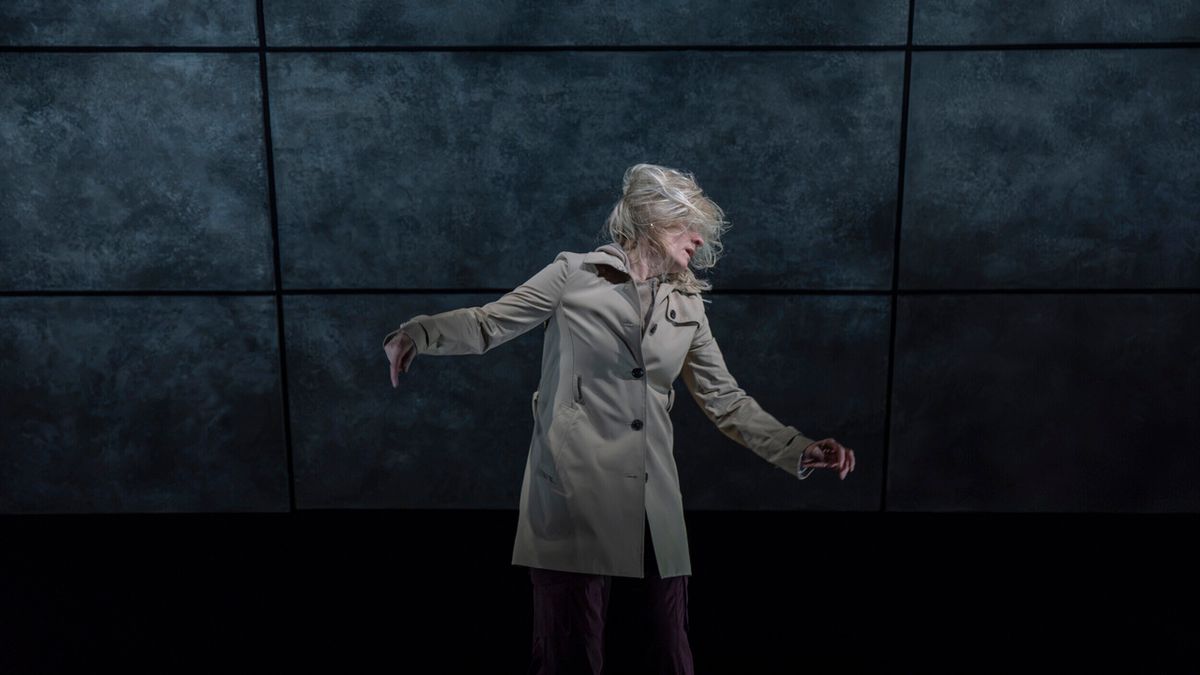

The National Theatre continue their commitment to new writing with a piece by Helen Edmundson. While this is wonderful in itself, this is not only a matter of having an original play on stage. Some Woman spotlights a category that’s often forgotten by the entertainment business, featuring a middle-aged woman as its protagonist. Anne-Marie Duff makes a splendid return to The National Theatre directed by Blanche McIntyre, portraying a woman who finds herself in a baffling position after a ten-year-old verbally abuses her on a train platform. The situation escalates, allowing Edmundson to weave a complex exploration of womanhood and misogyny in the 21st century.
Duff is mesmerising as the jaded, tired, divorced mother of two adult daughters. Her relationships are strained, buckling under the weight of shared history and unspoken resentment. It’s all vividly real. From Julie’s bond with her youngest to the painfully hostile dynamic with her firstborn, Edmundson writes sincere, verisimilar characters. Duff leads with a heartbreaking performance, introducing a woman whose life is suddenly spiralling out of control. Strong and composed in front of others, her façade falls when she’s alone.
%20and%20Grace%20Doherty%20(Ginny)%20n%20Some%20Woman%20at%20the%20National%20Theatre_%20%C2%A9Ellie%20Kurttz%20056.JPG?format=auto&width=800)
The burden of being a woman is exquisitely delineated in Duff’s sophisticated intricacy, while the ambiguity in Edmundson’s script continually muddles the truth of the matter. Kate (played by a precise Hannah Onslow) might have a biased opinion of her mother, but is there any validity in it? Is Julie really so badly tempered? Her recollections of a childhood spent between slamming doors and arbitrary screaming clash with what we see of Julie, now a diminished woman who’s trying hard not to crumble under the pressure of the events.
Though stoic and principled in her public behaviour, in private, she is the picture of dejection. As the main storyline coils and unravels beautifully, a series of tangential thoughts are introduced. The role of motherhood in the life of a woman compared to fatherhood in a man’s, the inevitable influence on children of the parents’ beliefs and teachings, the effects of misogyny on our mental health – Edmundson’s play is rife with ideas. Each of them has an identifiable ramification in the central plot in spite of any further development. The writing encourages the audience to use their brains.
%20and%20Anne-Marie%20Duff%20(Julie)%20in%20Some%20Woman%20at%20the%20National%20Theatre_%20%C2%A9%20Ellie%20Kurttz%20069.JPG?format=auto&width=800)
McIntyre exploits every beat in the script, establishing a coherent pace that balances the more breathless narrative sequences with quieter moments filled with emotion. Visually, she arranges the actors in factions, often grouping the cast to isolate Duff and creating a skewed image. Robert Jones designs a flexible set that moves the action from the comfort of Julie’s home (lovingly overflowing with life, there are photos on the fridge and recorded heights of the kids on the door frame) to the chilling impersonality of an office or a court. Jones encloses the stage in grey slabs, enhancing the feeling of alienation: the colourful warmth of the scenes set in the house is always threatened by the cold that surrounds it.
Duff is joined by a cohesive company. Grace Doherty is Ginny, Julie’s second and more similar child; her mental health has everyone tiptoeing around her, much to Kate’s annoyance. She is thoughtful and reserved, almost scared to take up space – like her mum would normally be. In contrast, Hannah Onslow is unafraid to make her voice heard. She has overcome her eldest daughter syndrome, which has brought on a vague superiority complex. Kate’s relationship with Julie is, to say the least, tense.
%20and%20Grace%20Doherty%20(Ginny)%20in%20Some%20Woman%20at%20the%20National%20Theatre_%20%C2%A9Ellie%20Kurttz%20121.JPG?format=auto&width=800)
They butt heads constantly, each of them reproaching the other. Julie, however, tries and fails to connect. Tobi King-Bakare is Nathan, Kate’s boyfriend and comic relief. Business-oriented and often OTT, he’s the only acceptably likeable man in the lot. Geoffrey Streatfeild (Richard, Julie’s ex-husband), Daniel Millar (Mr Dunster, the headmaster), Tom McCall (DS Woods, whose gaze is intimidatingly unwavering), and Stephen Wight (Mr Blake) psychologically torture Duff to different degrees.
While Streatfeild hides his chauvinism under a nice-guy attitude but slips up whenever Julie’s slightly more inflexible in her requests, Wight plays a most hateful character. His Mr Blake is instantly hair-raisingly horrid. He stalks Duff like prey before figuratively pouncing on her. As a woman, watching the only scene they share is viscerally terrifying. He inflicts his power on her, never showing any physical violence, but activating an innate female fear. It’s an arresting moment.
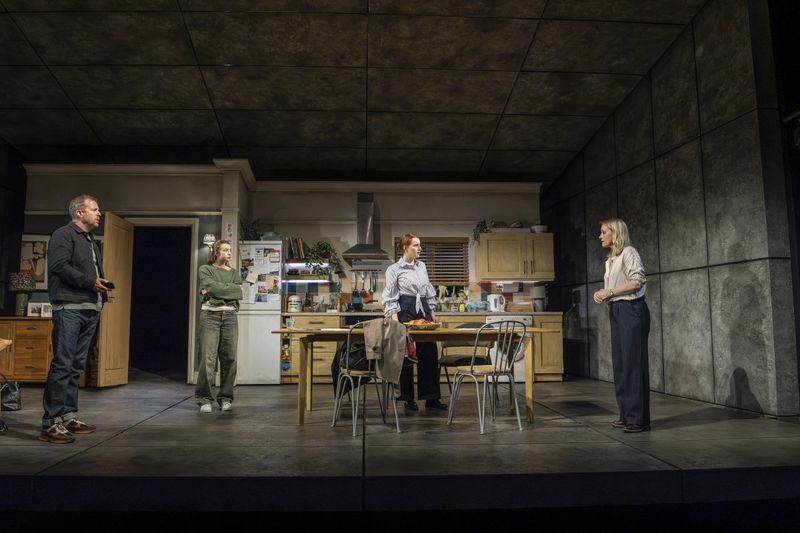
Running unbroken at just under two hours, the show is perfect. It offers a variety of reflections, from the more basic nature of sexism and family drama to the dangers of red-pill content and the alarming failings of our schools. It also reframes fault, instigating an interrogation of who’s to blame for the kids’ actions – both Julie’s and Mr Blake’s. Some Woman is meaty
Some Woman runs at The National Theatre until 21 November
Photo Credits: Ellie Kurttz

See more BroadwayWorld in Google
Our stories show up more often in Top Stories and Google’s AI answers.
Breaking Broadway alerts by text
Get the biggest stories sent straight to your phone.
Sign up for all the news on the Fall season, discounts & more...

|
Powered by

|







Reader Reviews
To post a comment, you must register and login.