


Review: A MIDSUMMER NIGHT'S DREAM, Shakespeare's Globe
Emily Lim's more-is-more take on the comedy opens the Globe's summer season
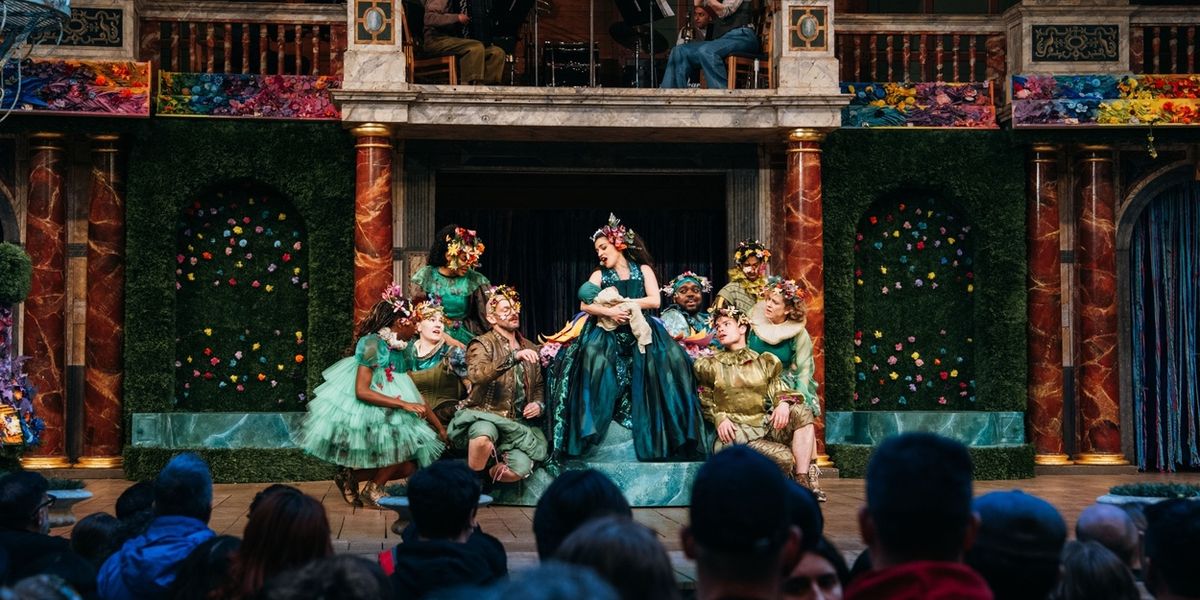
 A few scenes into Emily Lim’s version of A Midsummer Night’s Dream, the Globe stage undergoes a transformation. Austere statuary gets wheeled away, the columns are swathed in plastic flowers, and Michael Grady-Hall as Puck blows bubbles to make more flowers emerge from the floorboards. The effect is colourful, tacky, and gloriously synthetic.
This sense of artifice pervades the entire production – there’s a sense that everyone is aware of the role they’re performing. It’s an imaginative move to cast Enyi Okoronkwo and Audrey Brisson both as the feuding fairies Oberon and Titania and as the Athenian royal couple Theseus and Hippolyta. As we move to the ‘dream’ section of the narrative, the pair are a bridge unto another world. Much like the rudimentary actors in the famous play-within-a-play of Pyramus and Thisbe, this dual casting acts as a reminder that we are watching actors play roles.
In fact, hardly any interpretation of these highly familiar characters feels obvious. Oberon and Titania are far more playful and self-knowing than regal. Grady-Hall’s version of Puck is something of a hapless middle manager, taking iPhone videos and accidentally falling in love with audience members. Even Bottom (Adrian Richards) here is less a clown and more an earnestly obnoxious theatre kid, clad in Hamilton and Cats T-shirts and somewhat self-aware of his lack of talent as an actor.
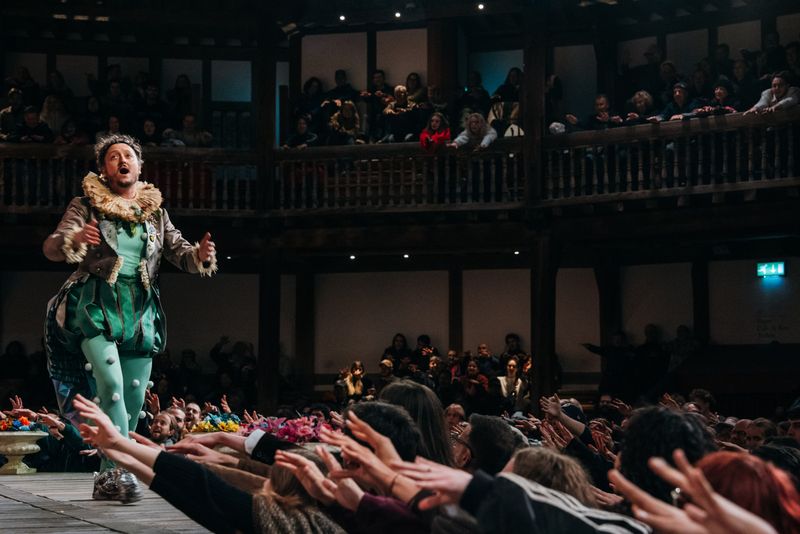
Photo credit: Helen Murray
Meanwhile, the love square between Hermia, Helena, Demetrius and Lysander is rendered as an aspirational teenage fantasy, with the quartet in preppy pastels that look like something out of Clueless or the Archie comics. The four performers – Sophie Cox, Romaya Weaver, Gavi Singh Chera and Mel Lowe – all have some degree of teenage petulance, eking all the moping self-pity out of lines like “I’m as ugly as a bear”. When other characters spectate the foursome’s low-stakes romantic shenanigans, they’re sitting back and watching the telenovela unfold.
This version of Dream is something close to a folk musical, with original songs by Jim Fortune. The inherent artificiality of musical theatre, breaking into song and such, works well with the general sense of performance, and of witnessing some sort of deftly choreographed ritual.
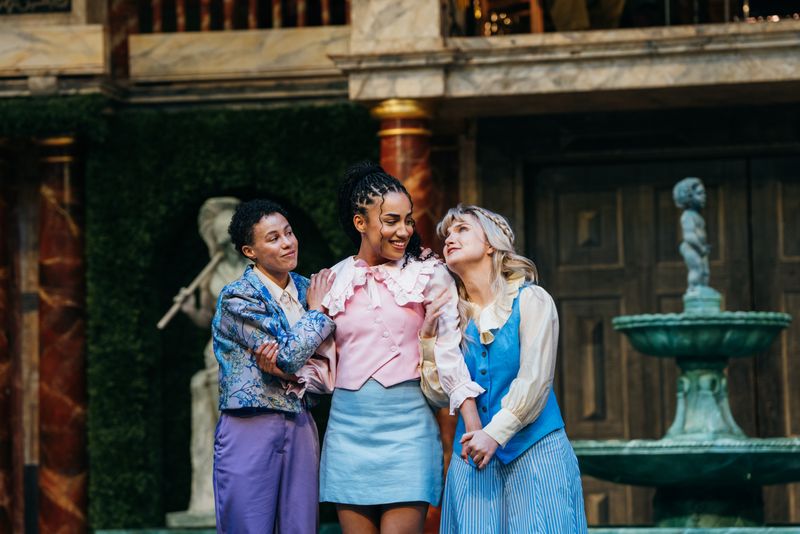
Photo credit: Helen Murray
There’s also some call-and-response with the audience, an idea of communal folk traditions also on display in Jeremy Deller’s stamp designs and Edmund Hall’s trade union-inspired banners (subtle details that sadly sometimes get lost in the visual feast). Part of the fun is our involvement in creating our own fantasy – when our singing wakes the lovers from their sleep, we feel some genuine power as a collective.
Granted, sometimes the audience participation does go too far. There’s one particularly aggravating sequence where one too many audience members get called up on stage – to perform in Pyramus and Thisbe, to officiate the weddings, and so on – that it feels crowded up there. After so many unrelenting pantomime gags, what could be the production’s comedic zenith – the indulgent farce of the play-within-a-play – unfortunately feels like an afterthought.
Still, this is a Dream that embraces the text’s silliness and excess and doesn’t try too hard to prove a point, unlike the Globe’s deliberately dark takes on the play last year and in 2023. What’s more, if you prod a little harder at all the fluff, some interesting ideas about why exactly we tell stories remain.
A Midsummer Night's Dream plays at Shakespeare's Globe until 29 August
Photo credits: Helen Murray

Sign up for all the news on the Fall season, discounts & more...

|
Powered by

|
.jpg?format=auto&width=300)






Reader Reviews
To post a comment, you must register and login.